

Varminting with Thompson/Center Contenders
A Barrel for Every Varmint from the Hornet to the 30-30 Winchester
feature By: Patrick Meitin | May, 26
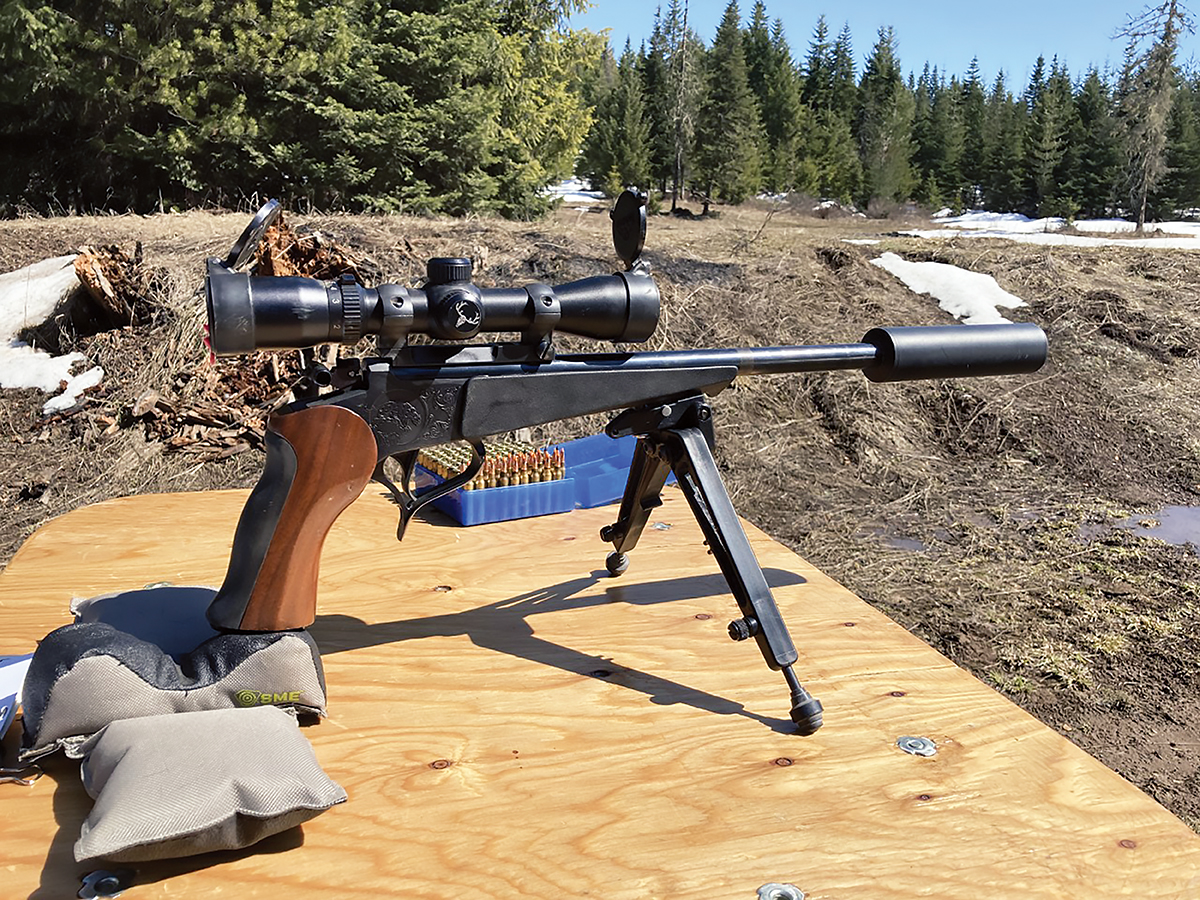
Varmint shooting dominates my firearms passions. As such, my arsenal contains far more varmint rifles than big-game numbers, but also a good number of handguns chambered in varmint cartridges. Varmint shooting for me is all about having a good time, and those good times often hinge on challenging my skills. I enjoy the challenge of calling predators, stretching yardages to extremes, but also the inherent challenge of varmint shooting with handguns.
.jpg)
My heavily customized Ruger 10/22 Charger 22 LR pistol and a Taurus 8-shot 22 Hornet revolver see regular spring ground-squirrel action. But the vast majority of my varmint hand-gunning endeavors involve Thompson/Center (T/C) Contender break-action, single-shot handguns.
There are a decent number of single-shot handguns available for serious varmint shooting, but none are as readily available or practical as the Thompson/Center Contender. The revolutionary design was launched in 1965 by Warren Center, introducing a generation to long-range pistol shooting. Contenders include interchangeable barrels and pioneered the use of bottleneck cartridges in handguns.
T/C’s original Contender, now the Contender G2, has remained highly popular, with original barrels available in a wide variety of cartridges and easily found at even mainstream outlets such as eBay. The newer T/C Encore Pro Hunter was introduced to handle higher pressures and more powerful rounds, such as the 22-250 Remington, but there are so many older Contender barrels floating around the used market, including aftermarket options, that your varmint-round desires are limited only by your wallet.
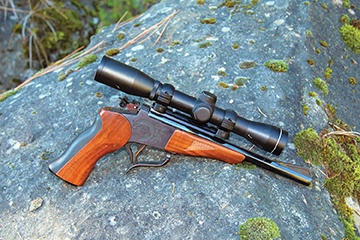
I’ve collected barrels chambered in 22 Hornet, 22 K-Hornet, 221 Remington Fireball, 223 Remington, 256 Winchester Magnum, 7mm TCU (Thompson/Center Ugalde) and 30-30 Winchester, paying no more than $300 for any of them. Contender barrels were made in such quantities that at least two of my barrels, the 221 Fireball and 256 Winchester Magnum, arrived in like-new 1970s-era packaging and had never been unsealed. In all, including aftermarket manufacturers, there have been more than 100 different cartridges chambered in Contender barrels, including a good number of wildcat rounds.
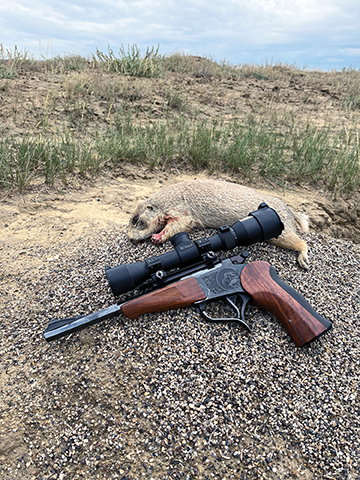
The most appealing thing about Contender handguns is that their break-action design lets me switch barrels in minutes. Remove the forearm (slot screw), tap the hinge pin out of the action frame, open the action (trigger guard under-lever) and remove the barrel. Swap barrels, reinsert the hinge pin and reinstall the forearm. Though it is much more fun owning the six actions I do to avoid all the fuss. By the way, that same action will accept longer barrels and buttstocks to create a single-shot varmint rifle.
As an interesting aside, this interchangeability eventually led to a Supreme Court case that established that owning a pistol and parts to convert it into a rifle did not amount to possession of an illegal short-barreled rifle. This gives the Contender an important place in gun-rights law. Of course, it is still illegal to attach the pistol barrel to a receiver that is simultaneously fitted with a shoulder stock, though, as Justice White remarked after the SCOTUS case, it would make little sense for a criminal to use a single-shot SBR (Short Barreled Rifle).
Contenders generally have good triggers crisp and user-adjustable. A switch located on top of the hammer and dual firing pins allow shooting rimfire or centerfire rounds from the same action; the middle position acts as a safety, preventing firing either round. Many barrels hold iron sights, but for varmints, adding an optic atop a T/C one-piece base makes more sense. Typically, Contenders are capable of rifle-level accuracy, though shooting skill and the quality of the rest obviously factor.
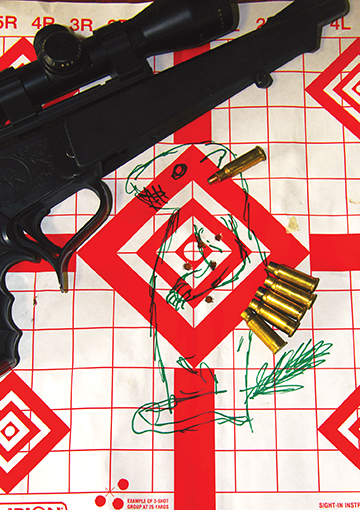
Original Contender barrels were 10-inch “sporter-weight” hexagonal tubes, with heavier 10-inch bull barrels arriving shortly after, and 14-inch “Super Contenders” appearing still later. With high-velocity rounds such as the 221 Fireball and 223 Remington, in particular, muzzle blast can prove migraine-inducing, which is why my 223 Remington is threaded to hold a suppressor.
If you play with enough disparate Contender barrels and actions, you will eventually find a set that requires refitting, replacing the locking bolt, or both. Trouble comes if the handgun doesn’t lock solidly, which will prevent it from firing due to a safety interlock, or locks too solidly, which makes it difficult to open. This is why owning several frames/actions is advantageous, as sometimes a barrel that proves incompatible with one frame works slickly with another. This is less of a problem when barrels and frames were manufactured at roughly the same time, as there were significant design changes introduced in the early 1980s involving the latch pivot point and locking bolt. Mixing new and old frames and barrels can cause sticky actions, but usually no safety issues. A qualified gunsmith should obviously address persistent incompatibility issues.
This is the only problem I’ve encountered with the single-shot Contender handgun, aside from a single hammer-spring failure, which was easily remedied. The simple Contender design is hugely reliable.
One precaution when choosing a handgun for varmint shooting involves bullet expansion in relation to the velocity produced by shorter barrels. Some varmint bullets, for instance, are designed for, say, 22-250 Remington velocities and fail to expand at slower handgun velocities, acting like FMJ projectiles. This can apply to specific bullets or the overall cartridge.
A good example of the first instance is Sierra’s fine 40-grain Varminter HP bullet. It is extremely accurate and works as designed with 223 or 22-250 Remington rifles, but with my 10-inch 22 Hornet pistol, it just doesn’t expand sufficiently to anchor ground squirrels or prairie dogs on the spot.
In the latter instance, I immediately think of my 7mm TCU, which also has a 10-inch barrel. While super accurate, the 7mm bullets I’ve tried, even at 100 grains, expand minimally. Most 7mm bullets were designed for rounds such as the 7mm-08 Remington and larger rounds shot from longer rifle barrels. As a varmint round, the 7mm TCU struggles not from an accuracy standpoint, but due to the available bullets. The 7mm-08 Remington starts at 2,900 feet per second (fps) with 100-grain pills, the 7mm TCU producing only 2,000 fps from my 10-inch Contender. The 7-30 Waters (a necked-down 30-30 Winchester) can push 100-grain bullets to 2,600 fps, which would likely yield more reliable bullet performance. This has placed a 7-30 Waters Contender barrel high on my wish list.
Varmint shooting with handguns essentially demands handloading. Factory ammunition for any given cartridge is assembled for rifles and their longer barrels. This can result in excessive muzzle flash from unburned powder, and sometimes in poor accuracy or sticky cases. A good place to start is Sierra Bullet’s 1st Printing of Rifle & Handgun Reloading Data Edition VI (2019) which includes an entire section titled “Single Shot Pistol Reloading Data.” Loadbooks USA also published The Complete Reloading Manual for the Thompson/Center Contender (1991). While the powder choices are often somewhat dated, they serve as a great starting point to compare to modern powders in the same cartridges.
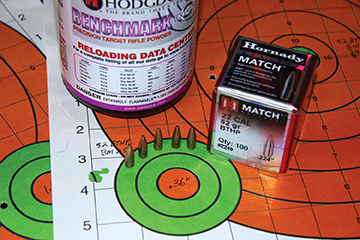
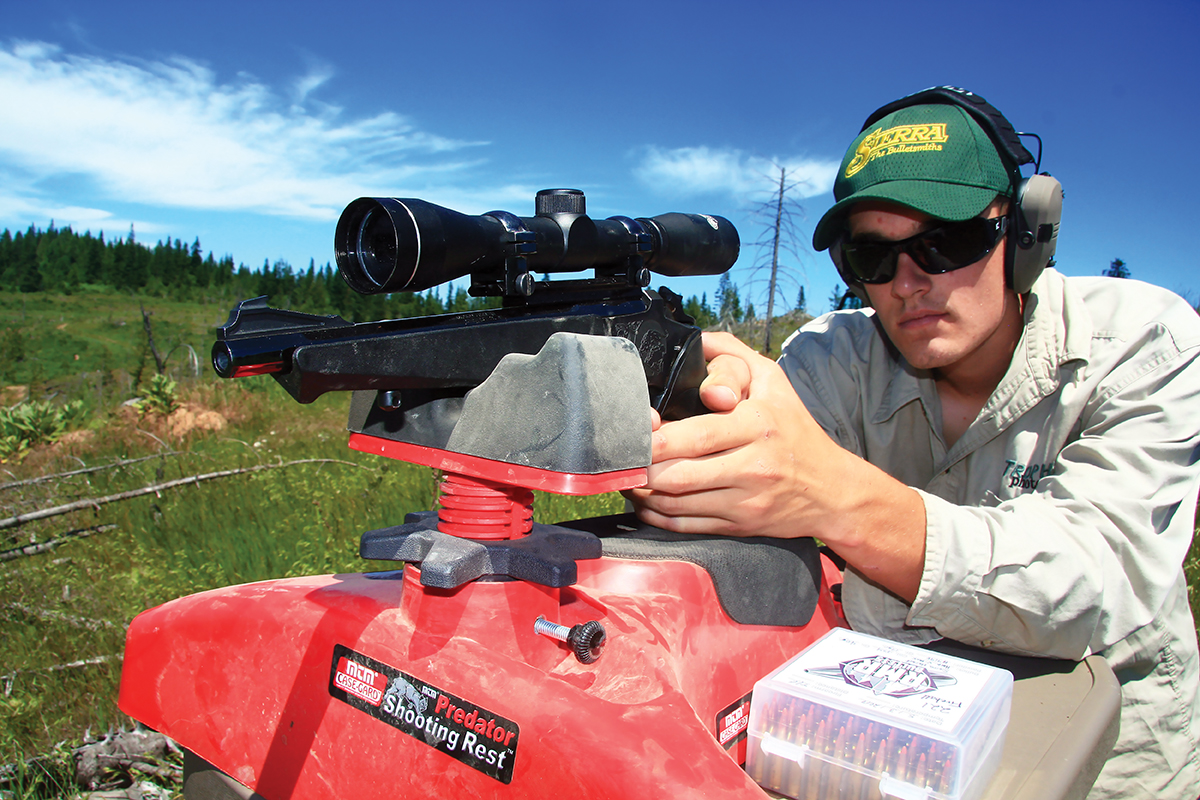
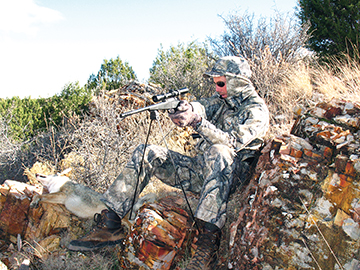
Handgunning for varmints with a scoped Contender isn’t like self-defense practice or plinking cans. Targets are more distant, sometimes hundreds of yards away, small and the scope magnification compounds every pulse surge. You must absolutely utilize a solid rest. While calling coyotes with a handgun, I utilize shooting sticks or a tripod. While targeting burrowing rodents, I shoot from a portable bench or the pickup hood, atop a cradle or sandbag. In the field, a bipod and prone position, or sitting behind a handy stump or rock, is in order. Contenders aren’t off-hand weapons, even at moderate ranges.
I own a couple of extremely accurate 22 LR Contender barrels (standard and Match chambers), but I admit I don’t shoot them often. I see no point in a single-shot Twenty-Two. In rimfire, the 17 HMR would be a highly welcomed Contender chambering. Yet it is bottlenecked centerfire rounds that really set the Contender apart. That is really the point of the entire concept.
In my own collection, this starts with the 22 Hornet and 22 K-Hornet. The Hornets are exceptional handgun rounds, producing negligible recoil, less ear-splitting muzzle blast (though they still demand quality hearing protection) and perfectly acceptable “minute-of-ground-squirrel” accuracy.

With the right bullets, they also produce drop-right-there terminal performance. This usually includes 35-grain Hornady V-MAX or Nosler Ballistic Tip Varmint and Tipped Varmageddon bullets, or 40- or 45-grain Hornet-labeled softpoints made with thin jackets. When loaded for a strong Contender action, the 10-inch-barreled 22 Hornet loses just 400 fps, on average, to a full-length rifle barrel.
The 221 Remington Fireball, based on a shortened 222 Remington case, once held the distinction as the fastest, flattest-shooting pistol cartridge when introduced in 1963 in the revolutionary Remington XP-100. My Fireball-chambered Contender barrel regularly produces sub-MOA 100-yard accuracy and reliable hits on burrowing rodents to 200-plus yards. The 221 Fireball is extremely efficient, producing 90 percent of the 223 Remington’s velocity while burning just 60 percent of the powder, making it an affordable high-volume varmint-shooting option.
My 223 Remington Contender barrel is a 14-inch number that produces rifle-like accuracy from a solid rest. I have little trouble picking off ground squirrels and prairie dogs to 200-plus yards, and once sniped a Texas coyote at a laser-verified 398 yards using a pickup’s side-view mirror as a rest. My 223 Remington once had a muzzle brake to allow marking my own shots, but the round’s velocity reaches a point where even quality ear muffs fail to fully insulate against muzzle blast, inducing headaches after 25 fast-paced shots. I eventually swapped the brake for a 5.56mm suppressor, turning this precision tool into a pussycat.
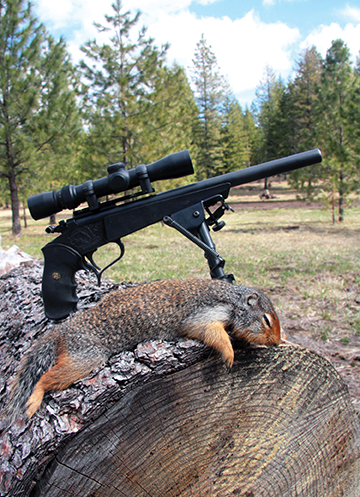
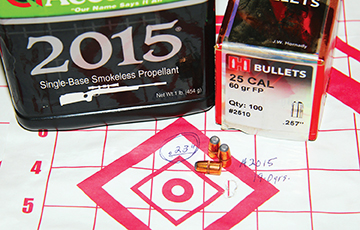
My 10-inch 256 Winchester Magnum barrel is a seemingly unlikely varmint cartridge, but Hornady’s 60-grain flatpoint (designed for 25-20 Winchester lever rifles) makes it quite viable. Formed by necking common 357 Magnum cases to .257 caliber, the 256 Winchester Magnum isn’t a ball of fire, pushing those 60-grain pills to just 2,300 fps, but it is pleasant shooting and highly accurate. When I find myself amidst a hoard of clear-cut Columbia ground squirrels squeaking at 75 to 150 yards, my 256 Winchester Magnum handgun makes for thrilling sport and quick kills.
I’ve already touched on the 7mm TCU’s failings as a varmint round, but its accuracy makes it difficult to ignore. This round appeared in the late 1970s as a darling of the metallic silhouette cartridge crowd, cases easily created by necking common 223 Remington cases up to 7mm and then fire-forming. I really need to audition some newer bullets, like Hammer Bullets’ 67-grain all-copper Stone Hammer, Hornady’s 120-grain V-MAX and Speer’s 110-grain TNT HP. The round certainly offers precision in spades; I just need adequate expansion at handgun velocities. All that said, I’ve found the 7mm TCU an excellent predator-calling round, providing a little extra punch on burly mountain coyotes, without inflicting undue pelt damage.
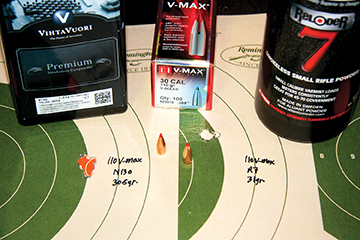
You might find it difficult to take the 30-30 Winchester seriously as a varmint cartridge, especially from a handgun. I’ve used my heavy 30-30 Contender barrel to hunt hogs, which I consider varmints, and a couple late-season depredation cow elk, but it also serves well as varmint medicine. It’s certainly accurate enough. When fed remarkably common thin-jacketed 100- and 110-grain bullets pushed to 2,100-plus fps, it does a bang-up job to 200 yards.
Contender actions and barrels are remarkably common and affordable, turning any varmint-shooting outing into pure fun.
.jpg)
.jpg)
.jpg)
.jpg)
.jpg)
.jpg)