

Savage 6mm-284
The Ultimate Long-Distance Varmint Cartridge
feature By: Layne Simpson | May, 26
A few Years ago, I traveled to Winner, South Dakota, to attend the Prairie Dog Conference hosted by a colorful gentleman named Chuck Cornett, who is also known far and wide as “The Dog Father.”
Chuck had friends from all over the country, and many of them were there. He also had a very nice collection of custom-built varmint rifles in every imaginable caliber. I do not recall how many eager prairie dog shooters attended each year, but it was probably somewhere between 20 and 30. Bright and early each day, teams of two or three shooters would depart in all directions for some of the finest hot-barrel varmint shooting I have experienced.
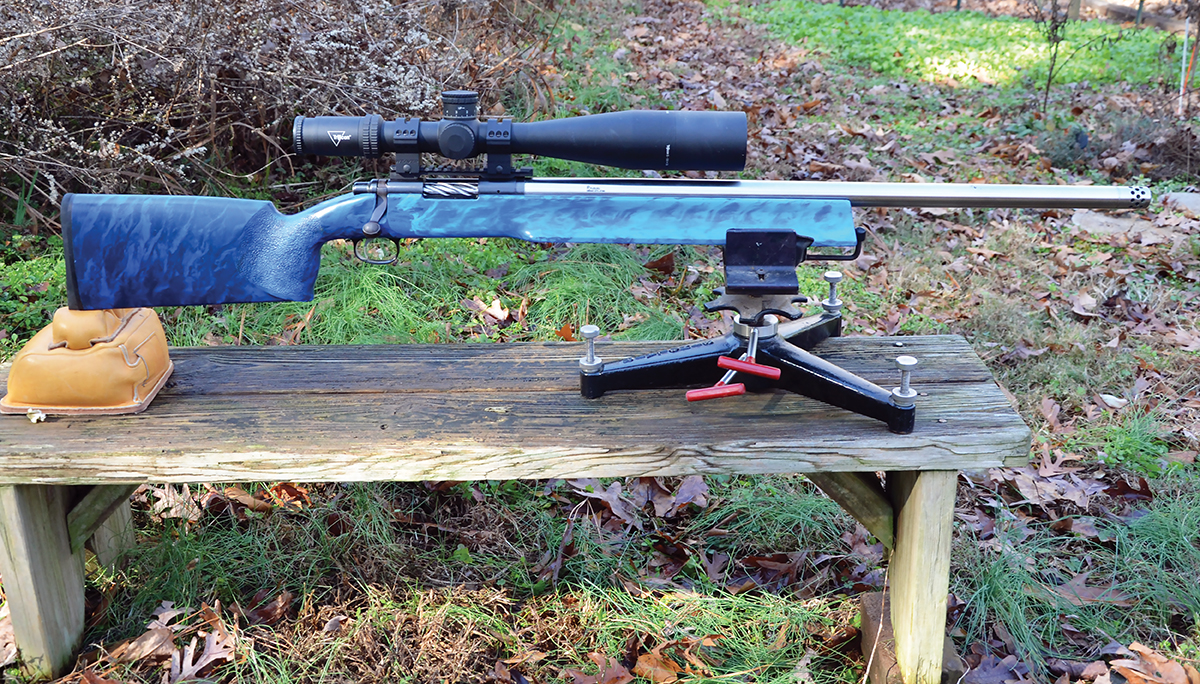
It was my good fortune to be teamed up with famous rifle builder Lex Webernick, who drove from his shop in Cedar City, Utah. He later relocated to Pleasanton, Texas, and is still in business there. I had actually met Lex and his lovely wife Lina at a SHOT Show several years prior, and when we shot prairie dogs in South Dakota, I already owned three of his 5-pound Lightweight Strata big-game rifles in 257 STW, 6.5 STW. and 7mm STW. In addition to several heavy-barrel varmint rifles, Lex brought along a couple of BR Pivot portable benchrests made by a fellow in Oregon (whose name escapes me), and it was the Rolls-Royce of such rigs. As I recall, it weighed close to 50 pounds and was easy to set up to use and to take down for hauling in the back of a van or pickup truck. Battenfield Technologies (Caldwell) purchased the patent and is now making that rock-solid, pivoting shooting bench under a new name.
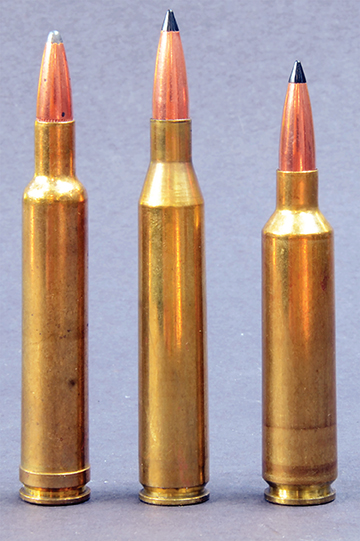
During that prairie dog shoot, Lex mentioned building the ideal long-distance rockchuck rifle, one capable of delivering the goods as far away as 1,000 yards. In order to consistently pull that off, the rifle would have to be quite heavy, extremely accurate and chambered for a flat-shooting cartridge loaded with high-coefficient, wind-bucking bullets. Its high-magnification scope would have the needed elevation adjustment. Lex kicked off the project by blueprinting a short Remington Model 700 action, which included replacing the factory recoil lug with a precision-machined lug with a thickness of .390 inch. In the event that barrels of various calibers would need to be switched at the range or in the field, the recoil lug was pinned to the front of the receiver. Lex chose the 6mm-284
Lex Webernick has long been high on Select Match Grade stainless steel barrels made by Shilen, a company founded many years ago by Ed Shilen, who at the time was a top-ranked benchrest competitor. In order to depart the Ennis, Texas, shop as Select Match Grade, the groove diameter of the barrel must air-gauge within .0003 inch of the company’s standard diameter for a particular caliber. The uniformity of the hand-lapped bore cannot vary by more than .0001 inch for the entire length of the barrel. To put that in perspective, a single page in the publication you now hold in your hands is a much thicker .001 inch. The 28-inch barrel of the rifle measures a fat 1.240 inches in diameter at the receiver, and from there it straight-tapers to a diameter of .995 inch at the muzzle. As I recall, the 6mm-284 reamers used by Lex to chamber the rifle were made by Clymer Tool. The rifle was built for shooting, with the rear of its McMillan benchrest stock resting on a bunny-ear sandbag and a Sinclair International adjustable front rest up front. The flat-bottom forearm of the stock is a bit more than three inches wide.
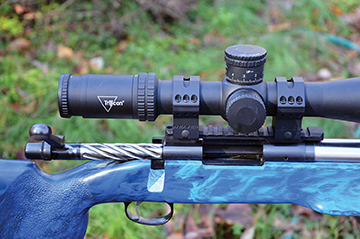
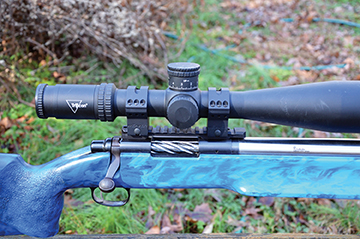
The rifle originally had a Nightforce 12-42X56 scope with a 30mm tube, and I eventually decided to use it on another rifle. The Webernick rifle now has a Trijicon AccuPower 5-50X56 scope with a 100 Minute of Angle (MOA) elevation adjustment range or 50 MOA both ways from optical center. Combined with a Talley Picatinny rail with 20 MOA of slant, no target is too far away for that scope. With it on board, the rifle weighs 20.5 pounds.
The 6mm-284, in which the rifle is chambered, has a bit of history. There was a time when various lever-action rifles made by Winchester ruled the roost among hunters who preferred quick-handling rifles capable of slinging lead fast. The 30-30 Winchester was king. That market dominance ended with Remington’s introduction of the slide-action Model 760 Gamemaster and the gas-operated Model 740 autoloader during the early 1950s. Both were initially chambered for the 30-06, with other powerful options, including the 280 Remington, eventually added. The great successes of those rifles prompted Winchester to introduce the lever-action Model 88 rifle in 1955 and the gas-operated Model 100 in 1960. Neither rifle’s action was capable of handling long cartridges so the 284 Winchester was developed specifically for them. Giving the case a rebated rim of the same diameter as the 30-06 simplified production. Due to a body diameter only a bit smaller than that of the 300 Winchester Magnum, powder capacity was comparable to the 280 Remington. According to the Speer Reloading Manual Number Ten, maximum velocities of the 280 Remington and 284 Winchester were quite close to the same.
As has almost always happened through the decades, that strange breed of critter called the wildcatter pounced on the new 284 Winchester case and necked it up for bullets of larger diameters and down for those with smaller diameters. At the time, the 243 Winchester and 244 Remington were also new, and both were receiving a lot of publicity. This may explain why the 6mm-284 became far more popular than other wildcats in the 284 Winchester case. Within a few years, 6mm-284 load data began to show up in reloading manuals. Maximum velocities for 75-grain bullets, both from 26-inch barrels, were 3,613 feet per second (fps) in the Speer Manual and 3,691 fps in the Hodgdon manual. Maximum chamber pressures listed by Hodgdon were 52,500 copper units of pressure (CUP) for the 6mm-284 and 58,800 CUP for the 243 Winchester. Why Hodgdon technicians chose to load the 6mm-284 to considerably lower chamber pressures than the 243 Winchester has puzzled wildcatters for decades.
My first rifle in 6mm-284 was purchased from a deer-hunting friend who pulled the 308 Winchester barrel from a Sako L579 rifle and replaced it with a Douglas 26-inch barrel with a 1:9 twist. My favorite Redfield 3-9X scope with the Accu-Range reticle in Sako rings increased its weight to a few ounces shy of 9 pounds. At the time, I was spending a lot of time in the field with a Remington Model 725 in 244 Remington. My favorite deer and feral pig load for it was 52.0 grains of Norma 205 behind the Nosler 85-grain Partition. I did not have a chronograph in those days, but a friend’s Hollywood Model 12 indicated a velocity of 3,314 feet per second (fps). That same bullet pushed along by 59.0 grains of Norma 205 from the 6mm-284 exited the 26-inch barrel of my Sako at 3,526 fps. With both rifles zeroed three inches high at 100 yards, the 85-grain Partition from the 6mm-284 landed about an inch above the point of aim at 300 yards, while from the 244 Remington it was about two inches lower at that distance. The 6mm-284 eventually got traded away years ago, but I still have that beautiful little Model 725 in 244 Remington.
When powder capacities are compared, the 6mm-284, 6mm-06 and 240 Weatherby Magnum are close to the same. For this reason, when the three cartridges are loaded to the same chamber pressure and fired in barrels of the same length, velocities will also be quite close to the same. I have a single-shot rifle in 6mm-06 built on the Encore action by the Thompson/Center custom shop. I also have a Mark V rifle in 240 Magnum, gifted to me decades ago by Roy Weatherby. Filled to the brim with water, average gross capacities are 64.1 grains for Lapua 6.5-284 case necked down and 62.9 grains for the 240 case made by Weatherby. The 6mm-06 formed by necking down the Nosler 25-06 case has a capacity of 66.7 grains.
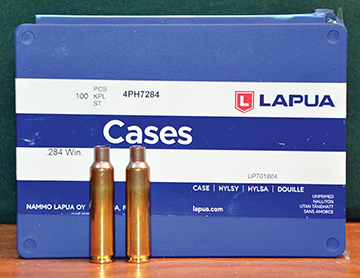
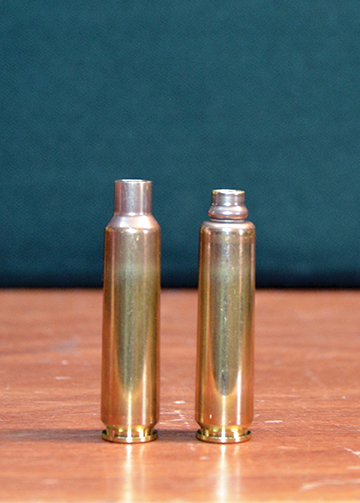
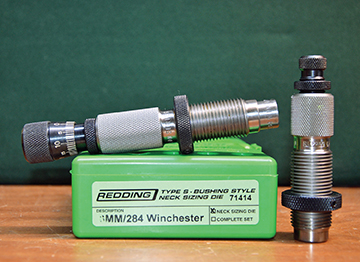
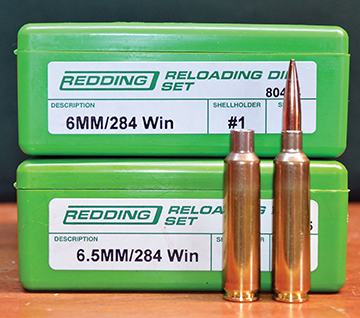
Lapua, Peterson and Quality Cartridge catalog 284 Winchester brass, but the odds of actually finding a supply are better with Lapua. The same goes for 6.5-284 cases and necking down either produces 6mm-284 cases of excellent quality and uniformity. I will add that attempting to neck down the 284 Winchester case for .243-inch bullets in a single step will result in collapsed shoulders. Running them through a 6.5-284 full-length sizing die prior to the 6mm-284 die will prevent that from happening. Outside neck diameters with .243-inch bullets seated are .2767 inch for the 284 Winchester case necked down, and .2734 inch for the 6.5-284 case necked down. The chamber neck diameter of my rifle is .277 inch, so Lapua 284 Winchester cases necked down with necks outside-turned just enough to uniform neck wall thickness put the neck diameter with the bullet seated at a perfect .276 inch. While the fit of Lapua 6.5-284 cases necked down is not as close, there is very little difference in accuracy between the two. Fired cases are neck sized with a Redding Type S die with a bushing .002 inch smaller than a loaded round. After a few firings, that same neck-sizing die with the bushing removed is used to bump back the shoulders of cases .002 inch. When cases need to be full-length resized, a Redding body die is used. Bullets are seated with a Redding Competition die.
During our first outing with the rifle, those bashful rockchucks failed to show, but there were plenty of prairie dogs in the area. Lex and I took turns spotting, ranging and shooting, and he won the match by toppling a dog off its mound at 1,283 yards. He chalked it up to luck, but I knew better.
.jpg)