

The 218 Bee Still Stings
Born of the 32-20, Built for the Varmint Fields
feature By: Layne Simpson | May, 26

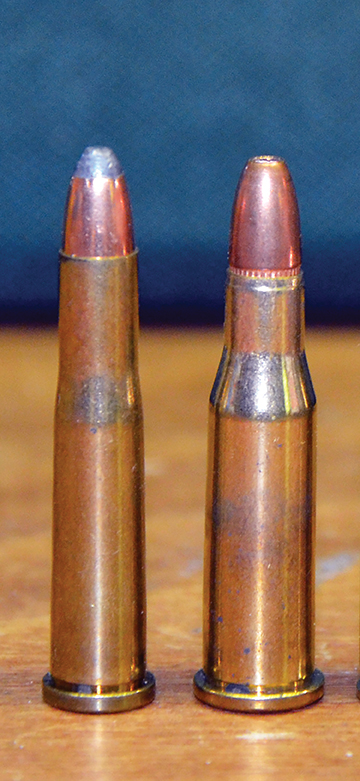
Winchester introduced the 32-20 Winchester in 1882 for the Model 1873 lever-action rifle. It was originally loaded with a 100-grain lead bullet pushed to 1,300 feet per second (fps) by 20 grains of black powder. The 32-20 was promoted by the company as ideal for bumping off varmints and, rather optimistically, powerful enough for dropping deer in their tracks as well. About 10 years later, Winchester necked down the 32-20 case for a 25-caliber lead bullet weighing 86 grains at a velocity of 1,460 fps. It was advertised as the perfect cartridge for taking small game for the pot, and good medicine for those pesky varmints in the family turnip patch.
Winchester later made the 25-20 an even better varmint cartridge by loading it with a 60-grain jacketed bullet at 2,250 fps and offering it in the Model 1892 rifle. Remington chambered its slide-action Model 25 for the cartridge, and Marlin Firearms attempted to steal a bit of Winchester thunder by offering it in the Model 1894 rifle as the 25-20 Marlin.
In 1930, Winchester began loading the old 22 WCF case with smokeless powder and jacketed bullets and introduced it as the 22 Hornet. It was offered in the Model 54 rifle in 1933, and when that rifle was improved and reintroduced in 1937 as the Model 70, the 22 Hornet found a home there as well. The little cartridge sold a lot of Winchester rifles to varmint shooters, so company decision-makers decided that a high-velocity, 22-caliber varmint cartridge would be equally popular in a lever-action rifle. So in 1938, the 25-20 Winchester was necked down to form the 218 Bee, and it was introduced in a modified version of the Model 92 called the Model 65. The little rifle weighed a handy 61⁄2 pounds.
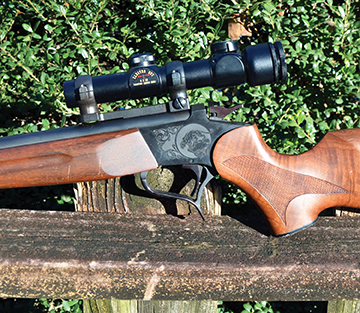
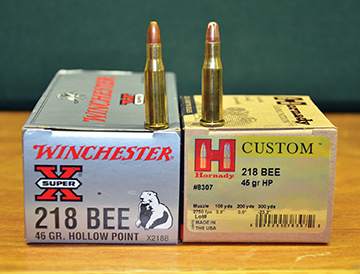
Eager to see the Model 65 sell, Winchester described the 218 Bee loaded with a 46-grain hollowpoint at 2,860 fps as superior to the 22 Hornet in the varmint fields. The advertising guys conveniently failed to mention that the Bee was loaded with a flat-nose bullet for the tubular magazine of the Model 65. At the time, the 22 Hornet was loaded with 45-and 46-grain pointed bullets, both at a velocity of 2,650 fps. While a bullet from the Bee exited the muzzle of a rifle 210 fps faster, it also shed velocity faster. Advertised remaining velocities at 200 yards were 1,610 fps for the Bee and 1,510 fps for the Hornet. Energy delivered to a varmint at that distance was 265 foot-pounds (ft-lbs) for the Bee and 235 ft-lbs for the Hornet, not enough difference to matter. Handload the 218 Bee with pointed bullets for bolt action rifles, as well as single shot rifles such as the Thompson/Center (T/C) Contender Carbine, the Ruger No. 1 and the Ruger No. 3, and the 218
Bee outperforms the 22 Hornet a bit more than that. Whereas the barrels of most rifles in 218 Bee have a 1:16 rifling twist, my Contender Carbine has a quicker 1:14 twist.
With the Winchester Model 65 out of production for more than a century, Browning introduced a Japanese reproduction in 218 Bee in 1980. Production was limited to 3,500 Grade I rifles and 1,500 of the more expensive High Grade versions. There have been others.
During a 1987 whitetail deer hunt on Anticosti Island with Tony Aeschliman of Marlin, he informed me that the company’s 1894 lever action would soon become available in 25-20, 32-20 and 218 Bee. The Model 1894CL, as it was officially called, had a 22-inch barrel, and it weighed 61⁄4 pounds. I still have one of the first built, and while not as accurate as my bolt action rifles, it is accurate enough to consistently drop a clover-munching groundhog within the effective range of the 218 Bee loaded with blunt-nosed bullets. While on the Anticosti Island hunt, Tony asked me which of the three chamberings would sell best, and I picked the 218 Bee. While my opinion proved to be correct, neither sold well enough to keep the rifle in production for more than a few years.
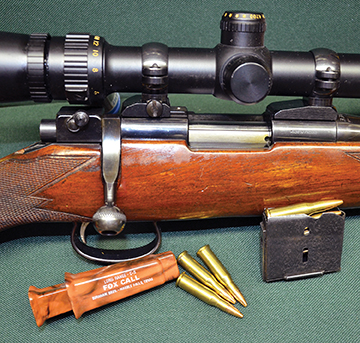
Several bolt-action rifles have been available in 218 Bee, with the Winchester Model 43 introduced in 1949. It was also available in 22 Hornet, 25-20 Winchester and 32-20 Winchester. I had three, one chambered for the Bee, the other two in 25-20 and 22 Hornet. In those days, rifles could legally be used when hunting turkey gobblers, and I enjoyed calling them in close before pulling the trigger. Those rifles accounted for quite a few Thanksgiving Day dinners.
In 1986, the original Kimber of Oregon produced a limited number of Model 82 bolt-action rifles in 218 Bee, as well as an improved version called the 218 Mashburn Bee. Kimber’s founder, Greg Warne, sent me one of the first built in 218 Bee, and it proved to be quite accurate. Making a detachable magazine for a cartridge that was projected to sell a relatively small number of rifles was financially impractical, so that particular Model 82 was a single-shot with a solid-bottom receiver. It had a fairly heavy, 22-inch barrel with a 1:14 twist. The little rifle was also available in 25-20 Winchester. In addition to the Classic with its stock of Claro walnut, the Cascade with a Monte Carlo-style stock and the Custom Classic with fancy walnut, ebony forend tip, and Niedner-style, checkered, steel buttplate were offered. Like the Winchester Model 43, that rifle thrived on the 218 Bee loaded with pointed bullets. The one I had consistently shot five Speer 40-grain bullets inside an inch at 100 yards, making it one of the three most accurate rifles in 218 Bee I have shot throughout the years. Cooper built Model 48 single-shot rifles in 218 Bee as well as the 218 Mashburn Bee. For those who do not know, the 218 Mashburn Bee was created by Oklahoma gunsmith Art Mashburn of Mashburn Arms, and it is about 100 fps faster than the standard 218 Bee.
My all-time favorite rifle in 218 Bee and the only one capable of consistently shooting its preferred bullets inside a half inch at 100 yards, is a Sako L46. Imported by Firearms International in 1949, it sold for $117.50, and for those capable of making their own stock, the barreled action alone was available at $97.50. The detachable magazine holds three rounds. I bought the Sako L46 Bee and a heavy-barrel L46 in 222 Remington from a friend, and in addition to the standard 3-round magazine, the 222 came with a 6-round magazine offered as an extra cost option at the time. The Sako L46 became quite popular among seal hunters in Finland, and for them it was offered in 7x33mm Sako, which was on a lengthened version of the 9mm Luger case. Most of the L46 rifles in 25-20 and 32-20 made their way to Australia. Most important to this story, the Sako L46, the Kimber Model 82 and the Cooper Model 48 proved that the 218 Bee can be quite accurate.
The Model 90, developed by Marlin and introduced by the mail-order firm of Sears, Roebuck & Co. in 1936, is rarely seen these days. It began life as an over-under shotgun in 12 gauge, and in 1939, a small-frame version in .410 was added. Also available was a combination gun with one barrel in .410 and the other in 22 LR, 22 Hornet, 218 Bee or 30-30 Winchester. Load data for the 218 Bee published in Lyman reloading manuals of the past were developed in a Marlin Model 90.
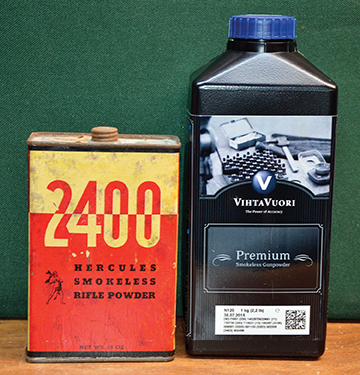
Filled to the brim with water, the Winchester 218 Bee cases I have hold 14.2 grains, about 4.0 grains more than 22 Hornet cases also made by Winchester. Despite the difference in their case capacities, the same propellants work equally well in both cartridges. IMR-4227
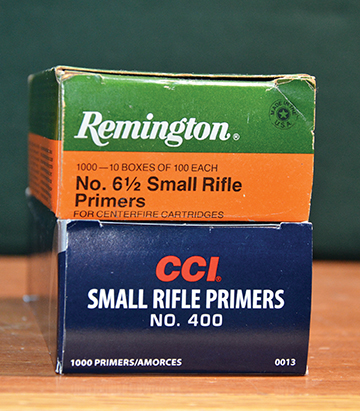
and 2400 are as good today as they were back when the 218 Bee was first listed in the Lyman Reloading Handbook. More modern powders such as Vihtavuori N120, W-296 and Lil’Gun work equally well. Many years ago, Remington developed the extremely mild No. 61⁄2 primer for the 22 Hornet, 218 Bee, 25-20 and other small rifle cartridges. It remains my first choice, but it is now difficult to find, so I have stocked up on CCI 400 primers.
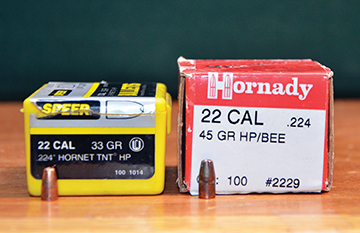
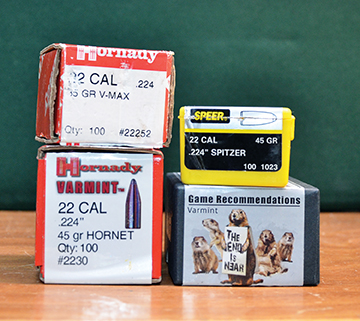
Like many rifles in 22 Hornet, the majority of those in 218 Bee have barrels with a rifling twist rate of 1:16. Exceptions with a quicker 1:14 twist that spring to mind are the Kimber and Cooper rifles and the T/C Contender Carbine. The fact that bullets much longer than .600 inch are not stabilized by the slower 1:16 twist rate rules out the use of the Nosler 40-grain Ballistic Tip and Hornady V-MAX of the same weight. Due to their shorter lengths, softnose spitzers as heavy as 45 grains from Speer and Hornady work fine. Bullets of that weight designed specifically for use in the 22 Hornet are actually better choices for the Bee because at the far edge of its effective range, they expand more violently on varmints than 40-grain tipped bullets, which are constructed to withstand higher velocities when fired from larger cartridges such as the 22-250 and 223 Remington. All things considered, the Nosler 34-grain flatbase hollowpoint, the Nosler 35-grain Varmageddon and the Hornady 35-grain V-MAX are hard to beat when loading in the 218 Bee for bolt-action and single-shot rifles.
When handloading for lever-action rifles, the Speer 46-grain FNSP and the Hornady 45-grain FNHP are equally effective on varmints ranging in size from ground squirrels to groundhogs. Both shed velocity fast and for this reason, 125 yards is about the maximum distance for consistently anchoring a mature whistle pig in its tracks. The Speer bullet should be a better performer on a coyote called in close because it does not expand as quickly and penetration is greater.
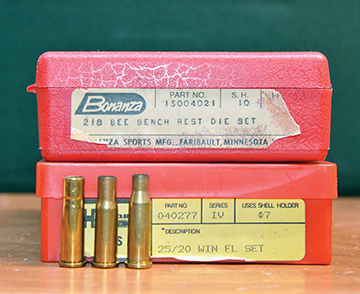
Winchester has not made a run of unprimed 218 Bee cases in many years and while Hornady has, good luck on finding a supply. The case can be formed from Starline 32-20 Winchester brass and while form dies are available from Redding, they may not be needed. Simply necking down the 32-20 case with a 218 Bee full-length resizing die will result in collapsed shoulders. Instead, use a 25-20 Winchester sizing die prior to the 218 Bee die, and you end up with a supply of cases. A secondary shoulder will appear, but it vanishes on the first firing and while the neck will be a bit shorter, it is not enough to matter. Trimming to the same length is the final step. In the absence of jacketed bullets, use a Lyman 225438 mould to cast 45-grain bullets from scrap wheel weight metal. Punching paper with the 218 Bee loaded with cast bullets is not only fun, but it is also an inexpensive way of keeping a mild-mannered little cartridge alive.
.jpg)
.jpg)