

Varminting Through the Ages
Notes from the Masters
feature By: Stan Trzoniec | May, 26
After carefully placing myself in a position to do some good, I finally began to see movement in the alfalfa some 30 yards distant. The chuck was a big one; its den matched his might, and my uncle wanted his hide. The cutting was due, and Uncle Frank dearly wanted to get rid of both that mountainous mound and the host tenant. This young hunter had worked hard this lazy summer afternoon in order to field a proper location for a speedy dispatch.
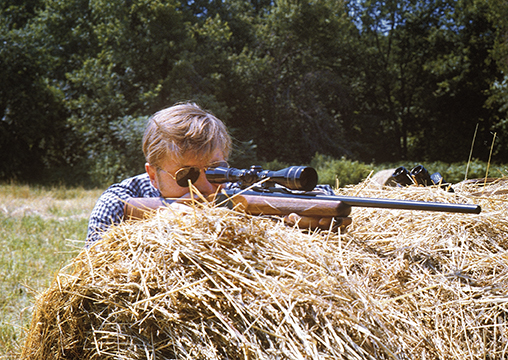
The creek was low as I carefully skirted some of the bigger rocks in search of a sniping position. Being the experienced 10-year-old hunter that I was, advance planning on my part a few days earlier had found the perfect spot in the shade where some ground erosion had made the prone position easy to take. The rifle was my uncle’s trusty 22 rimfire single-shot, bolt-action Winchester void of any optical gear but equipped with rugged iron sights and an awful 26-inch barrel. Checking my aim over these sights for what seemed like the hundredth time, I saw a head start to appear over this slightly windswept field. As I crouched down on the stock, my finger found the trigger and started that long, hard and agonizing pull to the rear for which this type of gun was famous for back then.
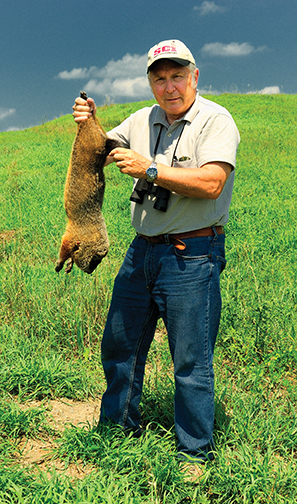
Then, in a heartbeat, it was over. For me, this is how it all started. The chuckin’, the guns and the ammunition. In short, the whole world that I found waiting for me thanks to the pioneers in the hobby. Little did I know then that this innocent adolescent would start on a journey that would begin 70 years of research, shooting and reviving some of the obsolete, outdated, or forgotten .22 caliber cartridges that men like Donaldson, Landis, Gebby, Kilbourn and Mashburn had the privilege of bringing to the shooting sports.
First, a few points need to be brought to the forefront in this article. One, for the most part, the woodchuck has been the subject of my hunting with the .22 caliber. Sure, there are other varmints, but I live in the east, so the chuck is the most favorable critter to hunt on the farm acreage here. They are big compared to the prairie dogs of the west and make a formidable target; you can recognize them out to 300 yards plus. Rifles with their myriad of choices in barrels, stocks or scopes will always be an interesting subject, and while I will mention them as they pertain to each individual gunsmith or inventor, the .22 caliber cartridge will be the main subject discussed here.
Under that heading will be the so-called “wildcats” like the 218 Mashburn Bee, 219 Donaldson Wasp or the 22 K-Hornet, and those that have been somewhat “commercialized” from their wildcat status by the big arms makers, to wit, 225 Winchester, 220 Swift or the 22-250 Remington. While the list is nowhere complete considering the century of activity, I will dwell on those that, to this author, seemed the most interesting when it came to history and those I have personally had the good fortune of working with and shooting over time with modern components and guns.
219 Donaldson Wasp
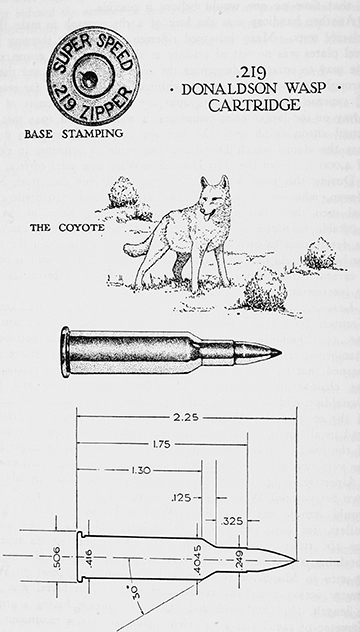
All of these tend to fall under the heading of “my favorites,” but the one that I would single out as my top favorite would be the 219 Donaldson Wasp, partially because this was the first wildcat I was exposed to by the sportsmen who came to the farm to shoot. Although it would be many years before I could chamber a rifle for it, when the time came, I was happy I could bring back the old days with this cartridge.
Noted for bringing back the sport of benchrest shooting, the development of the Wasp took some time to reach its zenith in popularity. Starting in the mid-1930s, Harvey Donaldson started his quest with the 22 Neidner Magnum, which proved disappointing. Moving on, he moved to the 25 Remington case, again not happy, he tried 219 Zipper brass. As a rimmed case, it was best-suited to be chambered in single-shot rifles, and changing the shoulder angle to 30 degrees finally gave him the results he was looking for.

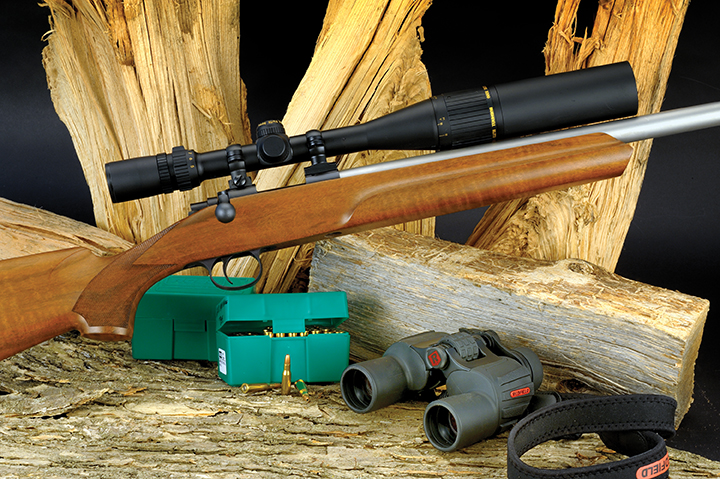
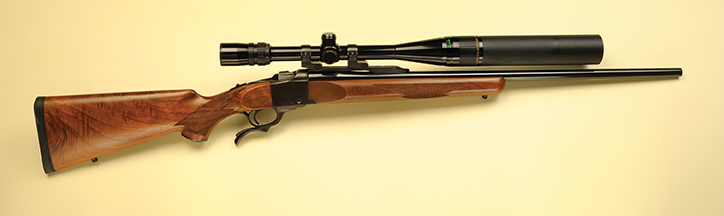
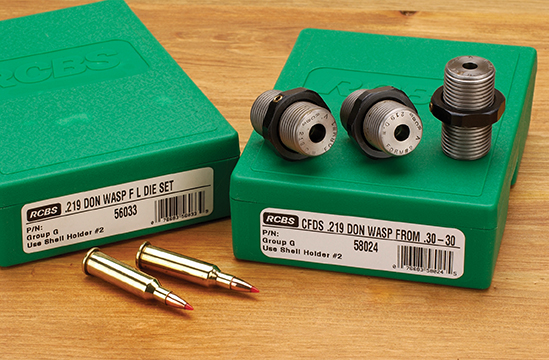
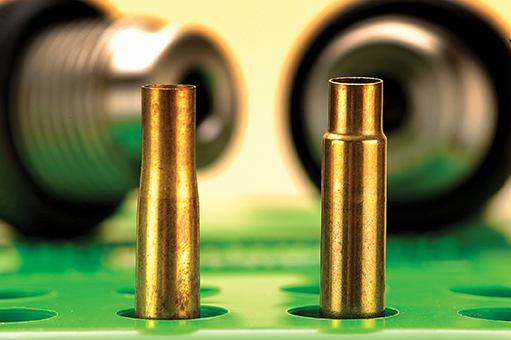
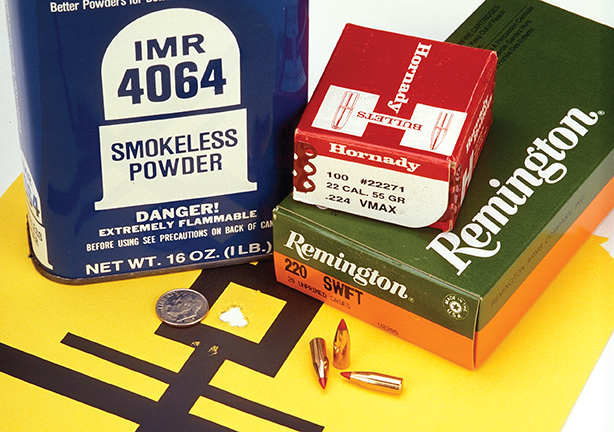
However, Zipper brass is almost non-existent, but the Wasp can be formed, albeit through a lengthy process, with current 30-30 Winchester brass with the help of a Redding die set. Additionally, Buffalo Arms and (E. Arther Brown Co) have reformed brass to use right out of the box. Once I had the brass formed and ready, I had my Ruger No. 1 chambered from a 218 Bee to the Wasp. Reloading came easy and with one of Donaldson’s original loads with a 52- to 55-grain bullet, over 28.0 grains of IMR-4064 provided under Minute-of-Angle (MOA) groups, followed by no problems with 3,100 feet per second (fps).
I was back in the state of New York again!
22 Hornet / 22 K-Hornet
The 22 Hornet is, to me, the one classic that made it big. In addition, it has the ability to adapt to a greatly improved version of the same cartridge known as the
K- Hornet. Presently, the Hornet is a cartridge of the 1930s, and was developed by three men, all working at the Springfield Armory. Credit has to be given to Townsend Whelen, G.L. Wotykns and A.L
Woodworth who took the 22 WCF and modernized it.
Digging deeper, we find the Hornet is not a new cartridge in its own right, but a revision of a German round more commonly known as the 5.6x35R Vierling. Interesting to note is that most ammunition manufacturers in this country were producing ammunition before a gun was even made to handle it. Soon after, a few single-shot and bolt guns started to appear, and it finally made a public appearance in the Winchester Model 54 line of rifles around 1932.
With its mild report and great accuracy, varmint hunters took to it as a priority round for chuck hunting. Granted, it should only be used for the larger varmints up to 150 yards or so, smaller game, a bit longer. Over time, this round has been chambered in everything you can imagine, from single shots to even handguns. A good load that served me well in my Browning Model 1885 (a trim rifle in its own right), was a 45-grain bullet over 9.7 grains of Alliant 2400 powder for around 2,600 fps.
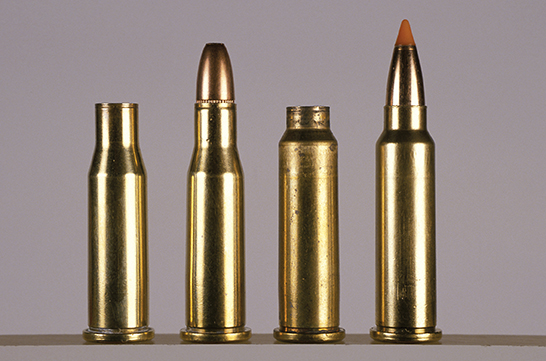
Looking at the improved K-Hornet version (which I used in a custom Thompson/Center [T/C] Contender), you can squeak out around 3,000 fps with the same bullet but with a payload of 11.5 grains of 2400. Either way, groups were more than acceptable thanks to the availability quality components and careful handloading.
218 Mashburn Bee
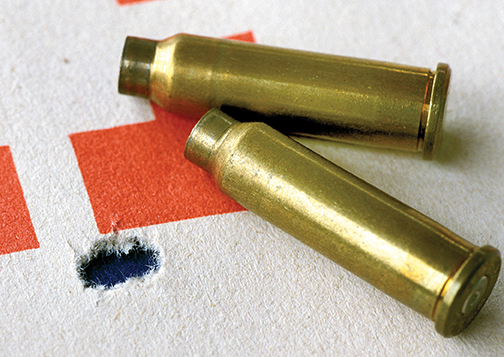
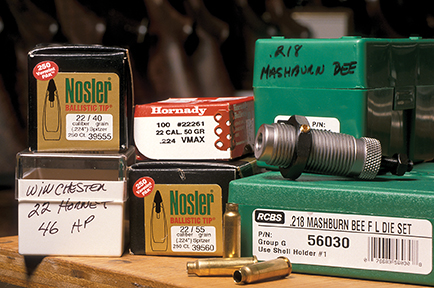
Being an eastern chuck hunter, the 218 Mashburn Bee was a natural for me. On smaller farms, the hedgerows were closer together, so a cartridge like the Mashburn with its mild report, small powder charges, and superb accuracy was just the ticket for these outings.
A.E. Mashburn of Oklahoma City, Oklahoma, designed the 218 Mashburn Bee. This is the most popular of the modified Bees, even though it has the most severe case modification by fire-forming, which steepens the shoulder and reduces the body taper for better performance over its original Bee variant, while still keeping the original case length of 1.345 inches.
Making cases for the Mashburn Bee is a simple task thanks to the availability of the Contender handgun and the wide variety of wildcat chamberings offered in the past by that company. To get to the working brass stage, all you have to do is take a factory or handloaded case, place it into the Mashburn chamber and fire-form it. It will move the shoulder forward quite a bit, but out of 100 cases, I had two that had noticeable neck splits, only 2 percent, not worth worrying about. Fifty-grain bullets are out there in spades. H-4198 powder (a classic load by the way) is a good choice, as are CCI BR-4 primers; all will net you very small groups around 3,100 fps.
Finally, for a time, you could order a Cooper Arms Model 38 or a Contender from their custom shop, but that is no more. If you want a Mashburn chambered rifle, hit the used markets.
.jpg)
219 Zipper
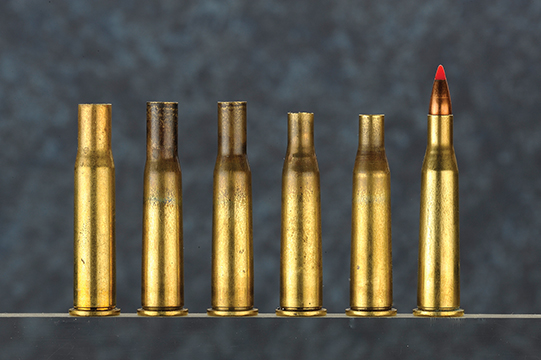
Another classic in the pure sense of the word is the Zipper. Introduced to the shooting world by Winchester in 1937, it was born under the 25-35 rimmed case with the parent company chambering it in a Model 64 lever gun. As a varmint cartridge, it seems it did not do well in this type of gun (although later in years it did gain some fame in the Marlin 336), so it was later available in the Model 64 bolt gun. However, since Zipper rifles are hard to get or non-existent in most cases, I turned again to Thompson/Center for a 24-inch rifle barrel for my Contender from their custom shop.
For the dyed-in-the-wool small game/varmint hunter, the Zipper was a natural with its light recoil and flat trajectory. With a 46-grain bullet, this little rocket could hit the screens around 3,400 fps; with a slightly heavier bullet, 3,100 would be a good number, handloading bested that by roughly 5 percent.
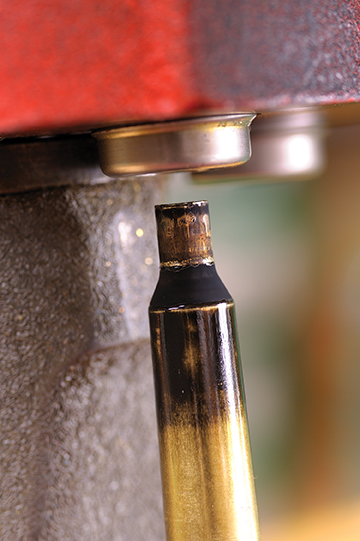
Since I had plenty of new 30-30 brass left over from the Donaldson loading session, I used it in conjunction with a set of Redding forming dies. With new brass, it has yet to go through any changes in its makeup from firing, hence it is a bit softer and easier to work with right from the beginning. With Redding, you need a set of three of their custom dies and a full die set from their Series C selection.
The first and second die are nothing more than helping the 30-30 case turn into the Zipper profile. The last die is a trim die, and that runs each case into the full die set to finish it off to factory specs. Final fire forming will complete the cycle, and before a formal loading session, trim all cases to 1.952 inches.
Old loading data shows the use of HiVel powders, which I believe was right around the burning rate of the current 4895 series of propellants. That being right I got under inch groups with a 55-grain Remington PLHP over 29.0 grains of H-4895.
225 Winchester
When it comes to a timeless varmint cartridge, the 225 Winchester is a prime candidate for any rifle battery. Even better to work with are the cartridges that are thrown by the wayside by something improved by way of another manufacturer, and in this case, the ongoing rivalry between Winchester and Remington Arms.
In short, the Zipper-adapted 225 Winchester was a success story gone sour. It seemed that the parent company had introduced the cartridge along with its Model 70 rifle to the public in 1964, and within a year, Remington commercialized the popular 22-250 wildcat. With the 220 Swift waning, the 225 Winchester was waiting in the wings, and it was a fight to the finish, but the Remington product won out, especially chambered in the popular Model 700. Today, there are no production rifles chambered for the 225 Winchester. HSM Manufacturing has plans for the ammunition. Winchester still lists the brass, but I do not believe they are currently producing it. Searching gun shows and the secondary market are the best prospects now.
For a rifle chambered for the 225 Winchester, I used a Ruger Number 1. Keeping the nostalgia of the cartridge, I sent the gun to the Montana Rifleman. They installed a custom 26-inch octagon barrel that turned that gun into a classic shooting machine, and with dies from Redding and a shelf full of .224-inch bullets, I began my handloading sessions.
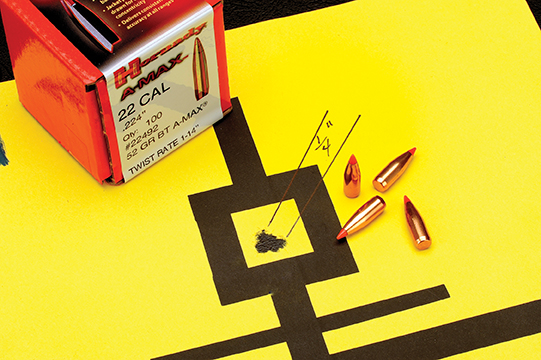
When the smoke cleared, Nosler’s 55-grain spritzer recorded groups that averaged .590 inch across with 30.9 grains of IMR-4064 powder (which Harvey Donaldson recommended) with a velocity of 3,360 fps. Another gem was the Sierra 55-grain boat tail with 34.3 grains of H-380. Groups here went to .610 inch, velocity was 3,420 fps, and increasing to 36.3 grains of the same powder increased the velocity to 3,583 fps with a gain of .652 inch at 100 yards.
I liked reviving the 225 Winchester, and it deserves more attention than it is presently receiving.
220 Swift
If there was ever a more controversial cartridge than the Swift in varmint circles, I haven’t found it. Like the rest of the classic varmint cartridges, the Swift has its own set of historical markers, as introduced in 1935, based on the rimless 6mm Lee Navy case. Winchester sought to go big time with the Swift and, to this end, brought on the Model 54 bolt-action gun to complement their new addition.
Right out of the gate, it had a reputation for great accuracy, coupled with a taut string trajectory. However, the problem on the sidelines was throat erosion caused by its high velocity of 3,500 fps or more, in a day and age when metallurgy was not at its peak. Some 30 years later, Winchester introduced the 225 Winchester to replace the aging Swift, but to no avail, as Remington, with its 22-250 entry, swamped the popularity of both. As a side note, Remington in modern times still held the Swift in high regard by introducing its battery-operated EtronX rifle again, pushed to the wayside for lack of hunter acceptance.
Looking back, I’ve had more than my share of rifles chambered for the Swift. From the Rugers to the Remingtons to even a few custom rifles, the cartridge has never let me down. The Swift is still out there with the varmint crowd, and ammunition is still available from Remington, Hornady and HSM. Ditto on the brass from the same sources plus Nosler.
Quoted as still being one of the fastest cartridges today, experience shows you can get very close to 4,000 fps with careful handloading, and with my favored 55-grain bullet, 3,800 fps is perfect and more comfortable for me on late, heavier summer chucks. On the commercial side, Hornady offers a 40-grain selection that will get you close to 4,200 fps. No matter how you cut it, the Swift is still one great varmint cartridge!
Out with friends, the question always comes up, that after 75 years “chuckin’,” do I have a favorite? The answer is simple: In .224 caliber, yes. In a cartridge, no, for if I did, I would not have had all this fun over the years.