

Heavy Bullets in the 204 Ruger
Why 39- and 40-Grain Bullets Excel
feature By: Patrick Meitin | May, 26
If I were forced (heaven forbid) to choose but a single varmint cartridge for all the variable conditions and ranges offered by North America’s disparate burrowing rodents, I would be hard pressed to do much better than the 204 Ruger. The 204 Ruger provides top-notch velocity and flat trajectories, and even betters the ballistics of the venerable 22-250 Remington, while burning much less powder. Many find this assertion difficult to believe, but a ballistics calculator tells the tale, especially at longer ranges.
This, of course, assumes the traditional 1:14 to 1:12 rifling twist of classic 22-250 Remington rifles, which essentially limits bullet choice to streamlined 55- to 60-grain polymer-tipped projectiles (though some fast-twist 22-250s are now available, like those from Savage). I know this seems heresy to many, but here are the numbers, all using Sierra BlitzKing bullets, applying a 10 mph crosswind and measured at 500 yards: 22-250 Remington with 40-grain BlitzKing (.196 ballistic coefficient [BC]@4,000 feet per second [fps]), 39.1 inches drop and 37.6 inches drift. The 22-250 with 50-grain BlitzKing (.248 BC@3,800 fps) delivers 37.4 inches drop, 29.4 inches drift. The 204 Ruger with 32-grain BlitzKing (.221 BC@4,100 fps) delivers 34.9 inches drop, 31.6 inches drift. The 204 Ruger with 39-grain BlitzKing (.287 BC@ 3,750 fps) gives 32.7 inches drop, 23.8 inches drift. This has everything to do with the magic of ballistic coefficients.
.jpg)
Thirty-two grains has remained a near-standard bullet weight for the 204 Ruger, and with good reason. I shoot 32-grain (Sierra VarmintKing, formally BlitzKing, Hornady V-MAX and Nosler Ballistic Tip Varmint) and 35-grain (Berger) bullets nearly exclusively from my own 204 Ruger. I choose them because they offer muzzle velocities often in excess of 4,000 fps, red-mist impacts on smaller burrowing rodents, plus DOA terminal performance on larger varmints such as rockchucks and coyotes. In the case of furbearers, they usually fail to exit, meaning minimal pelt damage for those who sell hides or wish to tan them as trophies. They accomplish this with negligible recoil and reasonable muzzle blast.
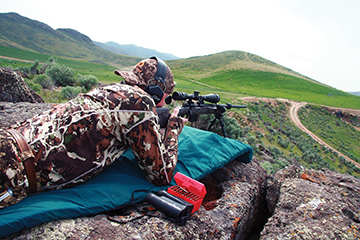
Though 32-grain bullets are difficult to beat, there is much to be gained by shooting heavier, longer, 39- and 40-grain .204-caliber bullets. This has become my standard approach any time I visit wind-cursed western Wyoming for annual Richardson’s ground squirrel and white-tailed prairie dog forays. A combination of Sierra’s 39-grain VarmintKing and 25 grains of Hodgdon 322 typically groups into less than 1⁄2-Minute of Angle (MOA) and creates wind-drift margins markedly less pronounced than the faster, lighter 32-grain pills at longer ranges.
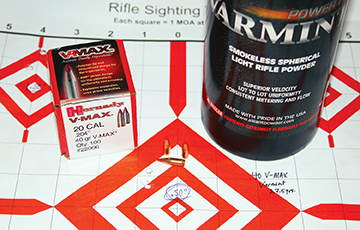
Looking at velocity alone, there was a time when I shunned 39- and 40-grain bullets from my 204 Ruger, rationalizing that I could shoot 40-grainers from my 223 Remington at essentially the same velocities. With this assumption, I was completely ignoring the 204’s much higher ballistic coefficients. Taking just the bullet examples in this test, we’re looking at a .202 G1 BC for Speer’s 39-grain TNT (.144 G1 for Speer’s 40-grain .224-caliberiber Varmint Soft Point); .227 G1 for Berger’s 40-grain BT Varmint (.151 G1 for Berger’s 40-grain .224-caliber FB Varmint); .239 G1 for Nosler’s 40-grain Ballistic-Tip Varmint (.221 G1 in the same .224-caliber bullet); .275 G1 for Hornady’s 40-grain V-MAX (.200 in .224-caliber); and .287 G1 for Sierra’s 39-grain VarmintKing (.196 G1 in .224-caliber).
This translates into about 4.6 to 6.8 inches less drop at 300 yards and 17.2 to 28.1 inches less drop at 500 yards. This also means 4.6 to 6.7 inches less wind drift in a 10 miles per hour (mph) wind at 300 yards, and 17.2 to 27.5 inches less wind drift at 500 yards under the same conditions. The 300-yard numbers alone add up to considerable margins, explaining my newfound fascination with heavy bullets from the 204 Ruger.
Ideal powders for the 204 Ruger fall in the medium-fast to medium burn-rate class, starting with Accurate 2520, to Alliant Power Pro 2000-MR. With 32-grain bullets, I have generally seen the best combination of accuracy and velocity from powders in the range of Alliant Reloder 15, Hodgdon Varget, Shooters World Match Rifle and Tactical Rifle and Vihtavuori N140. I was curious to see what the 40-grain bullets would prefer, which also gave me an opportunity to test some powders I’ve not auditioned previously in the 204 Ruger.
The 39-grain weight class was represented by Speer’s TNT (with the lowest G1 BC of the bunch) and Sierra’s 39-grain VarmintKing (with the highest G1 BC of the test). The TNT’s lower BC can be attributed to its simple flat base and hollowpoint design. Yet it includes a thin, precision jacket with internal fluting that results in explosive expansion. The VarmintKing includes an abbreviated boat-tail (BT), green acetyl resin compound tip and a precise jacket known for providing MatchKing-level accuracy. The Speer was paired with Alliant Reloder 10X, Hodgdon CFE 223 and Ramshot X-Terminator, all on the promise of top velocities. Sierra’s contribution was set up with Hodgdon Benchmark, Vihtavuori N135 and Alliant Power Pro 2000-MR.
The 40-grain weight class included Berger’s BT Varmint boat-tail hollowpoint design with a G1 BC of .227. A J4 Precision Jacket promises no more than .0001-inch runout and the tangent ogive lends it match-grade accuracy with minimal fussiness. It was matched with Accurate 2520, StaBALL Match and Hodgdon Varget. Accurate 2520 would seem a touch fast for this cartridge, but top velocities were promised.
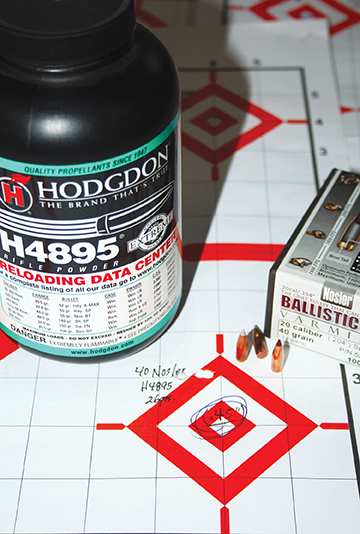
The Ballistic Tip Varmint from Nosler includes a boat-tail and orange polymer tip, tapered jacket and ballistically-engineered Solid Base. The combination provides match-grade accuracy and a .239 G1 BC. Versatile Hodgdon Extreme 4895 and H-322, and Shooters World Tactical Rifle, were paired with this bullet.
Finally, Hornady’s boat-tail polymer-tipped V-MAX is a varmint-shooting staple, touted as expanding on varmints down to 1,600 fps. The match-grade AMP jacket provides excellent accuracy. Power Pro Varmint, Shooters World Match Rifle and Winchester 748 were chosen, the latter in particular promising top velocities.
Utilized components included fresh Remington brass, Remington 71⁄2 Small Rifle Bench Rest primers, Hornady Custom Grade full-length dies and an Area 419 Zero Reloading Press. Brass was squared off to a trim-to length of 1.840 inches (as recommended by Hornady) and then chamfered on the inside and outside. Primers were seated using Lyman’s Accu-Prime Auto Load priming tool, which I highly recommend for fast, accurate work. All powder charges were measured with a simple Lee Precision yellow plastic scoop and tricked up to weight on a beam scale, both tools made by RCBS.
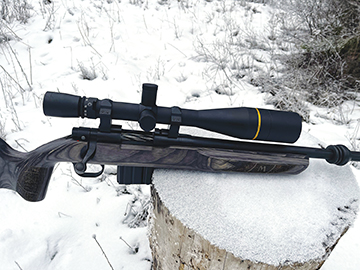
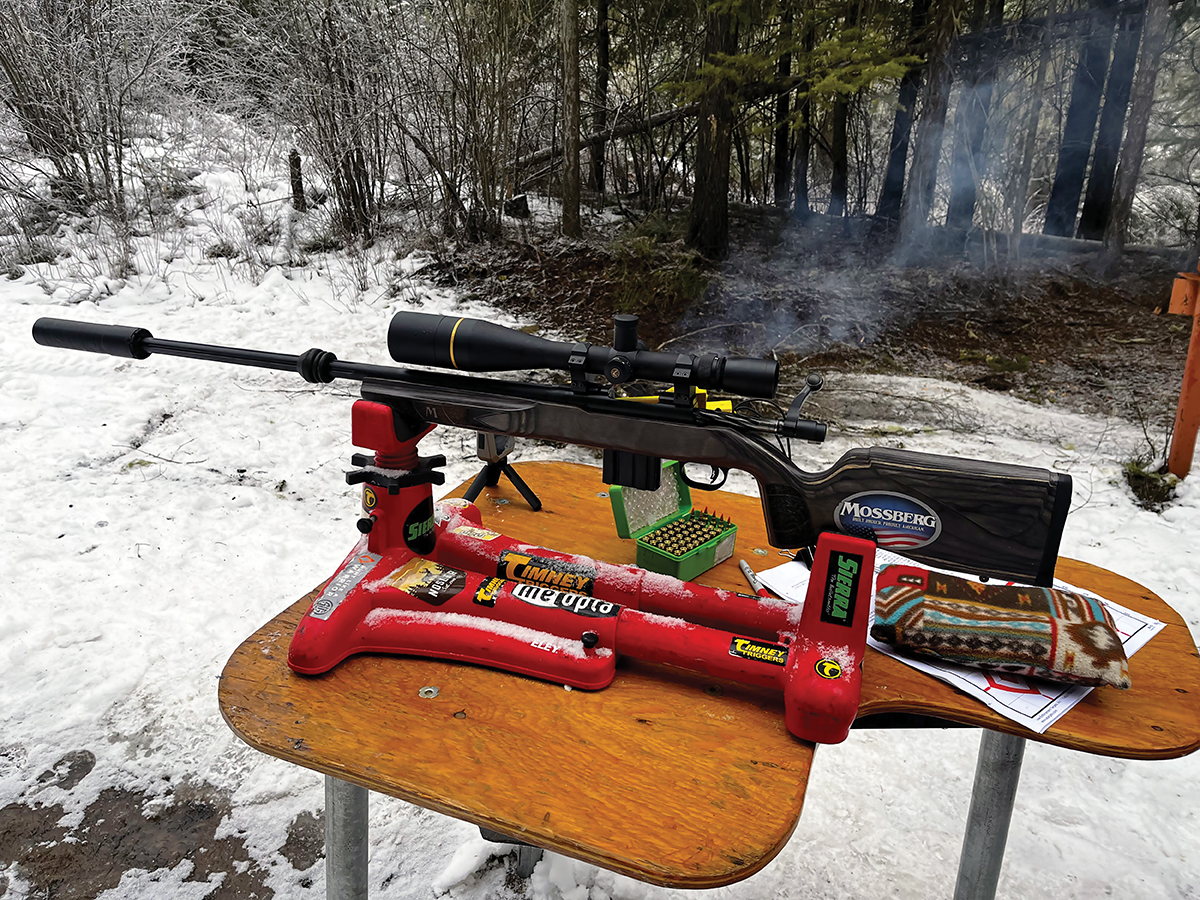
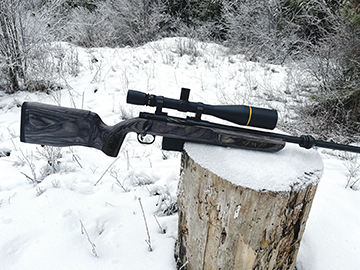
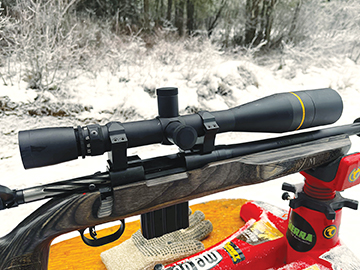
The test rifle is one I received on loan while seeking rifle models with distinctive looks for photography while working on my book, The Predator and Varmint Hunter’s Guidebook. It’s a Mossberg MVP Series Varmint that shoots so well I would have been a fool not to purchase it. Good thing, too, as this model is no longer chambered in 204 Ruger.
It consistently shoots bug-hole groups with Nosler’s 32-grain Tip-ped Varmageddon and 28.5 grains of Vihtavuori N140. It includes a 10-round detachable steel magazine and has always fed reliably. The Mossberg’s user-adjustable/center-blade LPA Trigger breaks at 3 pounds on my rifle. The medium-contour 24-inch barrel is fluted and is 1⁄2x28 threaded. This barrel has held a Limbsaver Sharpshooter X-Ring Barrel Deresonator from the
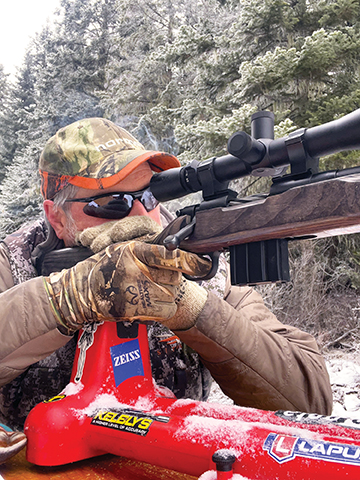
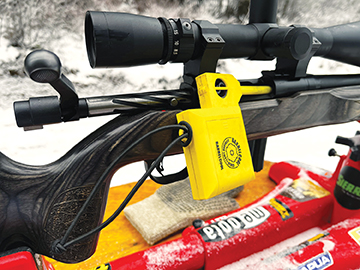
beginning, which was quite popular when the rifle was new. Whether this is part of the rifle’s inherent accuracy, I cannot in all honesty say, but it certainly hasn’t hurt, so it stays in place. I like the tactical-style laminated wood stock, though it is slightly short for my 6-foot, 5-inch frame, as it sits exceptionally well atop a bipod. It started its varmint-sniping career holding a Meopta scope, but now holds a Leupold VX-3i 8.5-25x 50mm set in Sig Sauer four-screw rings. The scope includes side parallax and capped target-style turrets. It is so sharp and clear th at it rarely comes off 25 power, even on the warmest spring days. The second focal plane (SFP) reticle is simple and super fine and has served this rifle and cartridge well. All shooting was conducted with a Silencer Co. Harvester EVO 30-caliber suppressor in place.
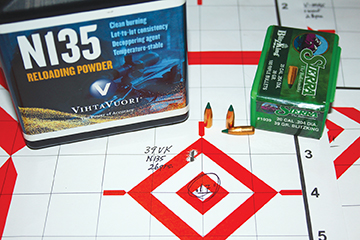
This outfit has accounted for untold numbers of burrowing rodents and dozens of coyotes and still shoots tight groups. I attribute its long barrel life to nearly obsessively monitoring barrel temperature while varmint shooting and setting it aside to cool when it becomes even moderately hot to the touch. Should the day arrive when accuracy begins to erode perceivably, I’ll immediately spend the money to have a new barrel installed.
One problem with the 204 Ruger as a handloading project is that extruded (stick) powders tend to log-jam in the neck due to its tiny neck opening. A good funnel, like those from Extreme Hardcore Gear, helps powder swirl into the neck and feed more reliably. Since my most accurate 204 Ruger load uses Vihtavuori N140, a stick powder, I’ve learned a trick to move things along. I fill my vibrating case tumbler with some cases in need of cleaning and fire it up. All I then need to do is touch the edge of the powder funnel to the tumbler bowl, and the powder shoots right into the case. For handloaders used to assembling standard 308 Winchester and 30-’06 Springfield-class ammunition, tiny .204-caliber bullets can prove difficult to handle, especially flat-base designs. The drop-down guide tube found on Hornady’s Custom Grade dies is a big help here, as well as giving cases a generous inside neck chamfer.
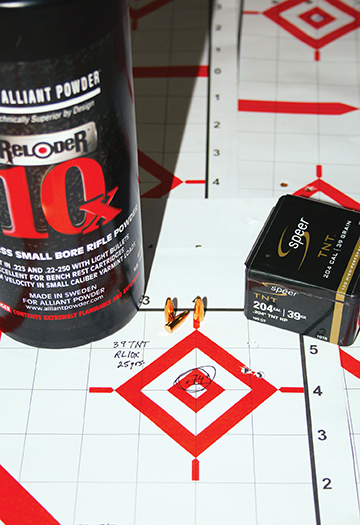
Hornady likely designed, and SAMMI established, a maximum overall loaded length of 2.260 inches to make the 204 Ruger compatible in an AR. That said, my Mossberg’s detachable magazine allows overall loaded lengths of up to 2.30 inches with polymer-tipped bullets. At this length, they just clear the magazine’s front lip, feed flawlessly, and most importantly, chamber freely. The 2.26-inch mark is essentially automatic with hollowpoint bullets, particularly flatbase examples.
This test reminded me, yet again, just how fussy my rifle is with the heavier bullets, something I cannot speak to with other 204 Ruger rifles. With any 32- to 35-grain bullet, I’m typically able to quickly find a load capable of punching bug-hole groups after auditioning just a handful of suitable powders. This just isn’t the case with 39- and 40-grain bullets. I’ve often wondered if this has something to do with my rifle’s 1:12 rifling twist. My rifle was also particularly persnickety with the two hollowpoints, my theory being that the extra jump into the lands is negatively affecting grouping. The two hollow points struggled mightily to break an inch, never mind the 1⁄2-MOA groups I deem necessary for serious long-range varmint work.
Powders allowing velocities in excess of 3,800 fps included Alliant Power Pro 2000-MR and Power Pro Varmint, Hodgdon CFE 223 and H-4895, Vihtavuori N135, Shooters World Tactical Rifle and Winchester 748. To hit the 3,900-plus fps mark, try Alliant Reloder 10x, Hodgdon Benchmark and Accurate 2520. No pressure signs were detected, even at the highest velocities; all primers retained rounded edges after firing, though keep in mind all testing was conducted at mid-20-degree temperatures, and pressures may jump in warm weather. Many of the powders that produced the highest velocities also showed noteworthy accuracy. These included Alliant Reloder 10x, Power Pro 2000-MR and Varmint, Hodgdon CFE 223, Benchmark and H-4895, Vihtavuori N135 (producing the tightest group of the entire test), Shooters World Tactical Rifle and Winchester 748.
.jpg)