

Mauser’s 22 Magnum Rifle
Classic Accuracy
feature By: Art Merrill | May, 26
Perhaps you’ve noticed that, despite its rimfire nature, pretty much no one plinks with the 22 Winchester Magnum Rimfire cartridge. At least, nowhere near the extent that we plink with our rimfire 22 Long Rifle guns – or centerfire AR-15s, for that matter. While not as expensive as centerfire ammunition, 22 Winchester Magnum Rimfire is nonetheless three to four times as expensive as 22 Long Rifle plinking ammunition, and it’s just as non-reloadable.
Another reason the 22 Winchester Magnum Rimfire (a.k.a. 22 Magnum or 22 WMR) sees comparatively little use is that the more expensive cartridge only adds about another 50 to 75 practical yards to the effective range (hunting distance) of the cheaper 22 Long Rifle (22 LR). Rifles in 22 WMR have historically not been anywhere near as accurate shooting as a truly accurate 22 LR rifle/ammunition combo. Note that no one makes match-grade 22 WMR ammunition or rifles for competition; which is the cause and which is the effect, is up for question.
All that said, the 22 WMR does fill a niche somewhere between the 22 LR and centerfire 22 varmint rifles, enough so that it soldiers on 70 years after its introduction without a sign of being discontinued. In fact, 22 WMR ammunition is getting better, with choices now including polymer-tipped bullets, higher velocities and self-defense rounds. For varminting and small game, for example, Hornady offers a 22 WMR 2,200 feet per second (fps) 30-grain V-MAX bullet load, a lighter version of heavier .224-inch V-MAX bullets purchased by handloaders, and that also tops factory-loaded centerfire ammunition. While uncounted millions of cheap and cheesy pot metal 22 LR revolvers and rifles have been manufactured, the same can’t be said of guns chambered for the 22 WMR. At this moment, I can’t name one 22 WMR firearm I’ve ever handled that I would consider substandard in materials or workmanship to the degree that 22 LRs have been subjected to the past 200-plus years. For whatever reason, 22 WMR rifles seem to get more respect. One such respectable rifle is Mauser’s discontinued bolt action Model 201.
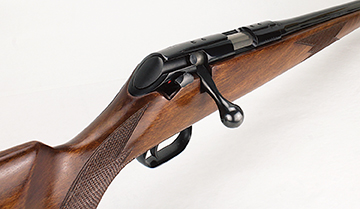
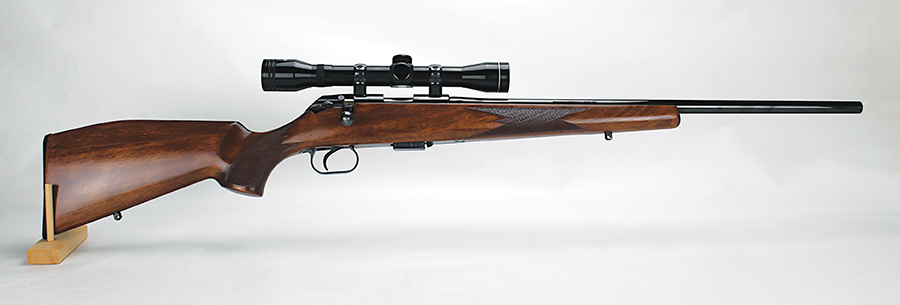
Mauser chambered Model 201s in 22 LR and 22 WMR, and both versions exude quality. There are two Model 201 variants, the standard and the Luxus. According to the Mauser owner’s manual, a walnut Monte Carlo stock with a rubber recoil pad, rosewood fore end tip and checkering differentiates the Luxus Model 201 from the standard model. The Luxus also has a higher metal polish to the blued parts. In some contradiction to the owner’s manual, the rifle here sports checkering and a lustrous blue from a high polish, but the butt plate is plastic, and there is no forearm tip added (the plastic butt plate may be a replacement, as one resource claims Model 201s had no plastic parts). The somewhat plain (possibly beech) stock wears a new custom stain and tung oil finish. One could argue the butt stock is Monte Carlo, but to me, that drop at the heel makes it look instead to have more of that European “hogback” profile. Lacking a known Luxus to examine, this one, then, appears to be the non-Luxus, or standard version.
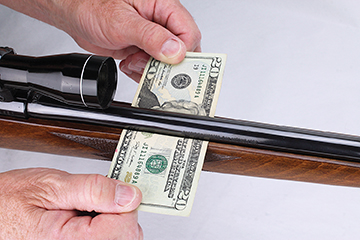
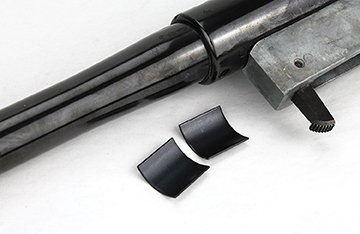
Mauser literature says the barrel is “special ordnance steel” with six-groove rifling and a right-hand twist. Not included is the twist rate, which a tight-fitting patch on a cleaning rod shows to be 1:12. Two vertical pins attach the medium-contour barrel to the receiver, and there is no provision for iron sights. A pair of bedding plates under the barrel, just in front of the receiver, is perhaps the Model 201’s most unusual feature. The two thin plates are stacked one atop the other and are curved to match the barrel contour; the plates support the barrel to free float it from that point forward.
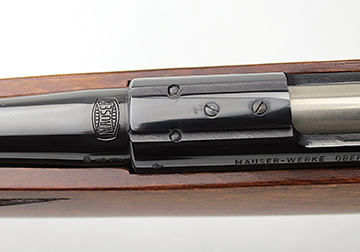
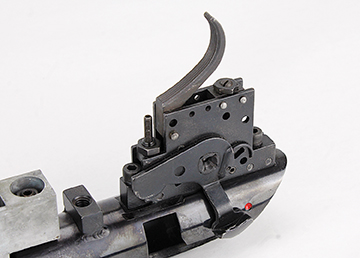
An 11mm dovetail rail for rimfire tip-off or “claw” rings grooves the top of the streamlined receiver, interrupted by the ejection port that wraps over the top. Both standard and Luxus Mauser 201s came standard with a single-stage trigger featuring adjustable weight and travel. A double-set or “French hair” trigger pushed forward to set, could be had on special request.
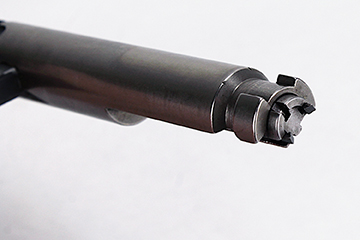
Vying with the bedding plates for the “Most Unusual Feature” title, the Model 201’s bolt has two forward locking lugs, just as would be found on a centerfire rifle, and bolt throw is only 60 degrees. Also unusual, the bolt design is actually a kind of bolt within a bolt, the inner part non-rotating, and the outer sleeve with a handle attached bearing the bolt lugs that turn into their recesses. Twin extractors (or the left one may actually be a cartridge guide) ensure that a particular operation is carried out without argument from a recalcitrant case.
Apparently, the Model 201 has a bit of a reputation for a fragile ejector. Essentially a stamped steel cube with a bit of nubbin peeled upward to engage a case rim, it nonetheless appears to be beefy enough to withstand a lifetime of reasonable use. Engaging the safety locks the trigger, trigger lever and bolt handle.
Five and 10-round magazines were available for the 22 WMR version and are of high quality. Mauser no longer manufactures the magazines, of course, but 10-round magazines, as well as a good selection of Model 201 parts, are still available from Numrich Gun Parts.
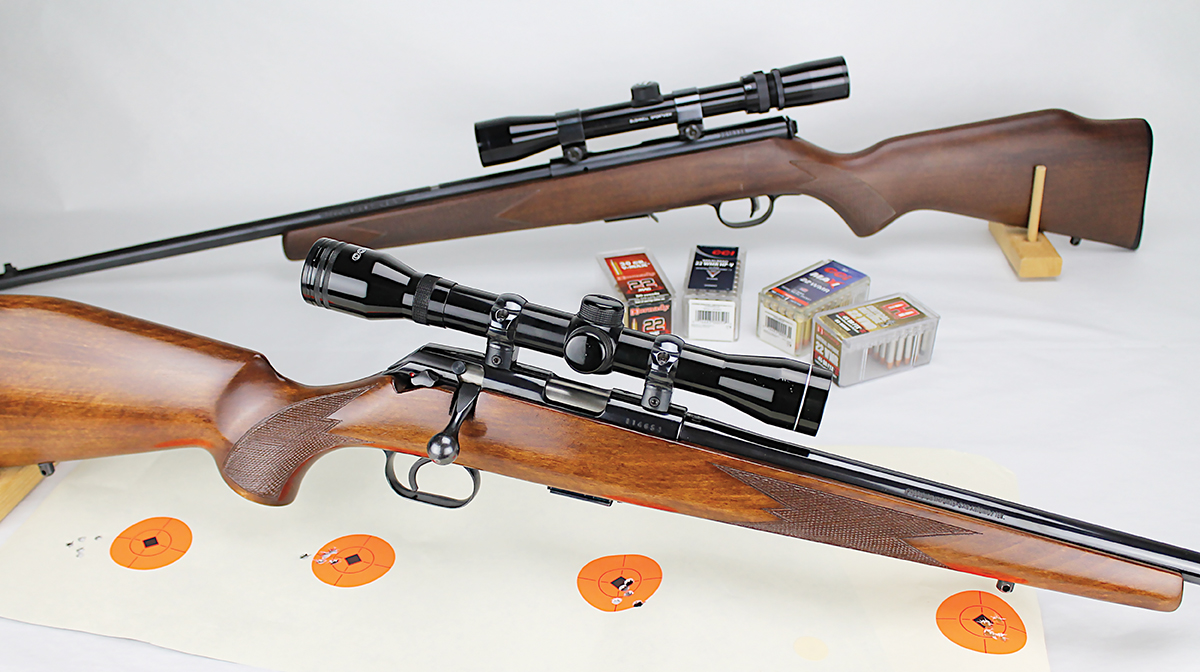
For an accuracy evaluation, I thought it might be interesting to compare the delightful but discontinued Mauser with my modern Savage Model 93 as, outwardly, they appear comparable. Both are mounted with older, not-expensive scopes, the Mauser a 4x Tasco, the Savage a 3-9x Bushnell (I left the Bushnell at 4x to level the optical field for the evaluation - and the Bushnell, by the way, has better glass). The Mauser’s barrel has a bit more beef, but the Savage’s Accutrigger breaks a half-pound lighter, at 23⁄4 pounds. Seventy-five or even a hundred yards is a better judge of a 22 WMR rifle’s character, but gusting winds, combined with the scopes’ low 4x magnification, necessarily limited a reasonable accuracy comparison to 50 yards.
The group sizes in the accompanying table tell the story. Though slightly heavier on the trigger and with an inferior scope, the Mauser’s beefier barrel, 1:12 twist, and possibly also its bedding plates aided it in punching groups significantly smaller than the Savage. Though the Model 93’s barrel is also free floated, Savage elected to give it a 1:16 twist, as for the 22 LR cartridge. It can still snuggle up three-shot groups at 75 yards, but the 93’s slim barrel heated quickly from sustained firing here, another inducement to open up groups. Incidentally, at the start of accuracy testing, the Mauser’s second shot printed precisely on top of its cold-bore shot to make a hole so small that at first I thought something had gone wrong, and I’d missed the target paper completely. On close examination through my 60x spotting scope, it was difficult to tell that the hole was actually punched by two bullets.
I chose the Savage Model 93 here for two reasons: (1) It is the only 22 WMR rifle in my racks and (2) it is accurate for a 22 WMR. The first game I ever bagged as a child, a cottontail rabbit, was with a 22 WMR bolt action rifle. I don’t recall the rifle make, but I clearly recall the checkered stock, bright bluing and scope. That rifle stayed behind our front door for the dispatching of any edible critters or varmints that may have wandered within range or intended mischief. Nostalgia, however, is no substitute for precise bullet placement, and no 22 WMR rifle that passed through my hands since then, until the Savage Model 93, was ever both pretty enough and accurate enough to stay long.
This Mauser 201 would be a keeper, as well, but it isn’t mine, and the owner isn’t selling it. That’s probably just as well, as the rifle would come with dubious karma and skeletons in the closet – deer skeletons, to be precise. The older gentleman who brought it to me for intensive cleaning and stock refinishing unabashedly related that, as a younger man, he’d used the rifle for many years in New Jersey to poach whitetail deer. “There’s nothing like it,” he said with a laugh. “It’s accurate, it’s quiet, and the deer just stands there looking confused, and then it falls over.” Here in Arizona, poaching mule deer ranks right up there with cattle rustling, but I reckon it’s different on the East Coast, where whitetails are apparently as thick as roaches in a greasy diner. Some years ago, a Georgia acquaintance amazed me when he displayed his hunting license: it folded out like an accordion, with a dozen doe tags included on quick-tear perforations. Big game as varmints? Go figure.
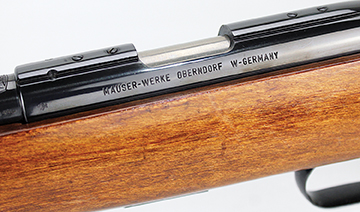
Oddly, I found it difficult to pin down the Model 201’s manufacturing run, but Mauser apparently produced the rifles during the 1980s-1990s. The importer’s name stamped onto the barrel of this Model 201 reads, “PRECISION IMPORTS-SAN ANTONIO / TX.” Preceding that, it appears the same rifle was produced by Voere in West Germany, and in the 1970s, marketed by importer Kleinguenther Distinctive Firearms, also in Texas, as the K-22 or KDF K-22. Beyond that, reputable, verifiable information fades. Online auction houses have realized four digits for 22 WMR Model 201s, in keeping with the rifles’ quality and desirability among aficionados, though for the most part, the rifles fetch money from the $500 to $800 neighborhood, the 22 WMRs typically garnering a bit more than the 22 LR version.
With an excellent combination of classic good looks and accuracy, they’re worth it.
A Faster Twist for Faster Jacketed Bullets
For the 22 Long Rifle cartridge, a 1:16 twist rate has been the choice for almost 140 years. When Winchester introduced the 22 Winchester Rimfire (22 WRF) in 1890, it, too, got a 1:16 twist, a bit of DNA that was then passed along to its offspring, the 22 Winchester Magnum Rimfire (22 WMR) when it was born in 1959. Given soft lead bullets at subsonic velocities (950 to about 1,200 fps), the 1:16 proved optimum. When the 22 WMR stepped velocity up to 2,000 fps, lead bullets got a copper plating (not a true jacket) that the 1961 Gun Digest lists as “Kopperclad,” but the twist remained at 1:16.
Many 22 WMR loadings have evolved away from swaged lead bullets to drawn cup-and-core bullets, just like jacketed centerfire rifle bullets, and muzzle velocities are now exceeding 2000 fps. That kind of bullet construction and performance takes the 22 WMR well beyond 22 LR territory and legitimately into centerfire country.
The bullet diameter of the 22 WMR is the same as that for centerfire 22s, .224 inch. One factory loading used here, in fact, is Hornady’s centerfire .224 V-MAX bullet with a muzzle velocity of 2,200 fps. A 1:14 or 1:12 twist is the recommended twist rate for launching lightweight .22 caliber bullets from centerfire rifles. We can credit the Mauser Model 201’s 1:12 twist as probably the premier reason for its superior accuracy with jacketed bullets over the Savage Model 93 with its slow 1:16 twist.
.jpg)