


Colors of Night
There Is a Lot to See When the Sun Goes Down
feature By: Jason Stanley | May, 26
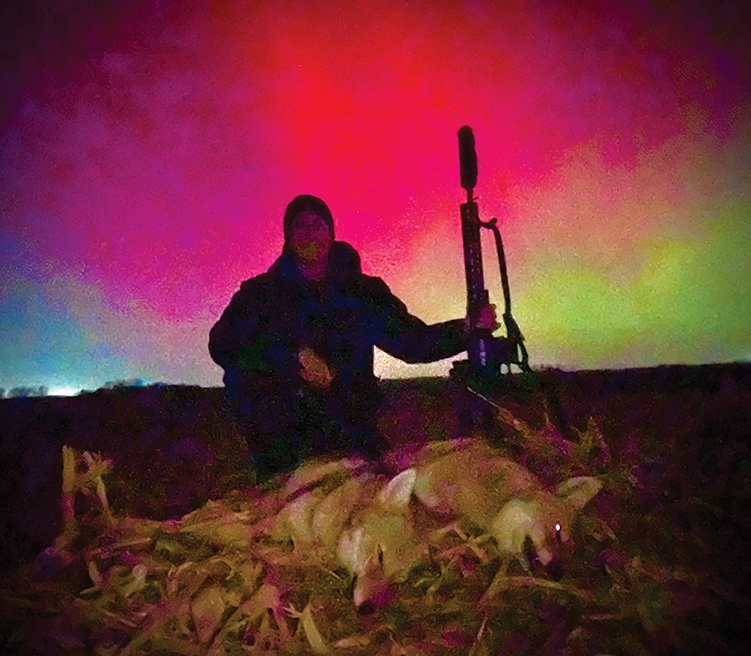
“Haven’t you shot enough coyotes?” was my wife’s semi-serious question as the door opened shortly after sunset. Well…No.
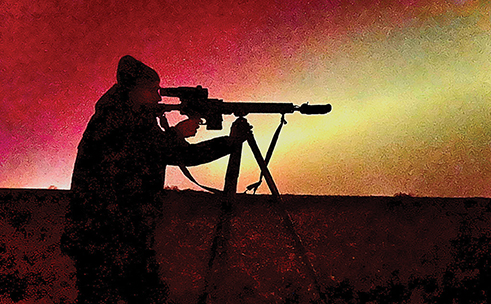
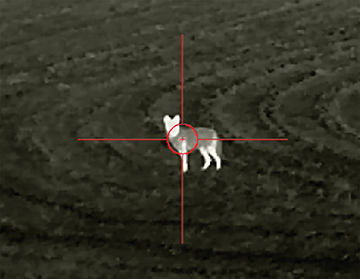
When landowners reach out regarding nuisance animals, the timecard is typically punched at sunset with a semiautomatic. There simply is no denying the sheer number of furs that can be harvested using thermal optics during the witching hours.
While squealing in the twilight, semiautomatics are my rifle of choice over bolt actions for two main
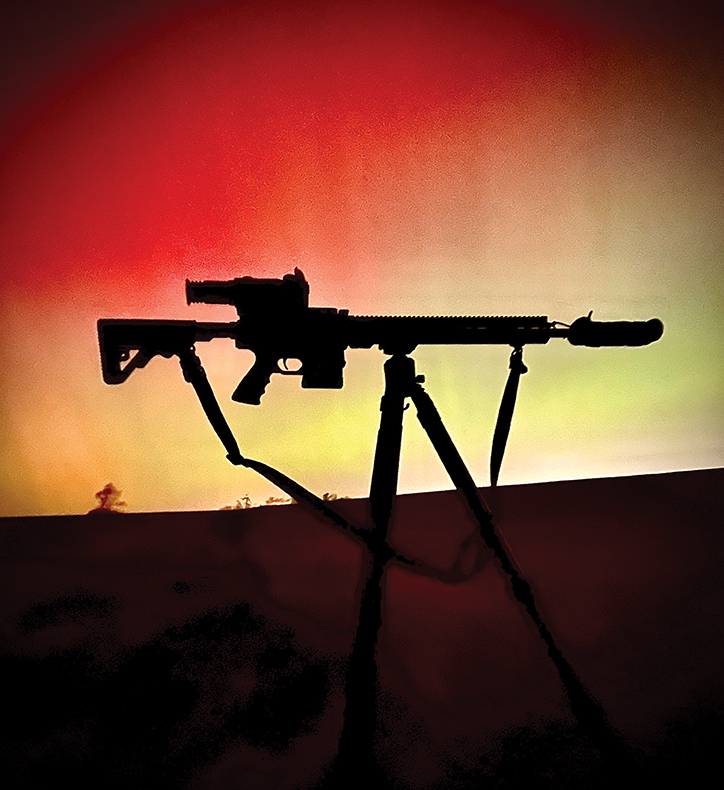
My initial night rifle was a Rock River Arms LAR-15 chambered in the popular .223. This is a very precise shooting gas gun, routinely producing groups with Sierra 52-grain hollowpoints propelled by 23.0 grains of Alliant Powder’s AR Comp under three-quarters of an inch, with the occasional sub-half-incher.
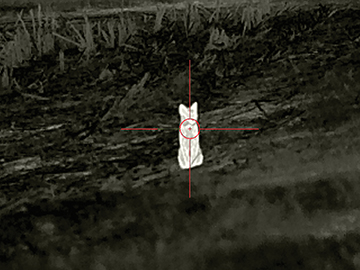
However, there is a problem. In southeast Nebraska, many of the fields have terraces. If that term is unfamiliar, terraces are long, man-made berms of dirt, built on the slopes of hills to help minimize soil erosion. These terraces often circle the hill in varying circumferences. When hit, if the fur bearer does not drop on top of the terrace, the heat signature is blocked by the berm, essentially making it invisible. Compounding the problem, due to the lack of depth perception at night, it is easy to lose track of which terrace the animal was behind. Any running resulting from a “less-than-perfect” hit would often require tracking the next day during daylight, thus justifying the switch to a Rock River Predator HP LAR-BT3 chambered in the harder-hitting 243.
Rock River is a company started in 1996 by brothers Mark and Chuck Larson in Cleveland, Illinois. During the early years, Rock Rivers Arms set industry standards for custom-fitted 1911 pistols. Shortly thereafter, the brothers turned their expertise to producing some of the finest shooting automatic (AR) rifles on the market. Their attention to fit, finish and function has earned them federal contracts with the Drug Enforcement Administration (DEA) and the Federal Bureau of Investigation (FBI). They now operate out of a 50,000-square-foot building in Colona, Illinois.
Before tuning the LAR-BT3, a one-inch Sightron-fixed twenty-four power scope was mounted in Burris Signature Rings. This is a dedicated hunting scope used for all my hunting rifles. Even though this rig would eventually be fitted with a thermal optic, the daytime scope provided more accurate data during load
First up was bullet selection for the 1:10 twist, twenty-inch, fluted, stainless-steel, twenty-four caliber barrel. Since the fur market in our area is nonexistent, pelt damage was of no concern. In fact, for this dedicated nighttime predator rifle, damage was sought after. More damage equals less searching. “Bang - Dead” was the job description. The resume of the Nosler 70-grain Varmageddon earned an interview.
New Starline brass was used. Necks were chamfered and deburred. CCI BR 2 large rifle primers were seated. No resizing was needed as the shoulders were already bumped back .003 inch from the chamber measurements on fired brass, and the factory necks produced .004 inch of neck tension.
Next came powder selection. In reloading circles, the .243 cartridge is famous for being a good eater, digesting a wide selection of powders. After unifying three different reloading manuals with my current powder supply, seven powders were chosen from the cabinet. To come out on top, the powder had to fulfill two requirements: speed and precision. In the hopes of limiting component usage, saving time, and providing a rough starting point, one-shot velocity tests were performed with all powders over a Garmin Xero Chronograph. Charges were started mid-range and worked up while checking for pressure signs.
Hodgdon 4895 was immediately let go due to the lack of speed. On the opposite end of the spectrum were Hodgdon Super Performance and Alliant Reloader 17. A two-hundred-yard load ladder was performed with each. Neither showed any signs of grouping. To save time and components, three shot groups were performed with the remaining four powders instead of load ladders. Hodgdon’s Hybrid 100V (HV100) had speed but refused to group. Hodgdon’s Varget and
The lone powder that had both velocity and precision in the Rock River was Hodgdon 4350. Data from three-shot groups at one-hundred yards showed a direct correlation between velocity and precision. A stiff load of 48.0 grains pushing the 70-grain pill 3,408 feet per second (fps) was settled upon.
Working seating depth away from the lands in .005-inch increments produced a trend of decreasing precision. A jump of .005 inch was chosen. Just touching the lands had the smallest groups; however, two-tenths of an inch in group size will not ruin a hunt, a stuck bullet can.
In late July, roughly one month before the calling season would unofficially begin, the required paperwork for a SilencerCo Omega 36M suppressor arrived. Excited to try my first can, the seven-inch-long suppressor was spun on and one shot was fired. Immediate pressure signs were encountered. Luckily, no damage was done to me or the rifle.
Keeping seating depth and neck tension the same, powder charge development restarted, this time with the suppressor. Three-shot groups were evaluated beginning at 46.0 grains of the same H-3450, and 46.3 and 46.5 grains both showed promise with groups around the 3/4-inch mark. Pressure signs were absent, and groups started opening over one inch at 46.8 grains. Retesting the 46.3-grain load produced a velocity of 3,300 fps and a confirmed .6-inch group.
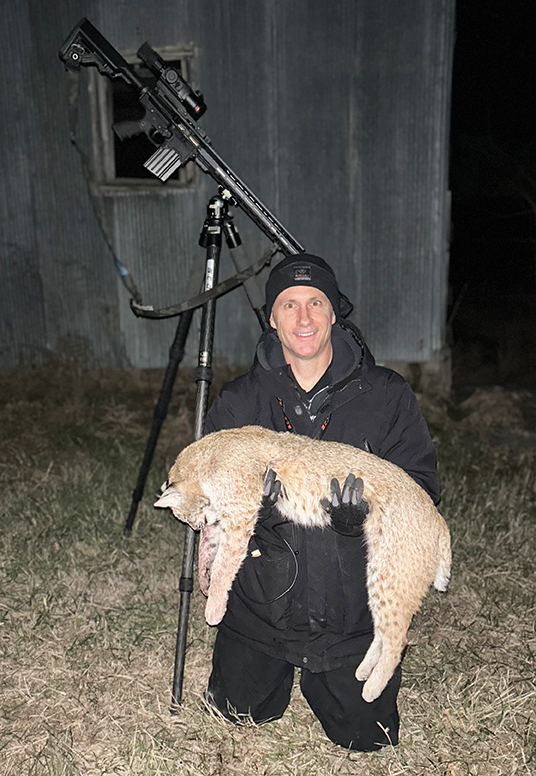
Rewinding a few years, when searching for a thermal optic to be used on the 223, I was overwhelmed by the data and the number of options. A phone call to Travis Shelton at Santa Claus Optics in Santa Claus, Indiana, changed that. Travis considered the average shot distance, terrain, animals hunted and price range to recommend the ideal scope for me: an InfiRay Outdoor RICO G-LRF 640 3X 50mm Thermal Weapon Sight which is distributed by iRAY USA.
In thermal scopes, the higher the resolution, the better the image detail. The RICO G-LRF provides 640 x 512 (327,680) pixels to help ensure you do not shoot an unintended target. The G-LRF also has the optimal pixel size of 12 μm (micron), adding to the clarity of the image.
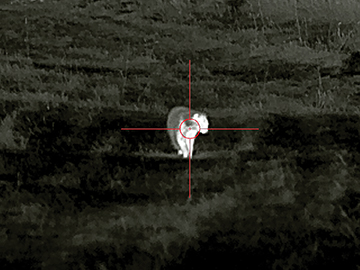
Assuming the available Benjamins are in the wallet, opting for the highest resolution and optimal pixel size is a wise move. Ironically, this was reinforced midway through drafting this article. I was calling at night for a farmer who asked me to dispose of a pair of Pepe Le Pews in a pasture one-quarter mile from his house. Having hunted this land for several years, there was little worry about domesticated animals except farm cats. A quick scan revealed no stinkpots, initiating a high-pitched rabbit-in-distress echo. Within minutes, a white-hot “bobcat” figure appeared on the screen. Bobcats in this area are considered a trophy, so excitement quickly ran its course. When the rangefinder read 150, the safety was moved to fire. However, something was wrong. The size was correct, the tail was snubbed, but the shape of the head was different, and it was not moving the way a cat moves. The finger came off the trigger, and the safety was clicked back on. A phone call the next day revealed the farmer had forgotten to mention his wife had recently bought a new dog, a boxer. Without a quality optic, there would have been some tough explaining to do, not to mention the mental agony of shooting someone’s pet.
The LRF in the name stands for laser range finder. This is a “must have” in my thermal scope due to the difficulty of judging distances at night and the terrain being hunted.
The RICO G-LRF allows the user to choose between five distinct color options for image illumination: white-hot, black-hot, red-hot, color and highlight. White-hot is my preference, which means the screen is mostly dark except for the heat source, which is white. When looking away from the scope, pupils are dilated, allowing better vision in the dark. This is much appreciated when looking at the remote to switch sounds. Whereas the reverse is true in black hot.
Short and long pushes of the four buttons located on top of the scope allow the user to scroll through a plethora of options. Memorizing the location and length of hold for the often-used buttons in the dark, such as power, stand-by, zoom, rangefinder and record, soon becomes second nature. Any recorded nighttime adventures can be downloaded to a computer with the supplied USB cord.
Directions were easy to follow for the basic setup. However, the initial zeroing of the thermal optic was challenging. Being new to this scope, directions had to be read and performed one step at a time. When rereading was required, the extra time caused the scope to “time out,” resulting in the process having to start completely over. To combat this problem, a cheat sheet was made, decreasing the time between reading and performing. Zeroing the IRAY is now a painless operation.
The rifle alone weighs slightly over nine pounds. With night optic, suppressor, accessories and ten rounds in the magazine, the scale balances at thirteen and a half pounds. Not horrible, yet I am glad most of the night strolls are a quarter mile and under, especially when dragging a twenty-five-pound coyote or two.
Replacing the 223 Remington Rock River LAR 15 in the night lineup with the Predator HP LAR-BT3 chambered in 243 Winchester has proven to be the correct decision. Since the switch, nearing triple digits of predators taken over the last two years and few have expired out of sight. The heavier and wider bullet provides more forgiveness in shot placement, resulting in fewer runoffs. The hollow thud of the 70-grain Varmageddon detonating in the chest cavity is a sure indication that no blood trailing will be necessary.
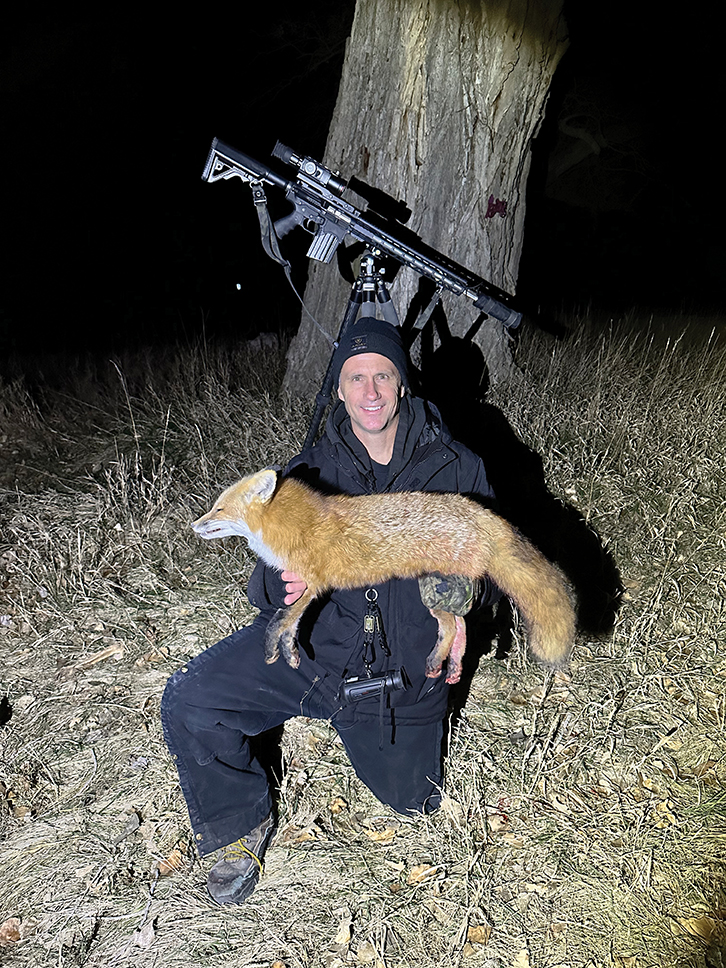
Just as every rose has its thorn, there can be a downside to setting up a rifle to explode fur. A local friend and landowner knew I wanted to harvest a red fox for a full-body mount. Derek called one night when his trail camera showed the elusive vulpes trying to get a free chicken dinner. Having a single thermal scope left only one choice of rifle to grab.
Instead of the fox coming to the call, the white-hot object exited a thick waterway up the front side of a terrace, stopped, then turned back. The one-hundred fifteen-yard prize was quartering to with a downward angle. When the trigger broke, a July pyrotechnic show erupted on the screen of the thermal optic. Entering the top of the shoulder, the 70-grain freight train fragmented. The firework display was the animal being completely disemboweled, and the hot material ricocheting off the frozen soil. Luckily, the taxidermist is a good seamster.
During the braggadocious phone call to my wife, she asked if I had taken a picture of the northern lights. Visually, the aurora borealis were cool, but nothing to “write home to momma about.” Until the lights were captured with my phone. For whatever scientific reason, the colors exploded on the screen. Even though the first three stands on that November night resulted in four coyotes, the remaining time was peacefully spent cherishing a once-in-a-lifetime opportunity. Few things are more beautiful than the colors of night.
Stay-down Shot Placement
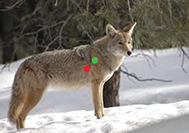
Nonetheless, not everything that counts can be counted. A major piece of the stay-down puzzle, which cannot be calculated, is shot placement. Regardless of caliber, to increase the stay-down percentage on broadside shots, consider shooting predators through the front shoulder. Essentially, placing the sleeping dart slightly forward and higher (green) than in the typical behind-the-shoulder shot (red), as on a deer. Yes, both shots will be lethal, impacting the scapula will provide the needed structure for the fast, thin jacketed, varmint bullet to act as a grenade, impacting all vital organs plus spinal cord, dropping, and keeping the prey in its tracks.
Laser Retrieval
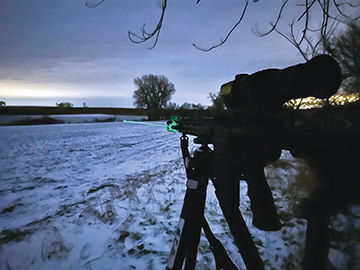
To save time looking for the quarry, contemplate employing a laser, such as CVLIFE Laser Sight for $30 on Amazon. This laser attaches to the rifle/tripod via M-LOK (Modular Lock) technology. Once the fur is down, unload the rifle, turn on the laser, and walk to the prize.
Scanners
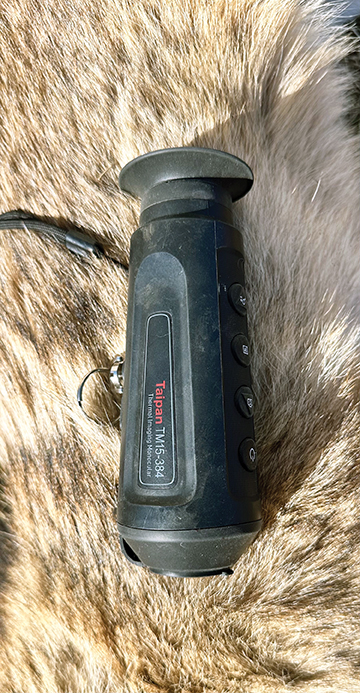
When the sun sets, often the only vision is through the night optic. If you are serious about spending the evening hours under the stars instead of under the covers, consider adding a scanner to the equipment list.
There are numerous advantages to using scanners. To start with, unlike when using a rifle and scope, there is very little muscle fatigue while searching for the heat signature of incoming predators, allowing hunts to continue into the morning hours. Scanners also lessen unwanted movement when exploring 360 degrees, decreasing the chances of being spotted by wary varmints. Earlier detection of targets is common due to the increased speed of scanning.
Once the illuminated object is spotted, move to the rifle and prepare for the shot. An added bonus: the scanner can still be used without moving the rifle off the incoming target to notice the sneaky ones sneaking in from other directions. Simply put, scanners are game changers in the world of nighttime predator hunting.