

21 Years with a CZ Model 452
8,000 Rounds and Still Going!
feature By: Gary Lewis | May, 26
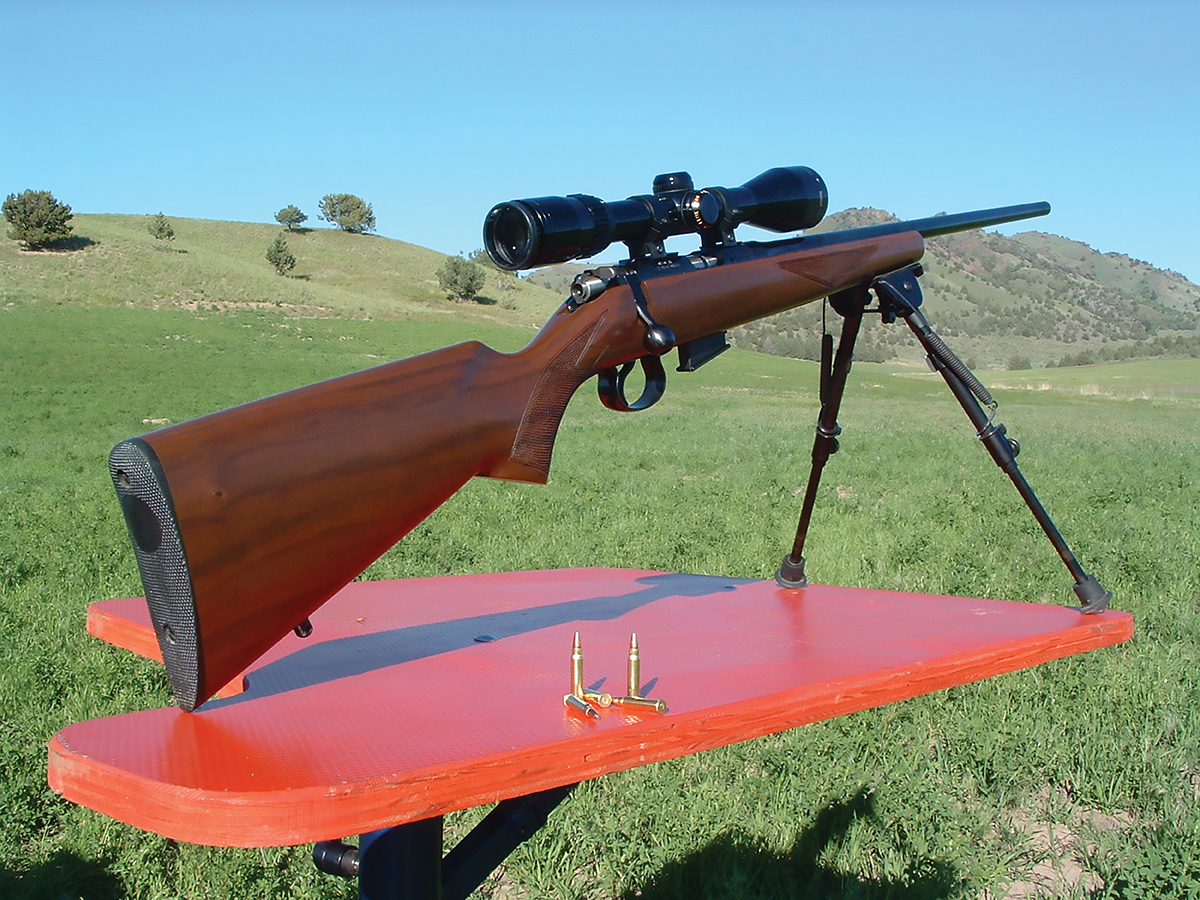
I have been living with a Czech model for the last 21 years, and while that sounds great, many people might think there are drawbacks. I can dispel the rumors. Other than a slight accent, she is Americanized. She might have put on a couple of ounces, but she has been economical to take on road trips, especially to eastern Oregon destinations like Bonanza, Bly and Crane.
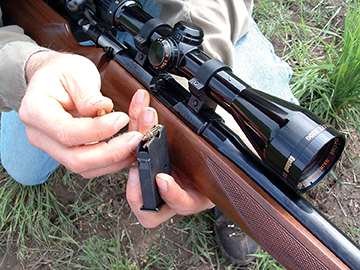
I think a lot of guys notice my Czech model because of her bottom metal, but I like her curves, especially around the wrist and at the fore-end.
Of course, I am talking about a certain svelte bolt-action CZ 452 American, which has been going places with me since 2005.
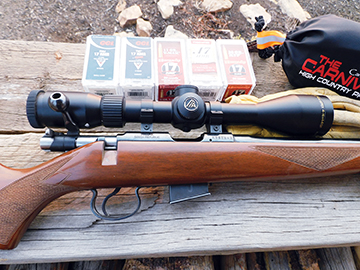
Back then, the CZ 452 American retailed for $420. I don’t remember what I shelled out on the first date, but I do remember the first priority was to install a set of Warne’s rimfire scope mounts and to top her with a Bushnell Elite scope. The rifle was new, the cartridge was new and the optics were superb.
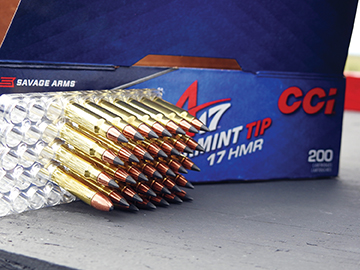
Here was a cartridge, the 17 HMR, that would reach much farther than a 22 Long Rifle and make a good shot you could see in the scope.
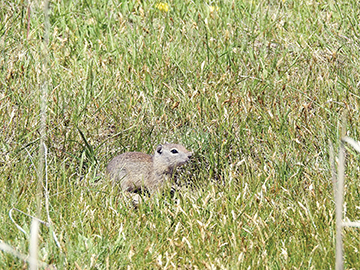
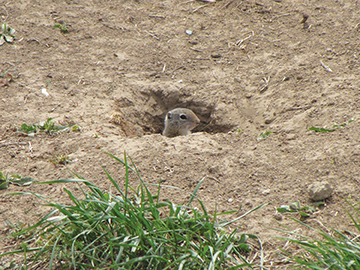
What the 17 HMR did for me was increase effective range on varmints like the Belding’s ground squirrel by a whopping 50 percent over the 22 Long Rifle.
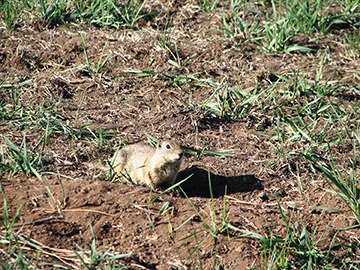
We call them sage rats in these parts. They are thin-skinned burrowers, long-term hibernators and eaters of the alfalfa, gobbling an average of 14.3 pounds of forage between March and July. They are satisfying to shoot with a 17-grain spitzer humming at 2,650 feet per second (fps), and there is so little recoil, the shooter can easily call his own shots.
The good folks at CZ knew what they were doing when they went to the design table on this particular rifle. CZ wanted to meet Americans right where they lived.
The CZ 452 was first designed in the early 1960s by a pair of brothers, Josef and Frantisek Koucky. Production began in 1964 and after CZ opened for business in Kansas City, Kansas, in 1998, the CZ 452 grew in popularity. It was natural to be chambered for the 17 HMR, which was introduced in 2003.
There were nine CZ 452 variants in those days, each with variations in stock configuration, barrel design, finish, fit, trigger and caliber. Turn one over and look at the barrel, and you will see the designation 2E ZKM. The “Z” stands for Zbrojovka Brno, the “K” and the “M” are for Brno designers Koucky and Malek. The 452 ZKM 2E stamp can be found on all 452s regardless of model.
I have owned this sweetheart for 21 years and calculate total round count at about 8,000 rounds, which would be 160 boxes or north of seven boxes a year.
According to my journal, the first hunt with the 452 American was on May 21, 2005, about 15 miles outside the small town of Mitchell, Oregon, when I bolted 150 rounds through the rifle.
There were a few shots at close range that day. These ground squirrels had been to school. Every time we appeared over the top of a rise, they would run for cover. Most opportunities ranged between 90 and 150 yards. The CZ 17 HMR could reach that far with a dead spot in the breeze, but when the wind really whipped up, I would grab something else. The 17 HMR may be fast, but its tiny bullet is prone to wind drift.
Five days later, we pointed the truck east again, this time with noted outdoor writer Ed Park in the passenger seat. Old friends, Joe and Evelyn Fitzgerald said they were happy to see us and invited us in for homemade bread that afternoon after we had ended the careers of a hundred alfalfa munchers. I wish I could have some of those days back to spend more time with Ed and Joe and Evelyn sitting in the living room of that old mail-order house, hearing their stories. Ed was never short of stories, and we had a lot of windshield time to talk about rifles, bullets and old timers.
Ed Park was the man who popularized canoe hunting for moose and caribou in Alaska and inspired those great Outdoor Life and Sports Afield covers. Ed and I hunted and/or fished together every year for the last ten years of his life. He suffered a stroke a few years before I met him and could not use the right side of his body, but he could wedge pillows and sandbags and shoot left-handed. He made a 101-yard shot on a ground squirrel with his handgun, and I remember making a 198-yard shot on a squirrel when the wind stilled in the afternoon, which got his attention.
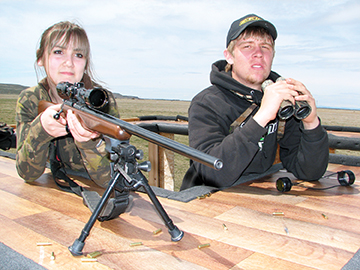
My middle daughter, Jennifer, was 12 years old in 2005, preparing for a black bear hunt in the fall. She shot hundreds of rimfire rounds on sage rats before Memorial Day and tagged a bear with her centerfire Ruger on Labor Day.
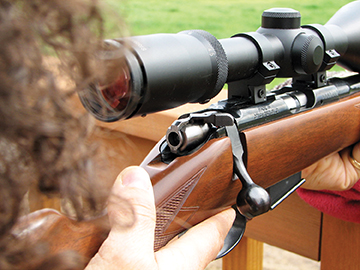
The CZ 452 firing mechanism is controlled with a two-position safety lever positioned just behind the bolt handle. Set it rearward to FIRE or set it forward to SAFE. Note that the end of the striker protrudes from the bolt body to indicate the rifle is cocked.
The single-stage trigger is similar to the original Winchester Model 70 and Mauser 98 trigger designs, with pull weight adjustable between 21⁄2 and 41⁄2 pounds.
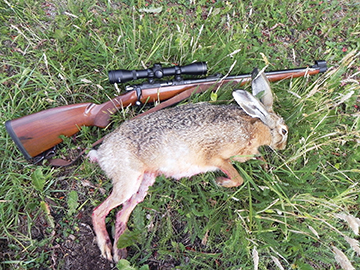
Besides tuning us up for big game hunts, the CZ American has accounted for countless numbers of Belding’s ground squirrels, numerous California gray diggers, dozens of rockchucks, a few jack rabbits, a coyote and a pigeon or two.
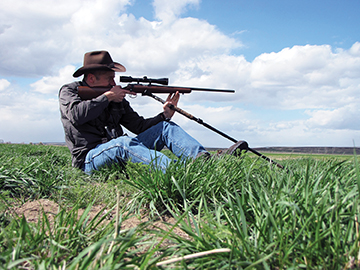
As to accuracy, the best 100-yard group I have recorded with the CZ 452 was a 0.648 3-shot group with CCI’s 20-grain FMJ.
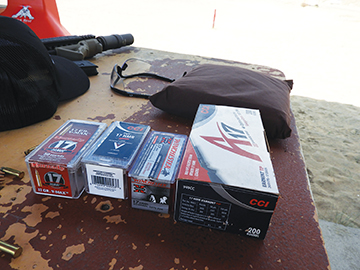
Last September, I tried to better that group on a September morning at the Central Oregon Shooting Sports Association (COSSA) range east of Bend, Oregon. Shooting from sandbags with four different loads, my best group measured 0.828. But there was little difference in group sizes between the tested loads.
I have always been skeptical of stated velocity on ammunition boxes and was surprised by the velocities I recorded. In general, the actual muzzle velocity was 100 fps faster than the stated muzzle velocity.
Somewhere along the line, I swapped out the Bushnell for a Burris scope and replaced that one later with an Alpen Apex 4-16 with a BDC reticle 44mm objective. They were all good optics, but as a gun writer, I have to swap scopes more often than I would otherwise.
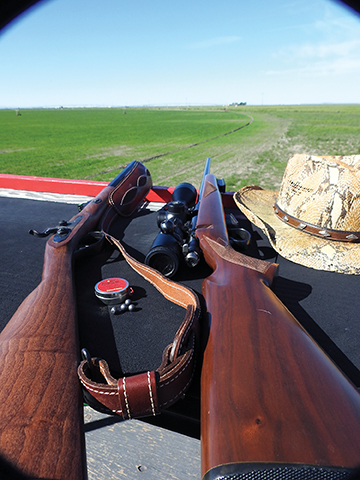
Made of blued steel and American walnut, the CZ 452 American is a classic rimfire sporter distinguished by a straight comb, rounded fore-end, American walnut stock, checkering, sling swivel studs, curvaceous trigger guard and medium-heavy contour barrel with no unsightly irons to detract from her lines.
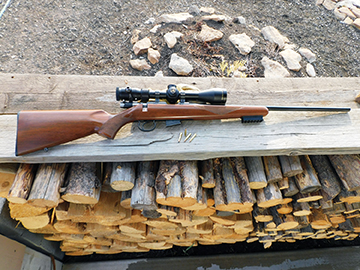
If all of this sounds nice, let’s not be hasty. The CZ 452 American is no longer in production, and picking up this Czech model is not as easy as sidling up to the bar and making conversation. There are online sites, though, where the lonely varmint shooter can find rimfire companionship and extra magazines. Look carefully at their profiles before making a purchase.
In 2005 and 2006, CZ-USA offered nine variants of the CZ 452: the American, the FS (with a Mannlicher stock), the Lux, the Ultra Lux, the Training Rifle, Scout, Silhouette and Style, with differing stock designs, triggers, sights, finishes and barrels chambered for 17 Mach 2, 17 HMR, 22 LR and 22 WMR.
A recent search on Gun Broker located a few CZs in search of new owners, including a left-hand model in 22 LR. Another rifle that caught my eye was a CZ 452 Special in 22 LR with a curvaceous Schnabel fore-end and a “Buy Now” price at $600. A Classic model in 22 LR had 13 bids and was poised at a current bid of $350 with two days left to go.
There was even a CZ 452, chambered for 22 WMR, in a Mannlicher stock, which reminded me of a time when I was in South America. Ah, but that was a long time ago. My Czech model and I have been happy together for 21 years.
.jpg)