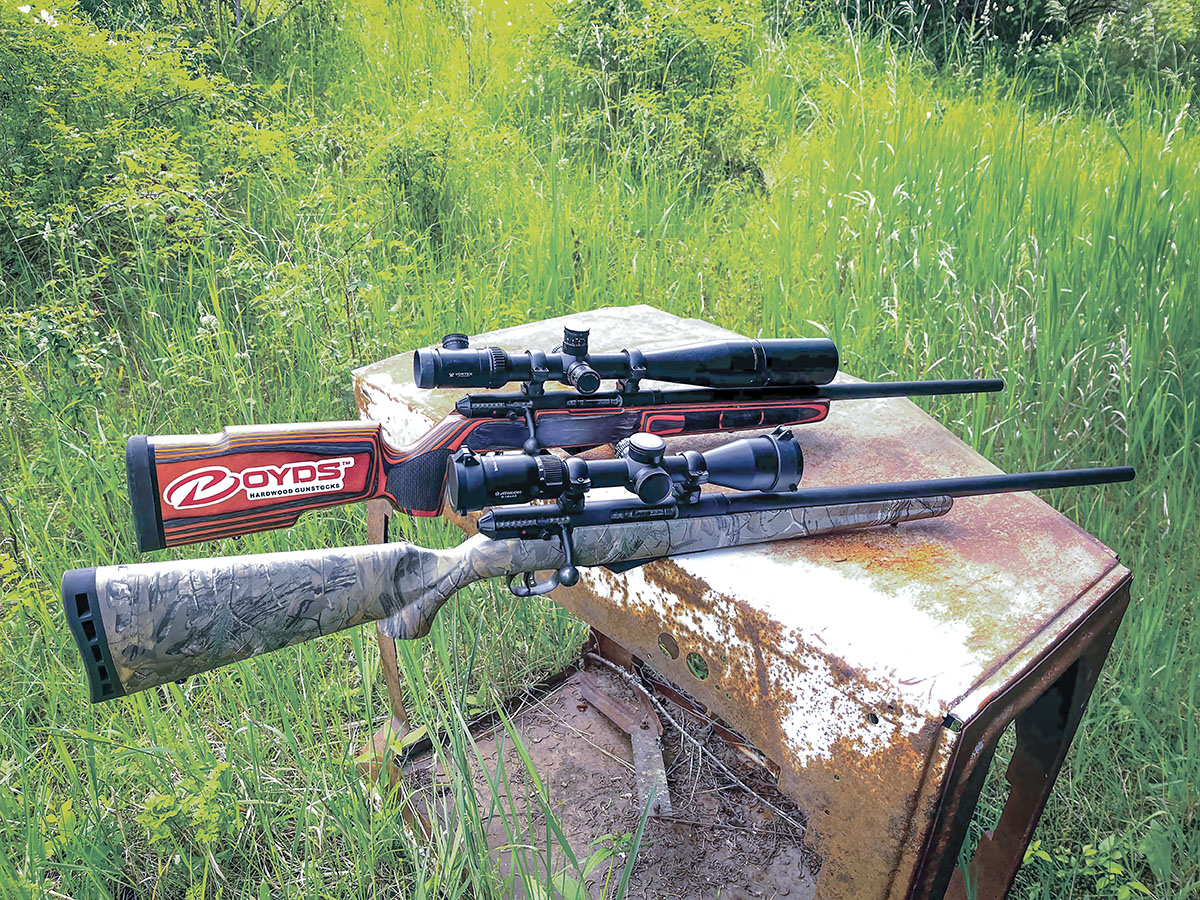
The two test rifles were Savage Arms’ Model 25 Walking Varmints. The 17 Hornet (left) was restocked with a Boyd’s Pro Varmint handle, the 22 Hornet (right) bedded in its original camouflage synthetic stock.
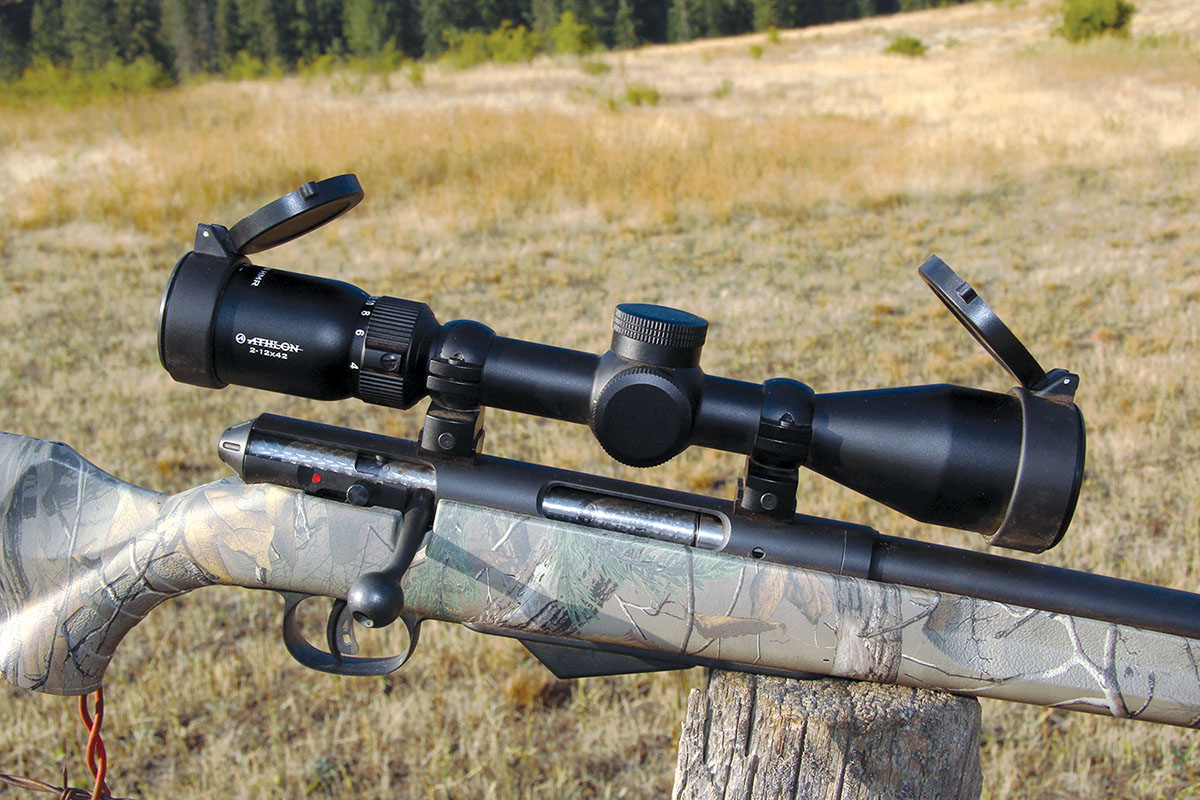
Patrick’s 22 Hornet is topped with an Athlon HMR 2-12x 42mm scope. The design provides capped turrets, superb optics and a compact footprint at an affordable price.
It’s safe to call the 22 Hornet our first modern varmint cartridge, if you consider 1930 modern. The cartridge had been in development since the 1920s, but
Winchester produced the first commercial ammunition in 1930.
Savage Model 23-D bolt action rifles chambered in 22 Hornet weren’t available until August 1932; Winchester’s Model 54 22 Hornet bolt action rifle wasn’t readily available until 1933. Stevens single shot Model 417 Walnut Hill target and 4171⁄2 sporting rifles also appeared in 1933.
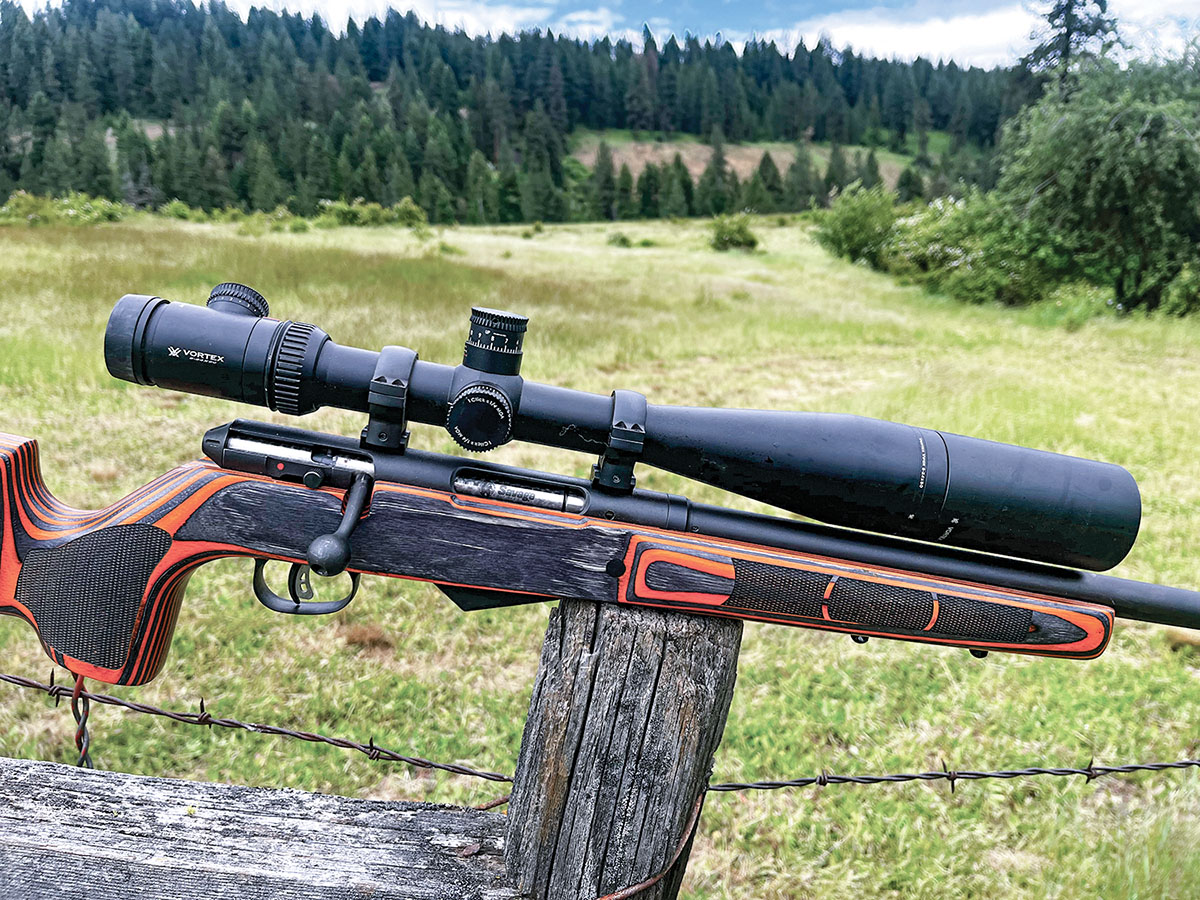
Patrick’s 17 Hornet rifle has long been topped with a Vortex Optics Viper PST 6-24x 50mm scope. This turreted, second focal plane scope includes gin-clear resolution and frog-hair-fine crosshairs ideal for varmint work.
Before the 22 Hornet (labeled 5.6x36Rmm by Europeans) varmint shooters utilized now-obsolete black-powder rounds such as the 22 WCF and 25-20 Winchester to knock off Eastern crows, groundhogs and foxes. The 22 Hornet set the small-bore, high-velocity movement into motion. It was never chambered in anything but bolt-action and single-shot rifles until recently, so it also introduced higher accuracy standards. The 22 Hornet’s ascendance was swift, and endures to this day despite a slew of ballistically superior varmint cartridges.
In the bigger-is-better hierarchy of the American psyche, it is remarkable the 22 Hornet has survived some 125 years of stiff competition, never mind remaining so widely popular. That popularity undoubtedly stems from its mild nature. The 22 Hornet is simply fun to shoot. Its quiet nature is ideal in settled areas, though I purchased my first (Savage’s Model 340 E) as a serious predator killer that wouldn’t damage hides during the raw-fur market spike of the early 1980s. Modern powders and bullets have breathed new life into the ancient cartridge.
The modernized 17 Hornet appeared in 2012, refined by Hornady after removing some case taper, sharpening the shoulder and shorting the case slightly to allow compatibility with standard 22 Hornet rifle magazines. The 17 Ackley Hornet appeared in the early 1950s, which included similar if slightly longer case dimensions. The two cartridges certainly aren’t interchangeable. The mild-mannered Hornady 17 Hornet provides trajectory on par with a 223 Remington shooting 55-grain bullets and uses only half the powder of the older 17 Remington.
As originally loaded, the 22 Hornet fired thin-jacketed 45-grain softpoints or hollowpoints pushed to around 2,100 feet per second (fps). Hercules 2400 (now Alliant 2400) pushed velocity to 2,400 fps, hence the label. Modern powders now allow 2,600 fps velocities with 45-grain bullets. That said, it has become fashionable to load polymer-tipped 35- and 40-grain bullets to 3,000 and 2,900 fps, respectively. After decades of 22 Hornet shooting, I now utilize mostly modern 40-grain polymer-tipped bullets for varmints, as they extend effective range to 300 yards.
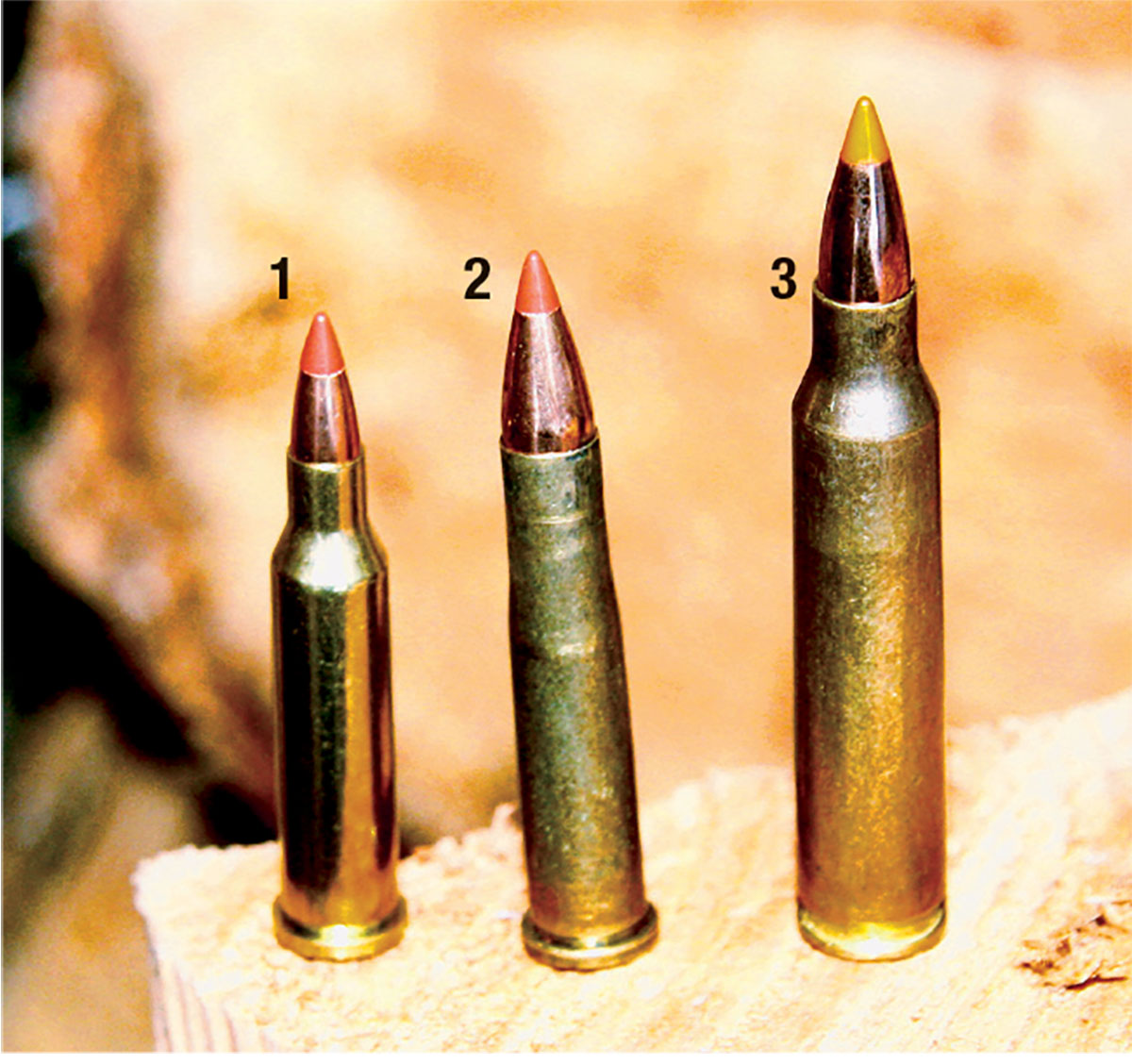
Shown here for size comparison are the: (1) 17 Hornet, (2) 22 Hornet and (3) 223 Remington. The two Hornets lack the energy delivery of the 223 Remington, but provide all the power necessary for effective small varmint shooting.
Traditional .224-caliber, 45-grain Hornet softpoints leave a typical 22-inch barrel at about 2,690 fps. By 300 yards they have slowed to 1,128 fps and dropped 19.5 inches (100-yard zero). Contemporary 35-grain poly-tipped bullets leave a 22 Hornet muzzle at 3,100 fps, but are traveling just 1,127 fps and have dropped 17.5 inches at 300 yards (100-yard zero). In contrast, a 40-grain Hornady V-MAX departing the muzzle at 2,800 fps and with a 100-yard zero is still clocking 1,698 fps and has dropped just 11 inches at 300 yards – an 8.5-inch advantage over the traditional 45-grain bullet and 6.5-inch advantage over the stubby 35-grain bullet.
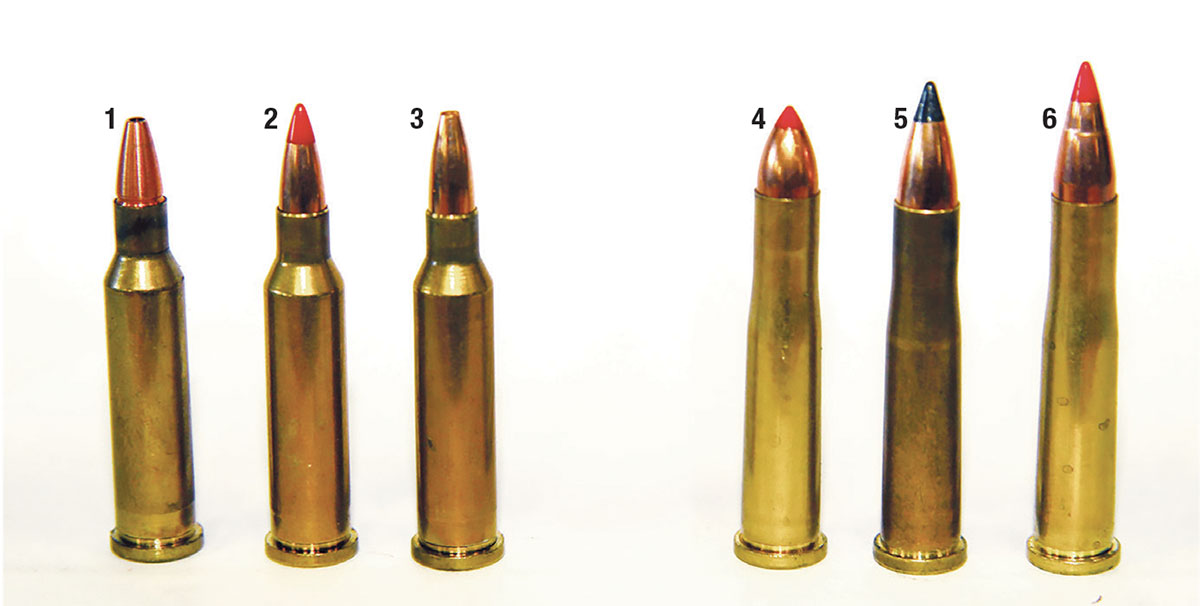
Bullets used to create Hornet loads included: (1) 17-caliber Hammer Bullets 18-grain Dead Blow, (2) Hornady 20-grain V-MAX, (3) Berger 25-grain Flat Base Varmint, (4) Hornady .22-caliber 35-grain V-MAX, (5) Nosler 40-grain Tipped Varmageddon and (6) Hornady 40-grain V-MAX.
The classic 45-grain bullet is still excellent for taking called-in coyotes inside 150 yards. The 35-grain bullets serve while sniping burrowing rodents at moderate ranges in settled areas, proving less prone to ricochets. My 22 Hornet sees a lot of action sniping high-density ground squirrel colonies in the Inland Northwest, where shooting distances range from 100 to 300 yards over agricultural fields, pastureland or clearcuts. Here, 40-grain polymer-tipped bullets rule.
Bullet selection for the 17 Hornet is generally more truncated. Seventeen-caliber bullets are available in 15.5 grains (Hornady NTX), 18 grains (Hammer Bullets Dead Blow), 20 grains (most common) and 25 grains (second most common). With this selection of bullet weights, muzzle velocities of 3,800 to 3,900 fps are possible with the 15.5-grain bullet, 3,600 to 3,700 fps with the 20 grain, and just 3,200 to 3,300 fps with the 25-grain slug. I typically forsake 25-grain bullets while targeting burrowing rodents, though I admit the extra weight provides additional reliability on tough coyotes. When loaded with 20-grain bullets, I consider the 17 Hornet a 350-yard burrowing rodent rifle on a reasonably calm day, trajectory hockey-sticking beyond that point.
Consulting my first loading manual, Speer Reloading Manual Number Nine (1974), it listed 22 Hornet powders including Hodgdon 680 (discontinued), IMR-4198 and -4227, and Alliant 2400. Those gave top speeds from 2,778 fps with 40-grain bullets to 2,732 fps with 45-grain bullets. Also note that many early loading manuals show maximum loads in excess of what you’ll find in modern load manuals. This can be attributed to the thinner walls of older Hornet cases; modern cases include beefier construction to prolong case life, thus offering lower case capacity.
Perusing modern load data (Hornady Handbook of Cartridge Reloading, 11th Edition and Sierra Rifle & Handgun Reloading Data, Edition VI), powders such as Winchester 296, Hodgdon 110 and Lil’Gun, Accurate 1680 and Ramshot Enforcer become more prevalent. These powders make velocities from 2,700 to 2,900 fps possible with 40-grain bullets and 2,600 to 2,700 fps with 45-grain pills. I’ve also experienced worthwhile results from Accurate No. 9 with 35-grain bullets, and Accurate No. 11 FS, Vihtavuori N110 and Shooters World Blackout with 40 grainers.
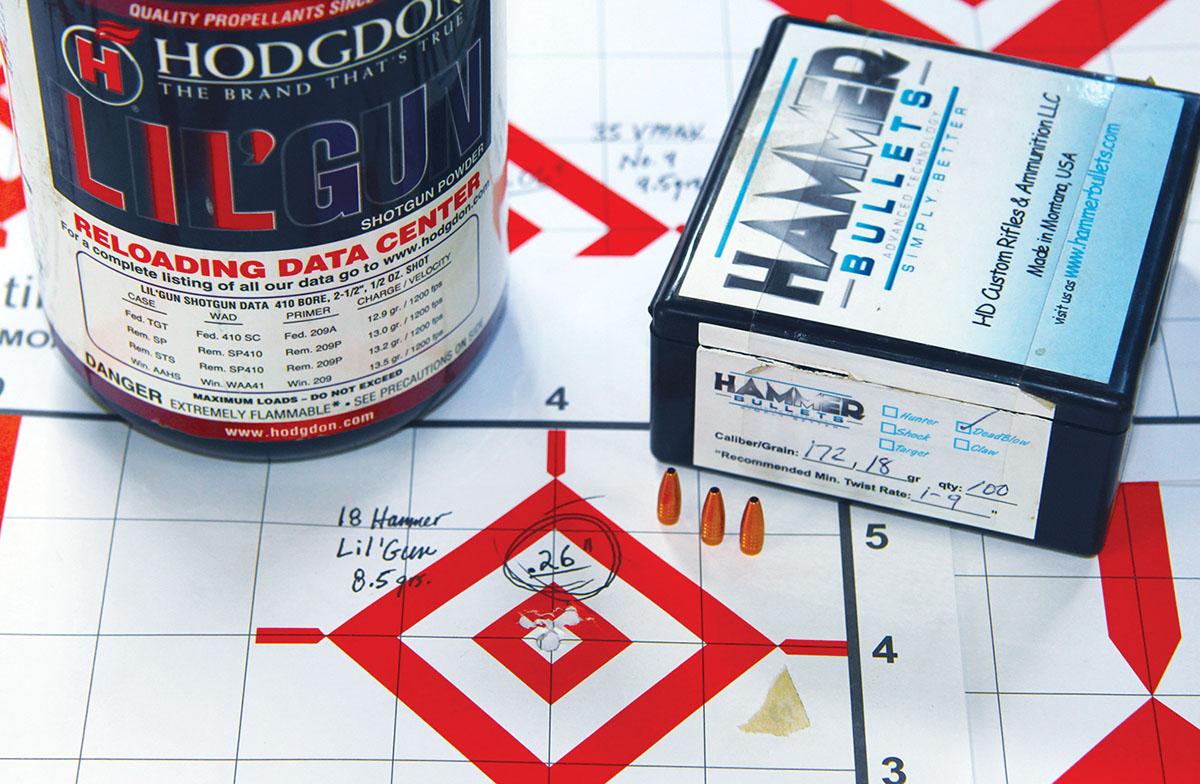
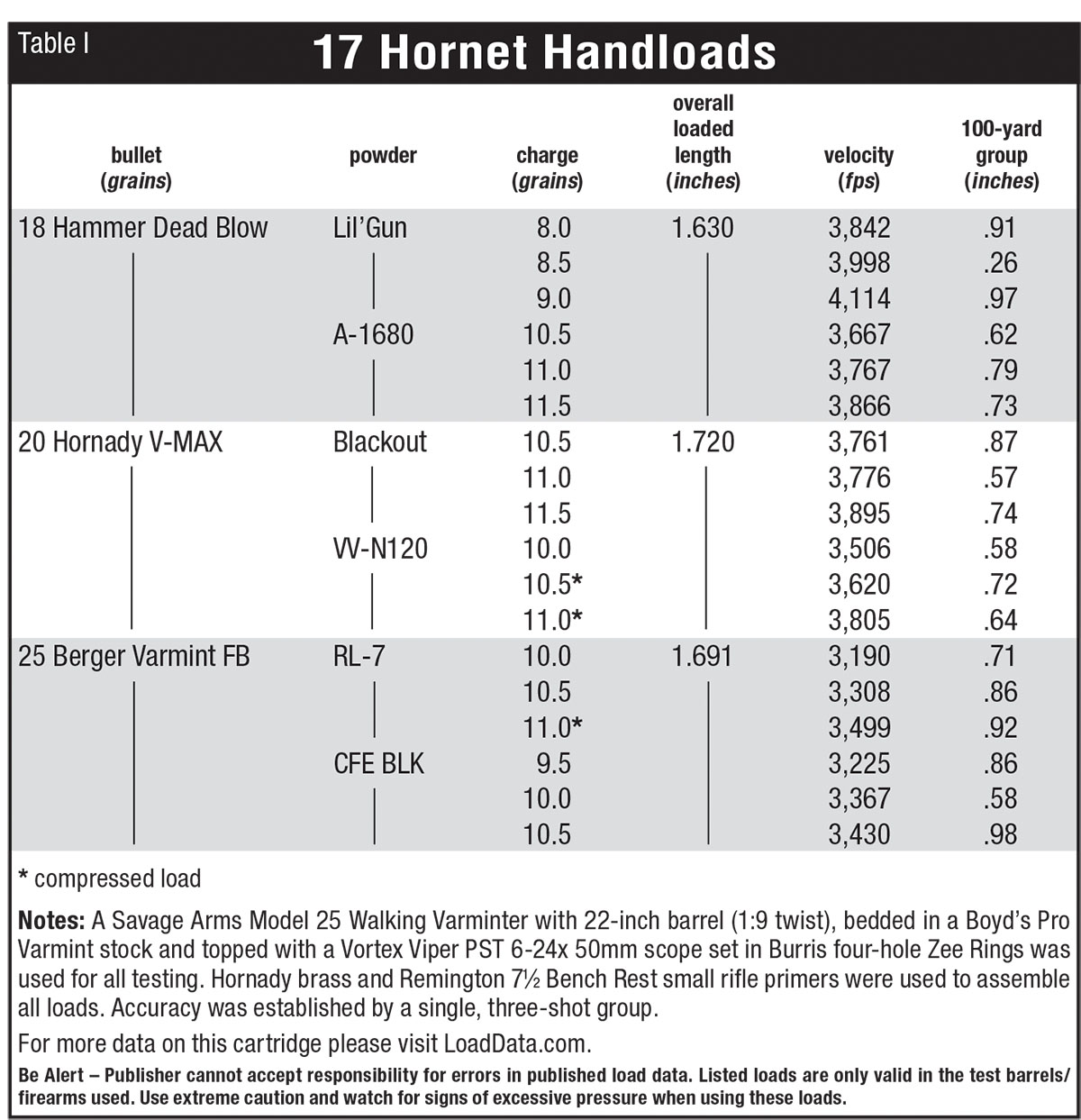
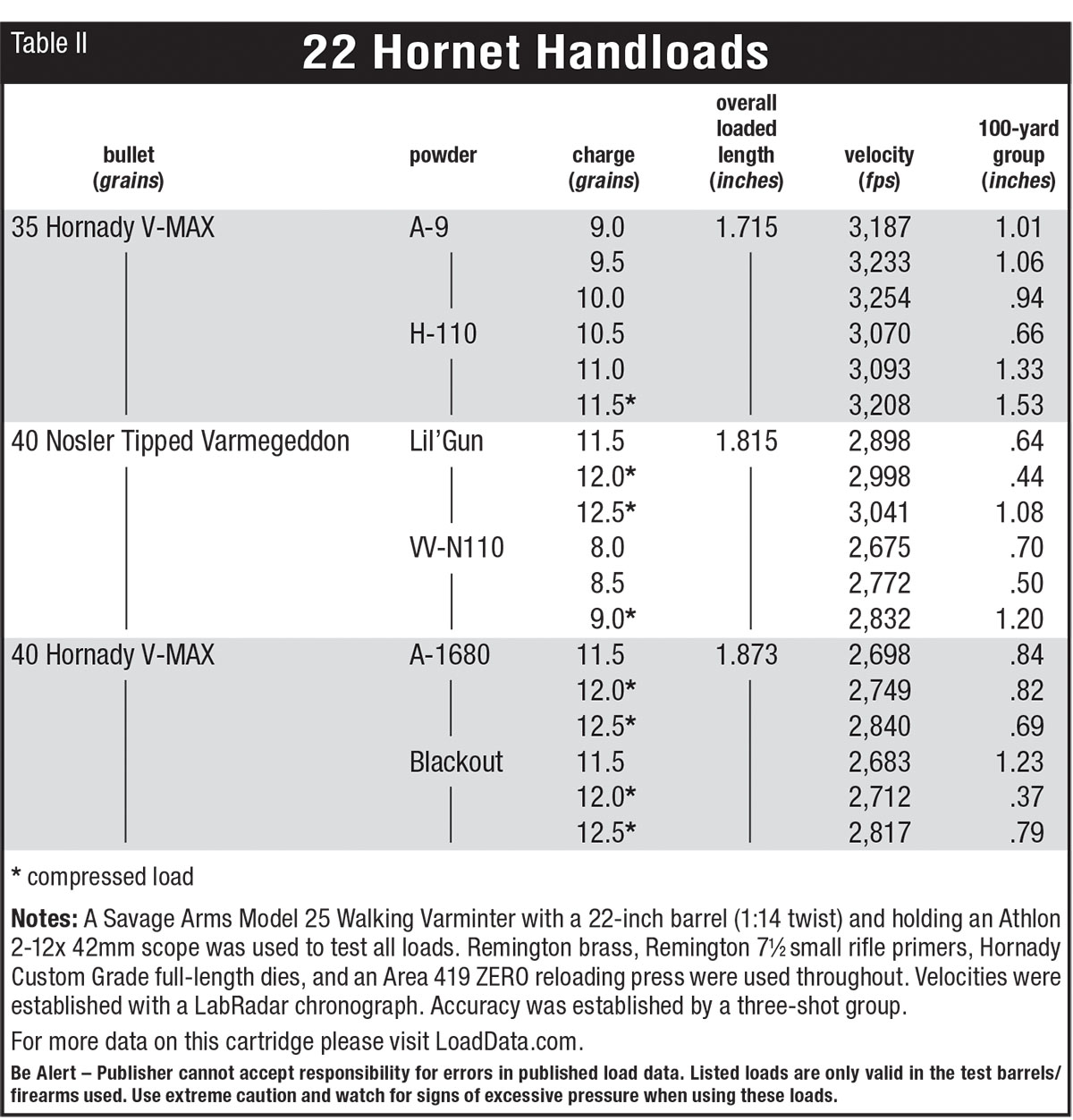
The tightest 17 Hornet group assembled by the Hammer Bullets’ 18-grain Dead Blow involved 8.5 grains of Hodgdon Lil’Gun. That group measured .26-inch and left the muzzle at a sizzling 3,998 fps.
Many of these powders also prove 17 Hornet compatible, though different chamber dynamics allow running some slightly slower powders in the 17. Hodgdon Lil’Gun remains a velocity generator in the 17 Hornet, as well as Accurate 1680. Slower-burning Vihtavuori N120,
Alliant Reloder 7,
Hodgdon CFE BLK and Shooters World Blackout are
also viable.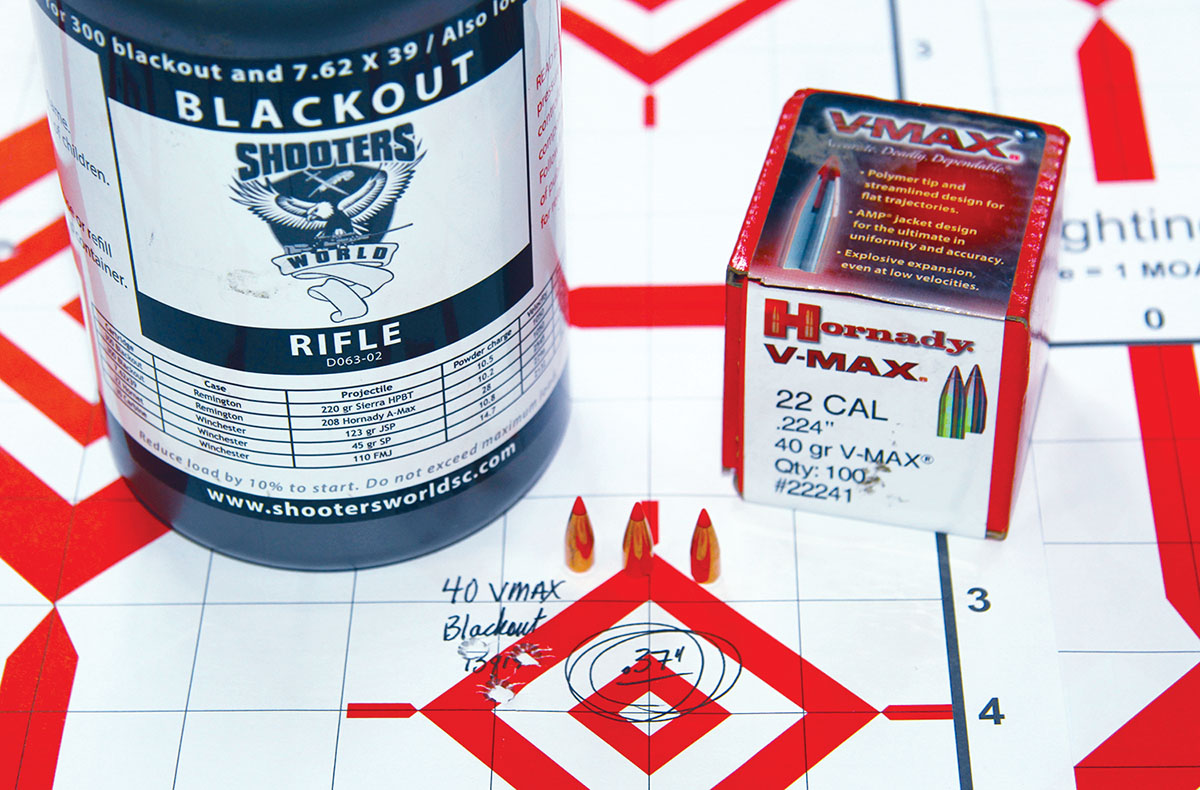
The smallest 22 Hornet group was produced by Hornady’s 40-grain V-MAX, 13 grains of Shooters World Blackout and a muzzle velocity of 2,712 fps. This load is a half grain off maximum.
For the 22 Hornet, test bullets included
Hornady’s 35-grain V-MAX (G1 BC .109),
Nosler’s 40-grain Tipped Varmageddon (G1 BC .211) and Hornady’s 40-grain V-MAX (.200). The 17 Hornet was paired with
Hammer Bullets’ 18-grain Dead Blow (estimated G1 BC .144), Hornady’s 20-grain V-MAX (.185) and
Berger’s 25-grain FB Varmint (.152).
Remington brass (trimmed to a short 1.380 inches and chamfered inside and out), Remington No. 71⁄2 Benchrest Small Rifle Primers and Hornady Custom-Grade New Dimension dies were used to assemble all 22 Hornet loads. Hornady brass (trimmed to 1.340 inches and chamfered), Remington No. 71⁄2 Benchrest Small Rifle Primers and Hornady Custom-Grade Full Length Dies were used for 17 Hornet loads. An Area 419 ZERO reloading press was used throughout.
My Hornet rifle pair are alike in all mechanical respects – differences found only in the stocks and optics paired with each. Both are Savage Arms Model 25 Walking Varmint rifles. My 22 Hornet includes its original synthetic Realtree Xtra camouflage stock and holds a
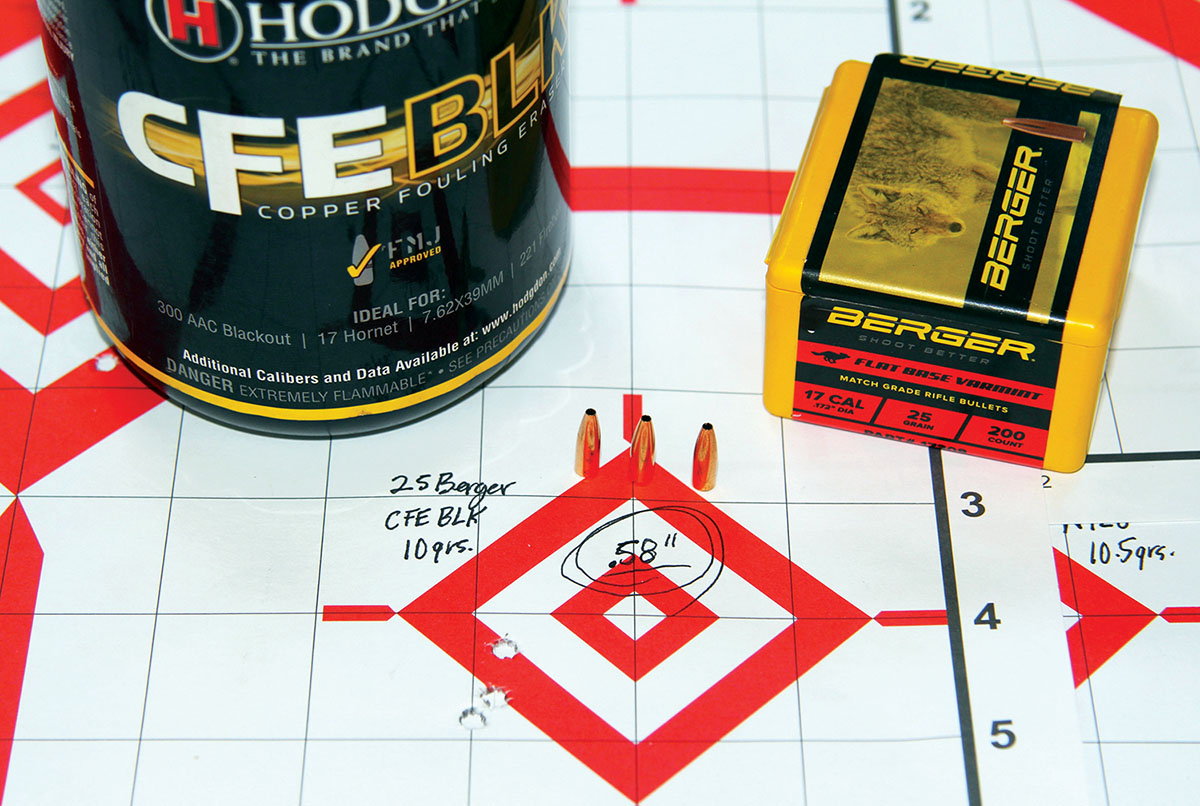
Berger’s 25-grain Flat Base Varmint bullet shot its best group using 10 grains of Hodgdon CFE BLK. That group measured .58 inch center-to-center and included a muzzle velocity of 3,367 fps.
newly-added Athlon Argos HMR 2-12x 42mm scope set on the factory-installed Weaver-style two-piece bases. My 17 Hornet was dropped into a Boyd’s Blaze Laminate Pro Varmint stock, which includes a custom 141⁄2-inch length of pull and fantastic ergonomics. It is topped with the Vortex Viper PST 6-24x 50mm scope. The factory-installed, two-piece Weaver-style bases have served well for more than a decade.
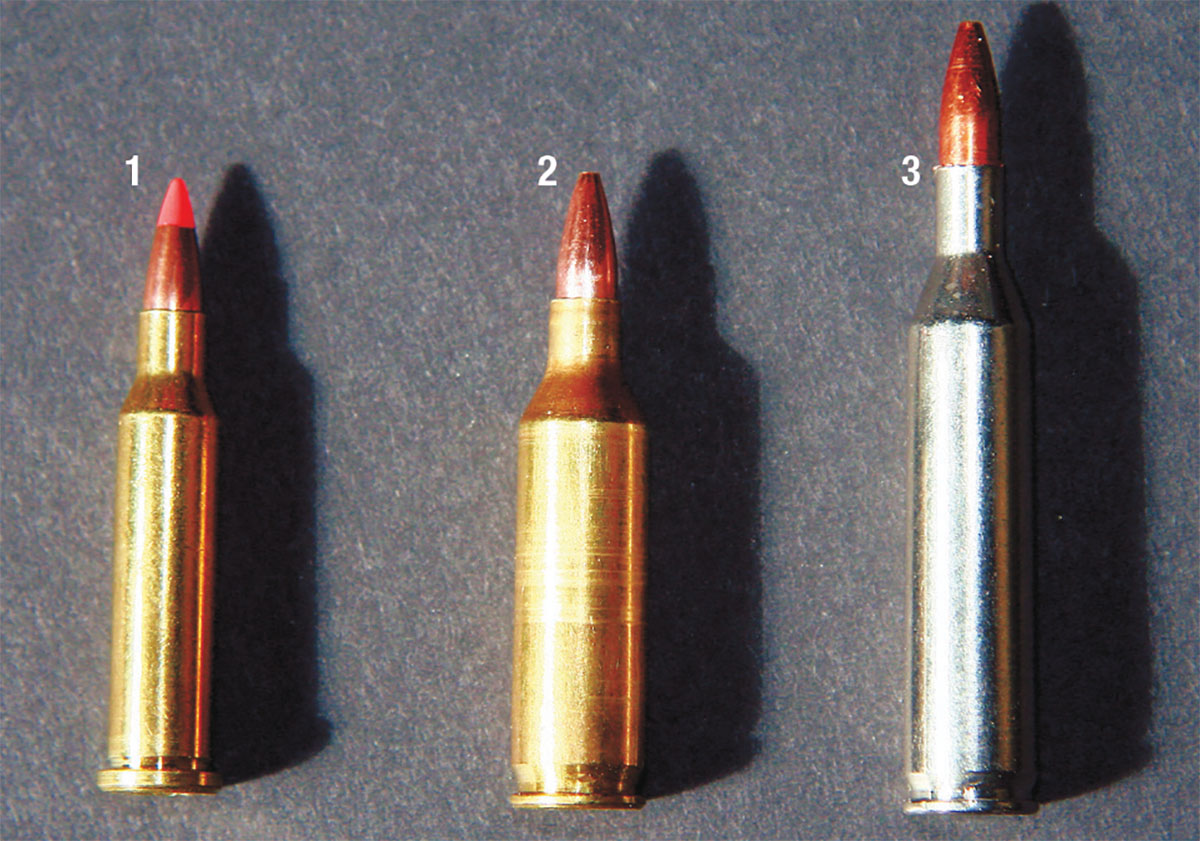
Shown for comparison are: (1) 17 Hornet, (2) 17 Remington Fireball and (3) 17 Remington. The 17 Remington is the oldest commercially available .17-caliber cartridge, the 17 Hornet the newest.
The 22 Hornet Savage M-25 Walking Varmint Camo includes an ambidextrous comb ideal for prone shooting and finger grooves of a sort in the grip. The “bottom metal,” detachable magazine, and trigger guard are all lightweight polymer. It includes a soft, ventilated recoil pad to tame the vicious recoil of the 22 Hornet… The 17 Hornet Savage M-25 Walking Varmint came with the same synthetic stock, but in plain black. Since I do more truck-based bench shooting with this rifle than walking, I swapped the light factory stock for a beefier Boyd’s Pro Varmint handle. The Pro Varmint includes a raised comb compatible with larger varmint scopes, a flat bag-rider bottom, near-vertical grip and wide forearm. It came with dual front sling studs to accommodate a bipod, plus optional laser checkering. A solid rubber recoil pad is included. Inletting is tight, and the overall effect is a steadier rifle over a bipod or bench-top rifle cradle. It proved a solid upgrade.
The Model 25 is an offshoot of Savage’s Model 40, the rimfire action replaced by a three-lug
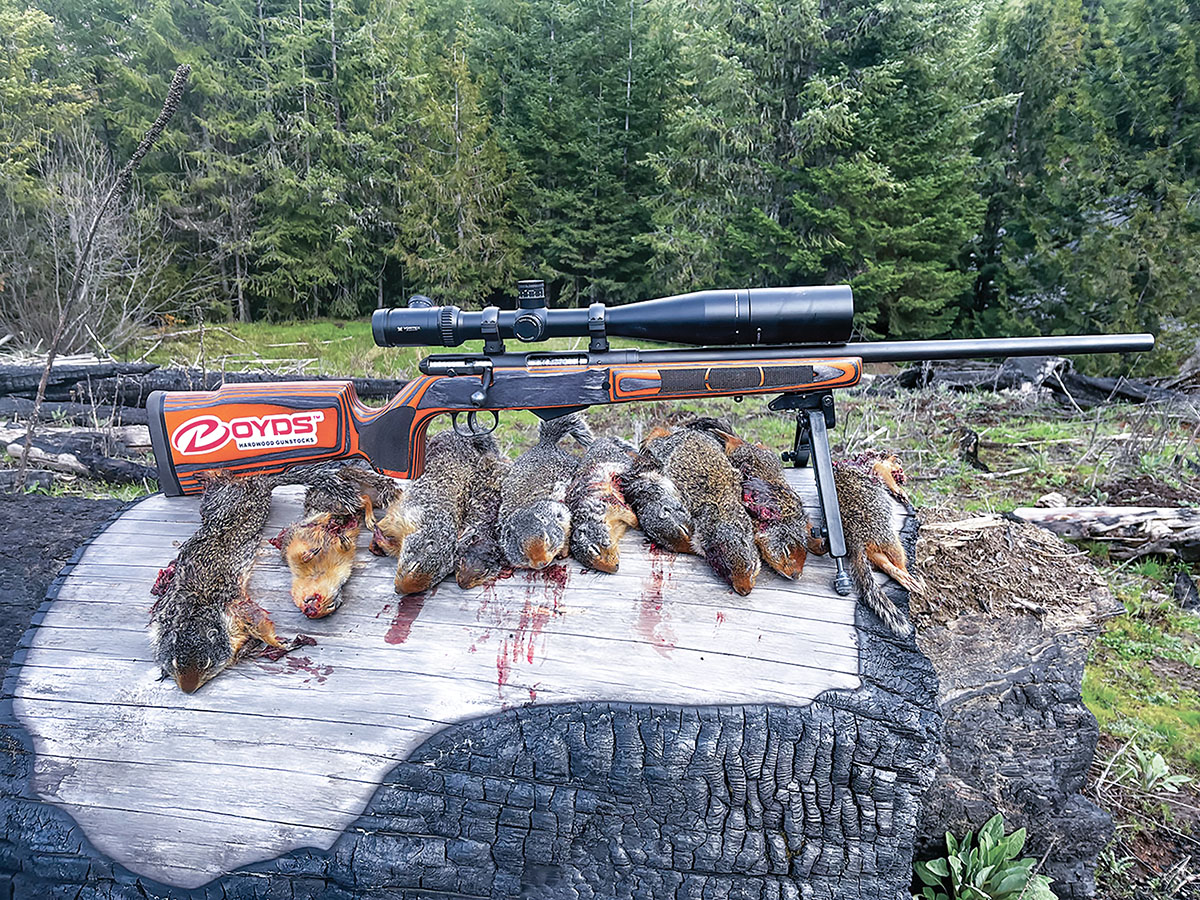
Patrick’s Savage Model 25 Walking Varmint chambered in 17 Hornet was dropped into a Boyd’s Blaze Laminate Pro Varmint stock with custom 141⁄2-inch length of pull. It is topped with a Vortex Optics Viper PST 6-24x 50mm scope.
centerfire bolt with 60-degree throw allowing unimpeded cycling around modern scopes with large ocular bells. This also allowed chambering rounds like the 204 Ruger and 223 Remington, as well as the 17 and 22 Hornets I own. They hold free-floated, medium-contour barrels and actions are pillar bedded. The bolt measures .635-inch in diameter, and includes a Sako-style extractor and pin ejector inside the bolt face. A spring mechanism is located behind the locking lugs to fill the chamber when the bolt is in full battery. Model 25 receivers include gas relief ports left and right.
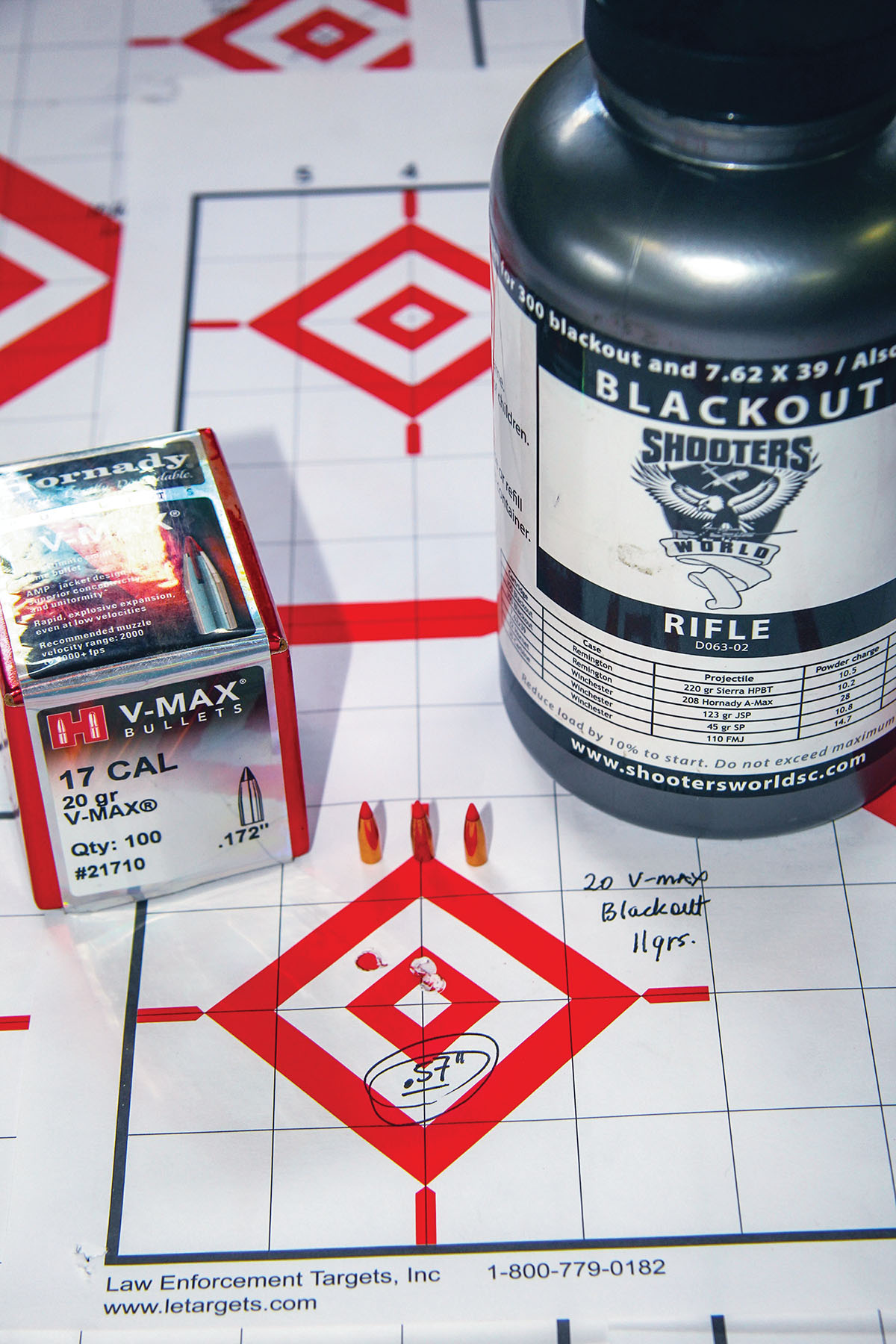
Eleven grains of Shooters World Blackout and Hornady’s 20-grain V-MAX produced this .57-inch group from the 17 Hornet. Muzzle velocity was 3,776 fps. Blackout also produced tight grouping in the 22 Hornet.
The bolt is removed by pulling the trigger after the bolt is pulled fully rearward, and the two-position safety is located behind the bolt handle. The trigger is Savage’s center-blade Accu-Trigger design – allowing light, user-adjustable trigger pulls without exciting anxiety from lawyers. Both of my M-25 triggers are adjusted to break at 21⁄2 pounds.
The barrels and actions received a matte finish. Barrels are sleeved into the receiver to be streamlined. Walking Varmints hold 22-inch barrels with a .710-inch diameter at the target-crowned muzzle. The detachable magazine holds four rounds and clicks into place positively, while also feeding slickly. The round action and side ejection port do not accommodate easy single feeding. Checking current prices, new black-stocked Walking Varmints sell for around $503, on average, and the Camo version for around $547. I paid $100 less for both of mine, new, but a few years have passed since those purchases.
Using my two Hornets for frequent high-volume varmint shooting, I’ve developed a single load for each. In the 17 Hornet, 12 grains of Accurate 1680 beneath a 20-grain Hornady V-MAX and a muzzle velocity around 3,650 fps has proven highly accurate and varmint effective to 350 yards (on a calm day and using a turret scope). In my 22 Hornet, 11.3 grains of Winchester 296 paired with a Hornady 40-grain V-MAX and a muzzle velocity around 2,800 fps has proven especially accurate and devastating on burrowing rodents to 300 yards.
In this series I wanted to audition some new combinations, particularly powders I’d yet to try: Vihtavuori N120, Alliant Reloder 7 and Hodgdon CFE BLK with the heavier 17 Hornet bullets, Accurate No. 9 in the 22 Hornet loaded with the 35-grain bullet and Shooters World Blackout with the 40-grain V-MAX. The 18-grain Dead Blow and 25-grain Berger FB Varmint in the 17 Hornet, and 40-grain Nosler Tipped Varmegeddon in the 22 Hornet are new to me in these rifles.
Tiny Hornet case capacities make them primer-finicky. Audition several makes to find an ideal, some even finding small pistol primers the most accurate. I long ago found Remington’s No. 71⁄2 Benchrest primer gives me the best accuracy. It’s vitally important to keep cases evenly trimmed, particularly the 22 Hornet, whose sloping shoulders promote faster case flow. You’ll notice my 22 Hornet trim-to lengths are shorter than recommended. This is to prevent seating long-for-caliber bullets past the beginning of the ogive – the Hornet’s long neck providing plenty of latitude. All powder charges must be tediously weighed, small discrepancies turning into large percentages when throwing charges in the 9- to 11.5-grain range. I’ve also found that seating longer 22 Hornet bullets to just kiss the lands can result in greater accuracy, helping to better center rounds in the chamber of a cartridge that headspaces largely off the rim (the 17 Hornet headspaces off the shoulder).
While many varmint shooters go all in on long-range fire breathers like the modern 22 Creedmoor or venerable 220 Swift, the Hornets retain a dedicated following of varminteers who understand shooting into the next zip code isn’t always what varmint shooting is about. If we were being completely honest, the vast majority of the small varmint shooting we enjoy occurs at less than 300 yards – distances for which the pleasant and economical Hornets are well equipped. This is why I still cherish mine, despite owning many rifles chambered in much faster varmint cartridges.