

25 Creedmoor Varmint Loads
How does the long-range wonder handle the newest varmint bullets?
feature By: Patrick Meitin | November, 26
I understand there are many shooters who have a lasting affection for quarter-bore cartridges, but I’ll also admit that when I first learned of the 25 Creedmoor I didn’t really see the point. It first came onto my radar via a Wolfe Publishing Handloader magazine “Wildcat Cartridges” column by Richard Mann (Handloader No. 307, April-May 2017). In that column, Mann talked about necking the popular 6.5 Creedmoor to .257 caliber, with no other changes. Mann called it the 250-Hillbilly, which first appeared in 2015. With the 250 Savage in circulation since 1913, and the 257 Roberts since 1934, that skepticism appeared quite valid.
What I missed was that the 25 Creedmoor would change .257-caliber bullet dynamics forever.
To understand that statement, a little history is in order. Twenty-five caliber bullets have long been noted for poor ballistic coefficients (BC), which was really a function of traditional 1:10 rifling twists more than the cartridges themselves. Take something like the 25-06 Remington or 257 Weatherby Magnum, which should be long-range juggernauts, and you are hit with the pointed reality that a .450ish G1 BC is about as far as you will ever be able to push things. Common 6.5mm and 7mm projectiles commonly include G1 BCs in the .600-plus range, which retain velocity and energy better at longer ranges by slipping through the atmosphere more efficiently.
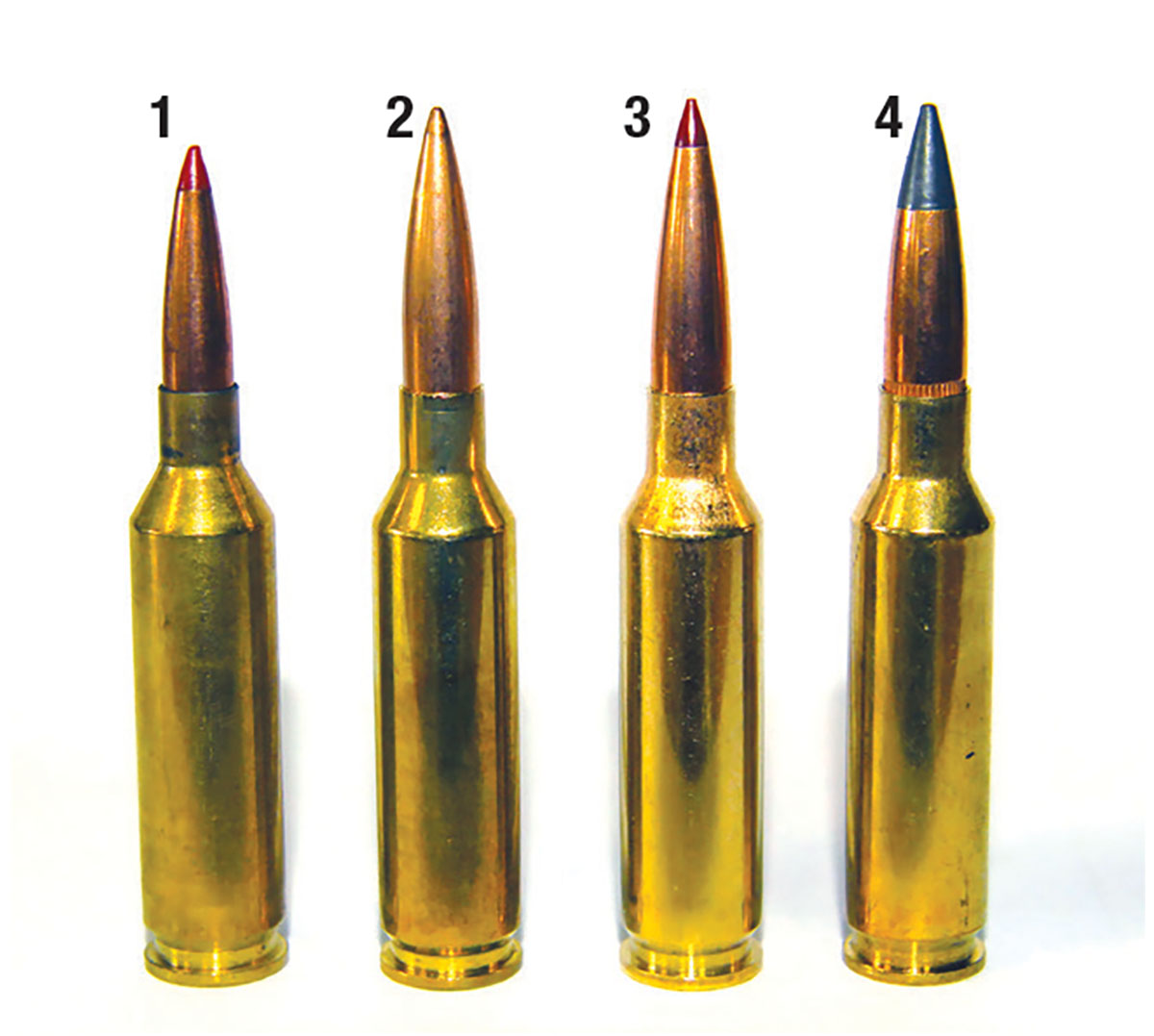
Taking my love-worn 25-06 Remington as an example, I have just a handful of bullets to choose from that will meet or slightly beat the .450 G1 BC threshold. What the 25 Creedmoor introduced was not only barrels with faster 1:7.5 twist rates, but bullets from Berger, Sierra and Hornady (for the time being) carrying G1 BCs of .613 (Berger 133-grain Elite Hunter), .633 (Hornady 128-grain ELD-X), .650 (Berger Long Range Hybrid Target) and .695 (Hornady 138-grain A-Tip Match). Sierra’s new 131-grain Tipped GameKing (TGK) has not yet been given a BC. This allows the 25 Creedmoor to easily mirror 6.5 Creedmoor ballistics, flattening trajectory and minimizing time in flight at longer distances to produce narrower wind-drift margins. Hornady was instrumental in optimizing throat and chamber geometry and pushing the cartridge through SAAMI (Sporting Arms and Ammunition Manufacturers’ Institute) acceptance in 2025.
So, that is the point of the 25 Creedmoor. A .257-caliber cartridge specifically designed to stabilize the newest long-for-caliber, low-drag bullets while also functioning in true short-action rifles. Take Hornady’s 128-grain ELD-X bullet fired from the 25 Creedmoor and their 143-grain ELD-X (.625 G1 BC) sent from a 6.5 Creedmoor, and the
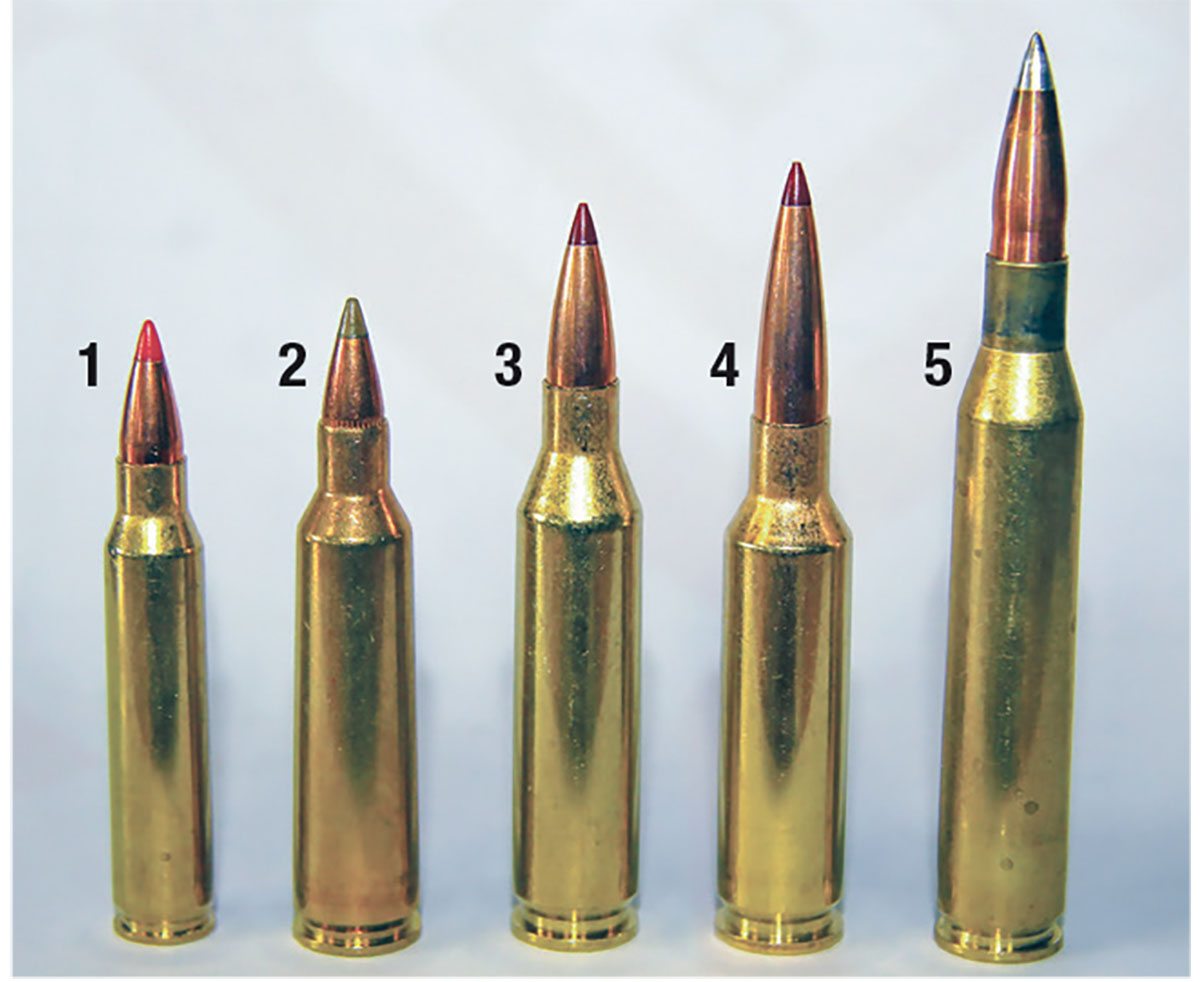
two produce drop and wind-drift margins within single-digit inches of one another (the 25 Creedmoor providing a slight advantage).
The new high-BC .257-caliber bullets have even got me to thinking about rebarreling my 25-06 Remington, which then got me to thinking about the 25 Creedmoor as a varmint cartridge. I have shot a decent number of prairie dogs and rockchucks with my 25-06 during windy days, which includes recoil that admittedly becomes annoying about 100 rounds in. The 25 Creedmoor, on the other hand, is a real pussycat, even with the heaviest .257-caliber bullets.
Like shooting 55- to 65-grain bullets from a 22 ARC, or 69- to 75-grain bullets from a 22 Creedmoor, both with fast-twist barrels, I see varmint potential in the 25 CM. Let’s say 75- to 95-grain varmint bullets at the light end, with a thin-skinned 135-grain Berger target bullet tossed in for extreme-range rockchucks or coyotes taken in excess of 400 yards. Such bullets are readily available in .257 caliber, with at least two completely new varmint-centric options coming on line this year.
Cases for the 25 Creedmoor are easily formed from abundantly available 6.5 CM or 6mm CM brass, simply running them through a 25 CM full-length sizing die and trimming to 1.910 inches. Properly headstamped brass is available from Hornady (Large Rifle Primers/LRP), Alpha Munitions (Small Rifle Primers/SRP) and Peterson Cartridge (LRP). All bullets selected carry G1 BCs higher than standard-issue 50- to 55-grain varmint bullets typically loaded in 22-250 Remington or 220 Swift cartridges shot from rifles including traditionally slow twist rates. Compatible powders range from Hodgdon Varget and Winchester StaBALL Match to Vihtavuori N555 and Hodgdon 4831sc. RCBS full-length dies were utilized for all loading.
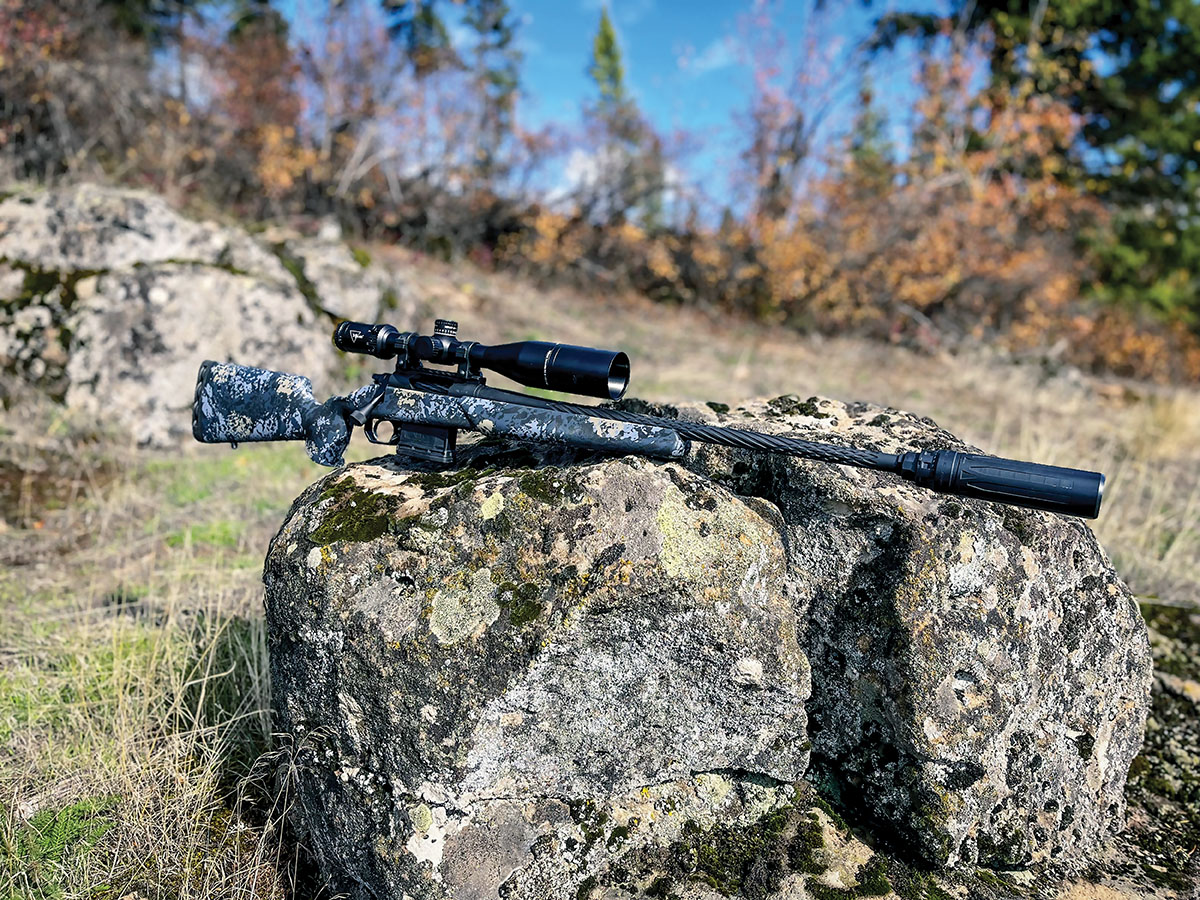
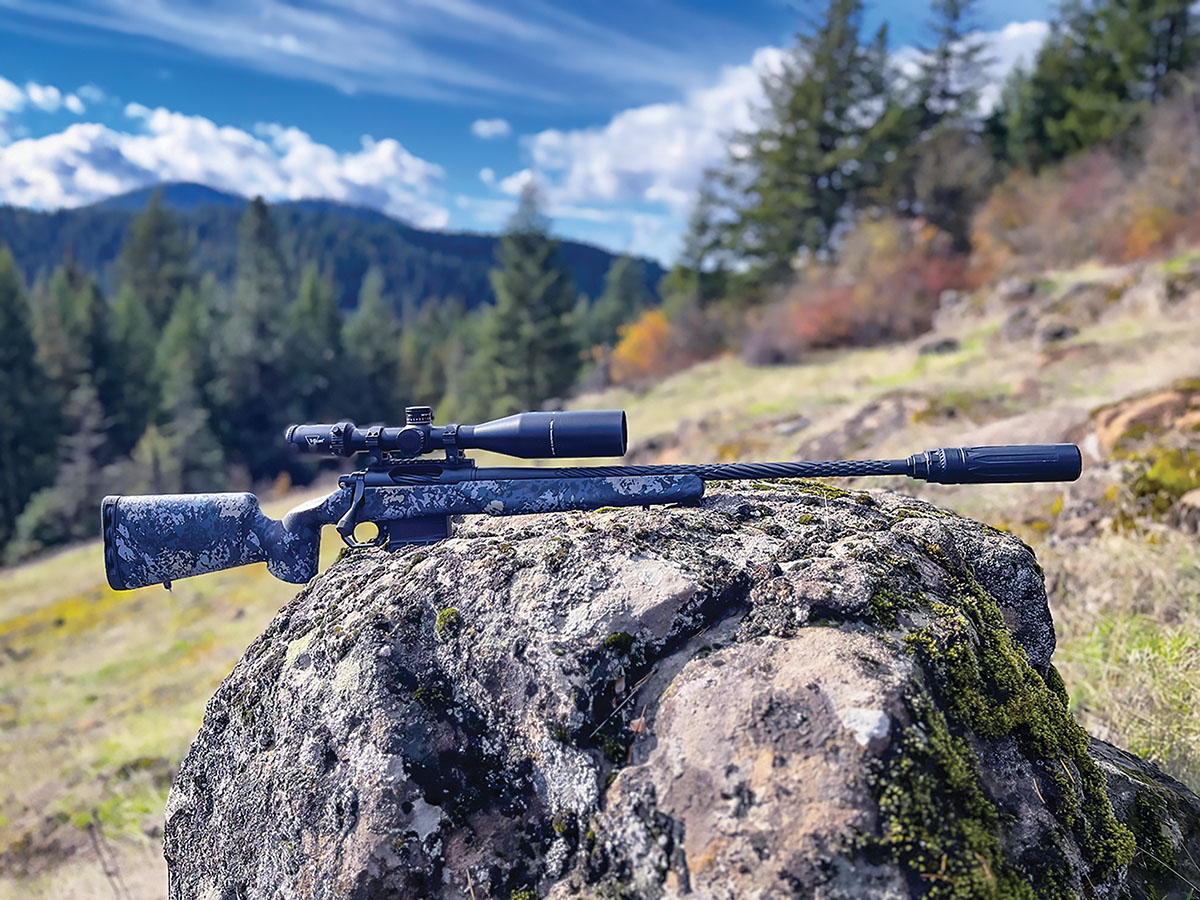
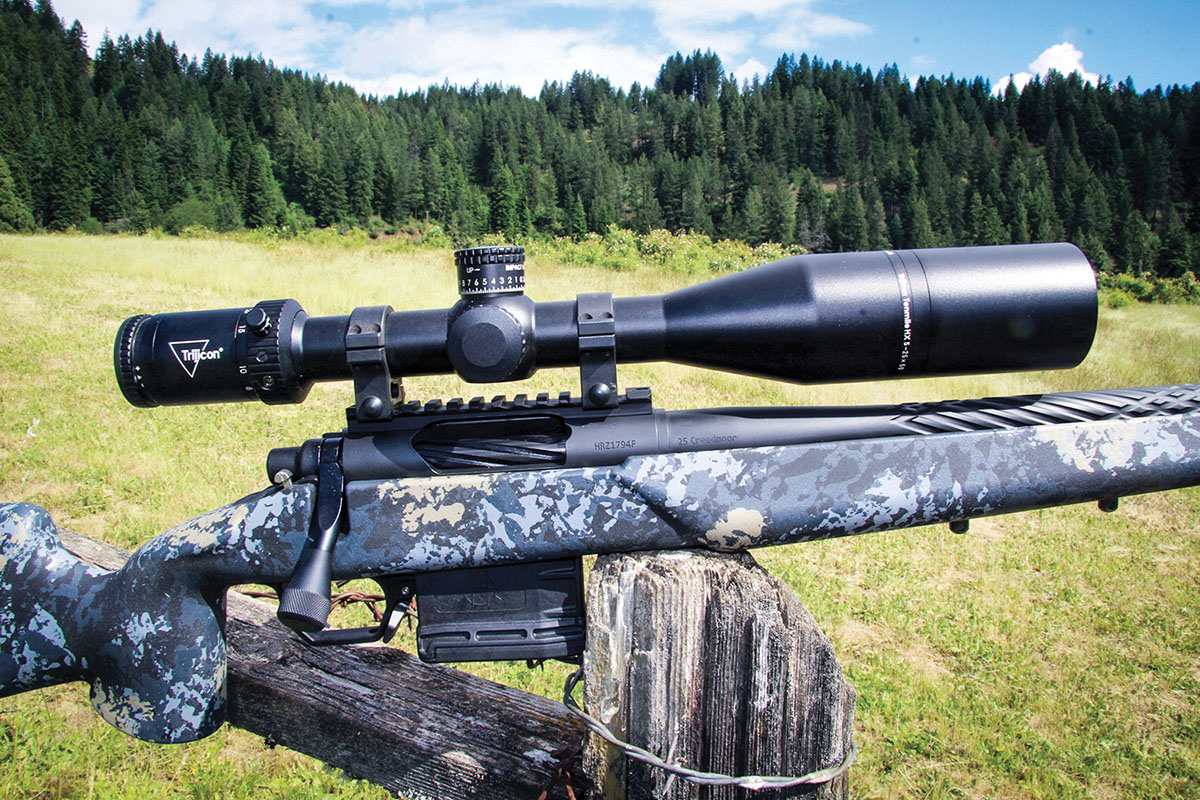
The test rifle was Horizon’s Vandal Prime, which is part of the company’s Core series. In addition to the new 25 Creedmoor, the Vandal Prime can be ordered in 22 Creedmoor and 6mm Creedmoor, as well as several popular big-game rounds. In the 25 Creedmoor, the Vandal Prime holds a 22-inch barrel with 1:7.5 rifling twist and 5⁄8x24 muzzle threads. The barrel is milled from 416R stainless steel to include snazzy three-flute/two-twist fluting, which effectively promotes faster cooling following
prolonged shot strings. It comes with an iota SIM muzzle brake. The action is a Stiller milled from 416R stainless steel, the stock a carbon iota Outdoors EKO texture-painted Midnight Grey, and the trigger is by TriggerTech. It comes with a 20-MOA Picatinny rail installed. Out of the box, the Vandal Prime weighs 7 pounds, 4 ounces. It comes with a 1⁄2-MOA accuracy guarantee and retails for $2,999.
The Vandal Prime includes a triple-pinned recoil lug and bottom metal manufactured in-house. The barreled action receives a KG Gun Kote finish. Cartridges feed reliably from a detachable polymer, five-round magazine. The user-adjustable, single-stage TriggerTech trigger broke crisply at 2 pounds, 2 ounces. The iota carbon fiber stock is pleasantly ergonomic, including a vertical grip, ambidextrous palm swells and thumb ledges, and a wide forend. Dual sling studs and a custom AirTech recoil pad molded from LimbSaver’s NAVCOM material are also part of the stock’s makeup.
Trijicon’s Tenmile HX 5-25x 50mm scope provided the ideal match for the 25 Creedmoor cartridge and Vandal Prime rifle. The scope was set in Trijicon four-screw steel rings. The scope is 14.25 inches long and weighs 28.8 ounces. It is a first focal plane (FFP) scope with an MOA-ranging reticle, backed by exposed turrets with an excellent zero stop system.
The MOA turrets provide standard 1⁄4-inch-at-100-yard movements. Trijicon’s top-quality, fully multi-coated, broadband, anti-reflective glass provides exceptional light transmission, sharp detail and true color fidelity with zero distortion and complete edge-to-edge clarity. The one-piece 30mm tube provides 50 MOA of elevation and 40 MOA of elevation movement. The side parallax dial is sandwiched beneath a user-selectable LED illumination dial. A 31⁄2-inch sunshade and spring-loaded Tenebraex flip caps are part of the package. Adding the scope brought finished rifle weight to slightly more than 10 pounds.
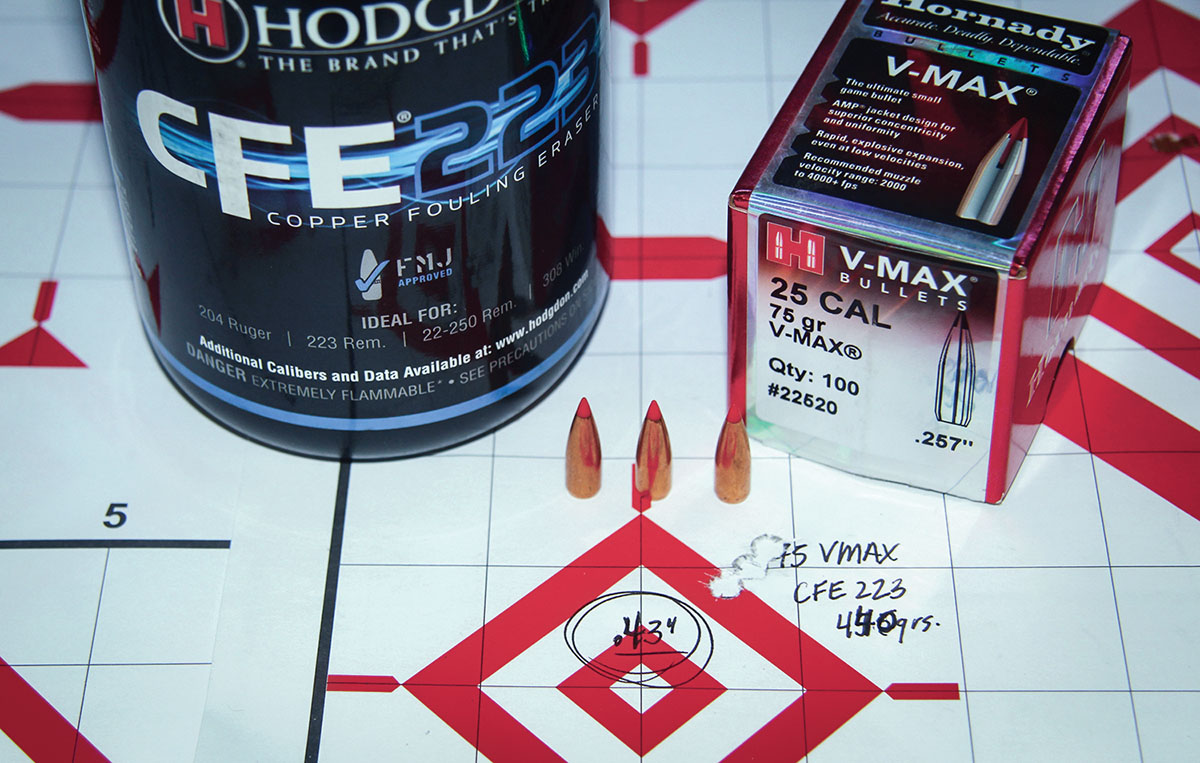
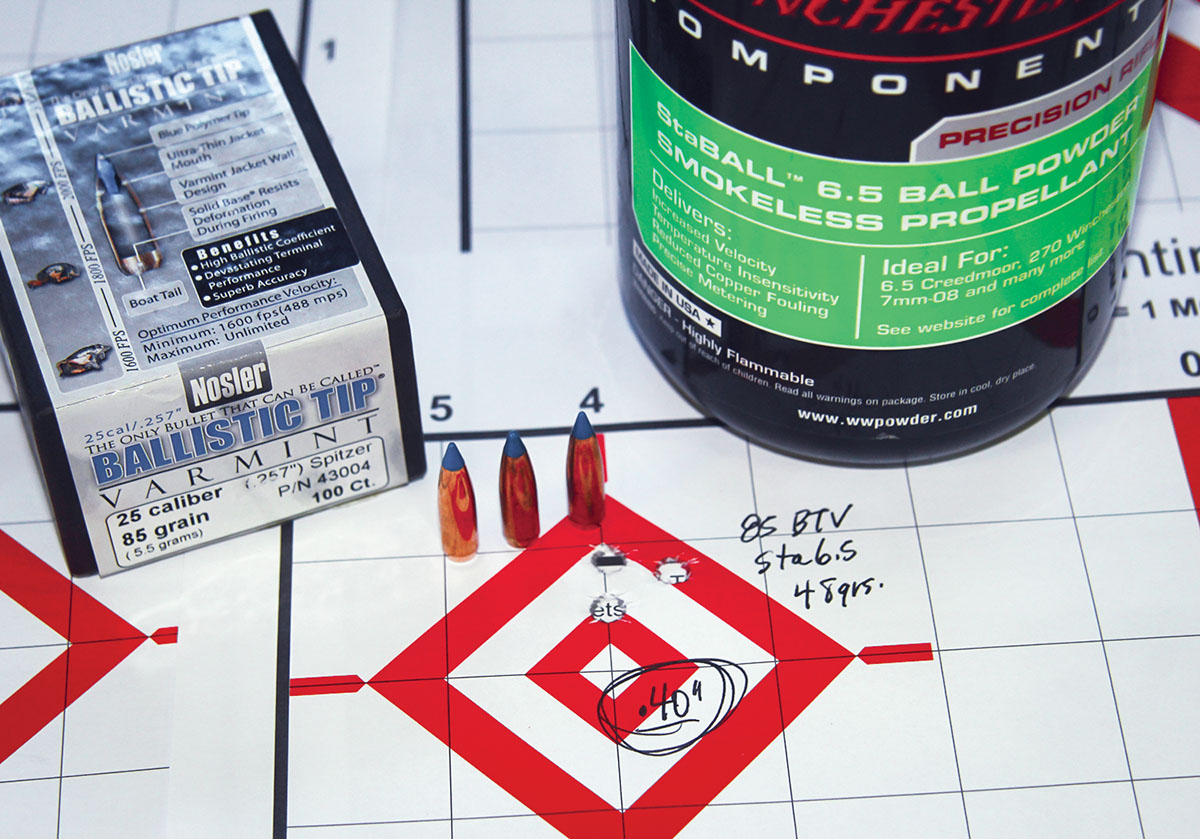
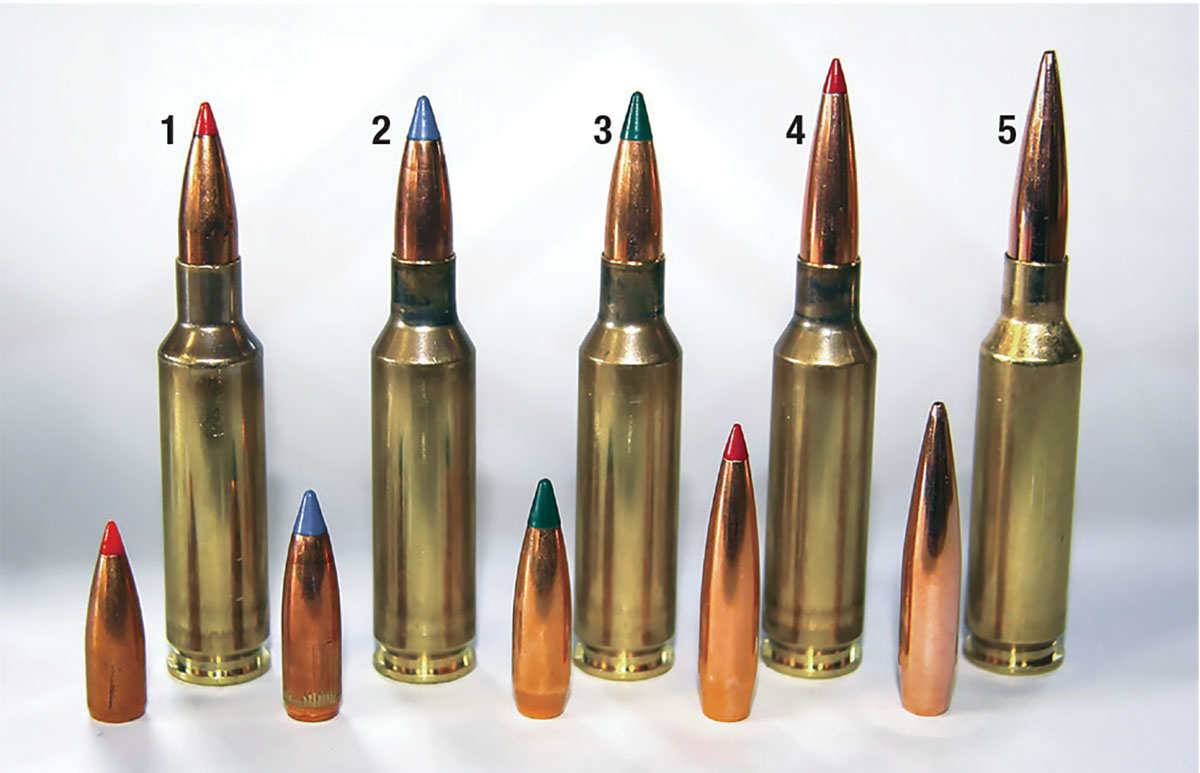
For .25-caliber varmint bullets, Hornady’s 75-grain V-MAX and Nosler’s 85-grain Ballistic Tip Varmint seemed an ideal place to start. These are consummate varmint bullets that I keep on hand for my 25-’06 Remington. Both have proven accurate and produce dismantling impacts on small varmints. The 75-grain .257-cal V-MAX includes an abbreviated boat-tail and signature red polymer tip to bring G1 BC to .290. It was paired with Alliant Reloder TS 15.5, Hodgdon CFE 223 and Winchester StaBALL Match. Nosler’s 85-grain Ballistic Tip Varmint includes a boat-tail and blue polymer tip creating a .329 G1 BC. The Nosler was set up with Hodgdon Varget, Vihtavuori N540 and Winchester StaBALL 6.5.
The 2.581-inch overall loaded length used to minimize the jump into the lands with the 75-grain bullet meant less than .257-inch of bullet pushed inside the case neck. This minimized neck tension, but accuracy proved worthwhile, providing a .72-inch overall group size. One problem encountered occurred with Hodgdon CFE 223 – the fastest powder tested with this bullet. When velocities exceeded about 3,675 feet per second (fps), bullet failure due to the high velocities combined with fast rifling twist occurred. With Nosler’s example, the rifle, seating depth, or powders chosen just didn’t prove compatible. This resulted in a 1.14-inch overall group average – the largest of the entire test.
The newest .257-caliber varmint bullets were represented by Sierra’s new 90-grain VarmintKing (formally BlitzKing) and Hornady’s 95-grain ELD-VT. Anyone who has taken the time to read this far is undoubtedly familiar with BlitzKing bullets, the new 90-grain VarmintKing including a pronounced boat-tail and signature green acetyl tip
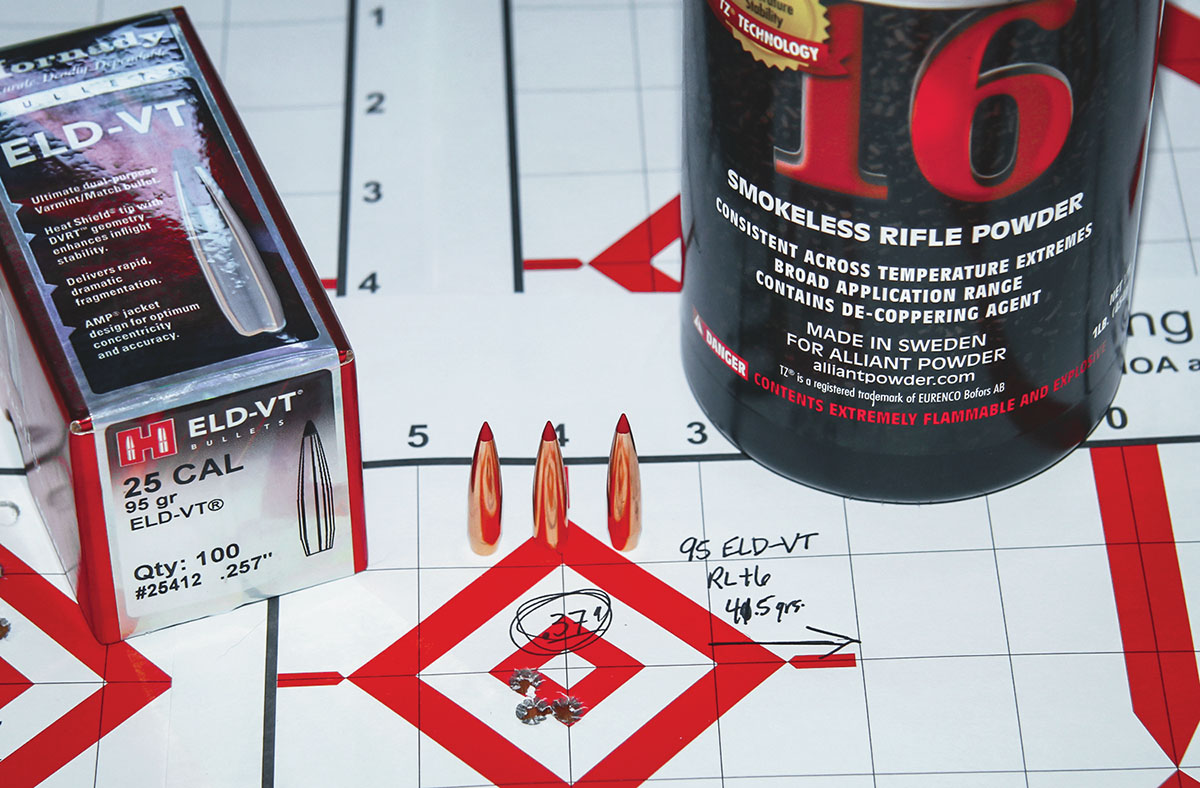
to produce a .388 G1 BC. The Sierra was fueled by Ramshot Big Game, Hodgdon LEVERevolution and Winchester 760. The 95-grain ELD-VT is part of Hornady’s new series of varmint bullets designed to combine maximized BC with aggressive bullet expansion. An ELD boat-tail and DVRT geometry Heat Shield tip that resists aerodynamic heat deformation gives this bullet a notable .453 G1 BC. Hodgdon 4350, Alliant Reloder 16 and Power Pro 2000-MR were selected for the ELD-VT. The Sierra provided the smallest group of the entire test by far, but also some unimpressive groups. Overall, the Sierra racked up a .93-inch overall group average with the powders auditioned. The ELD-VT proved the most consistent of the bullets tested, which, while not assembling the smallest groups of the test, did provide the smallest overall group average of .64 inch. Some seating-depth juggling would undoubtedly result in some sub-1⁄4-inch groups.
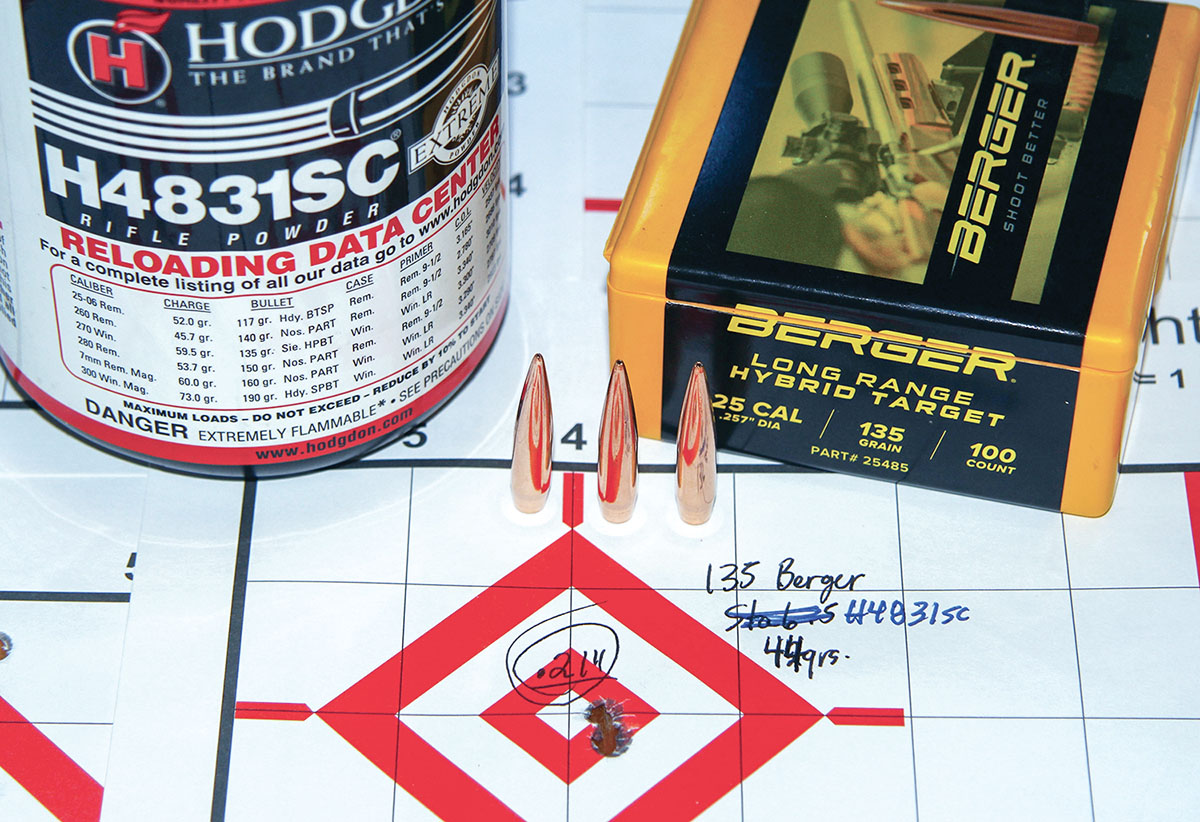
For those who truly want to challenge their long-range skills, I included Berger’s new 135-grain Long Range Hybrid Target bullet. Berger target bullets have traditionally expanded well on even small varmints, so I suspect this one will as well. Berger’s renowned accuracy, the hybrid ogive’s forgiving nature and a .650 G1/.334 G7 BC make this bullet ideal for the longest shots possible. It was paired with Hodgdon Superformance, Hodgdon 4831sc and Vihtavuori N555. The Berger showed some real potential with a sub-1⁄4-inch group, but as in previous testing, proved somewhat finicky. It produced a .98-inch overall group average. I suspect more accuracy could be wrung out of this bullet by auditioning various seating depths.
I have conducted some fairly extensive load development with light bullets combined with fast twist rates in cartridges like the 22 and 6mm ARC, so the results here didn’t come as a surprise. Some bullet failure is to be expected in these scenarios when velocity passes a certain threshold in relation to the fast rifling twist. When bullets do hold up, the results on target are utterly spectacular, all that bullet spin turning into a blender upon impact with varmints. Even marginal hits turn into DOA burrowing rodents.
I’m continually impressed by resulting light-bullet accuracy, given the necessarily longer jump into the lands these bullets introduce. Yet we found plenty of useable accuracy with the tested varmint bullets. That .43-inch at 3,594 fps 75-grain V-MAX load (44 grains Hodgdon CFE 223) would prove a serious red-mist generator. Despite the test rifle’s general dislike of the Nosler 85-grain Ballistic Tip Varmint, we still discovered a .40-inch at 3,415 fps load (48 grains Winchester StaBALL 6.5), providing an awesome long-range rodent dismantler with that bullet. The newer Sierra 90-grain VarmintKing and Hornady 95-grain ELD-VT options provided the most consistent true varmint-bullet results. I mean, you’re not going to do any better than a .13-inch at 3,166 fps group (42 grains Ramshot Big Game) formed with the VarmintKing, and that .37-inch at 3,063 fps (41.5 grains Alliant Reloder 16) ELD-VT load is nothing to get snooty about. The .21-inch at 2,884 fps Berger 135-grain Long Range Hybrid Target load (44 grains Hodgdon 4831sc) is the best result I’ve experienced with that bullet to date. I can’t imagine a better 400-plus-yard rockchuck or coyote option, though I’m not certain what that big bullet will do to a coyote pelt.
The 25 Creedmoor serves as the newest option for the one-gun shooter seeking a cartridge that is as at home on prairie dog plains as it is in the whitetail woods or on a mule deer ridge. That said, I would also argue that the 25 Creed better serves as a big-game rifle than any of the 6mm rounds that have traditionally fulfilled that role. I say this as an enduring 243 Winchester fan ...
House in the Woods and Timber Creek Outdoors Veteran Varmint-Shooting Retreat
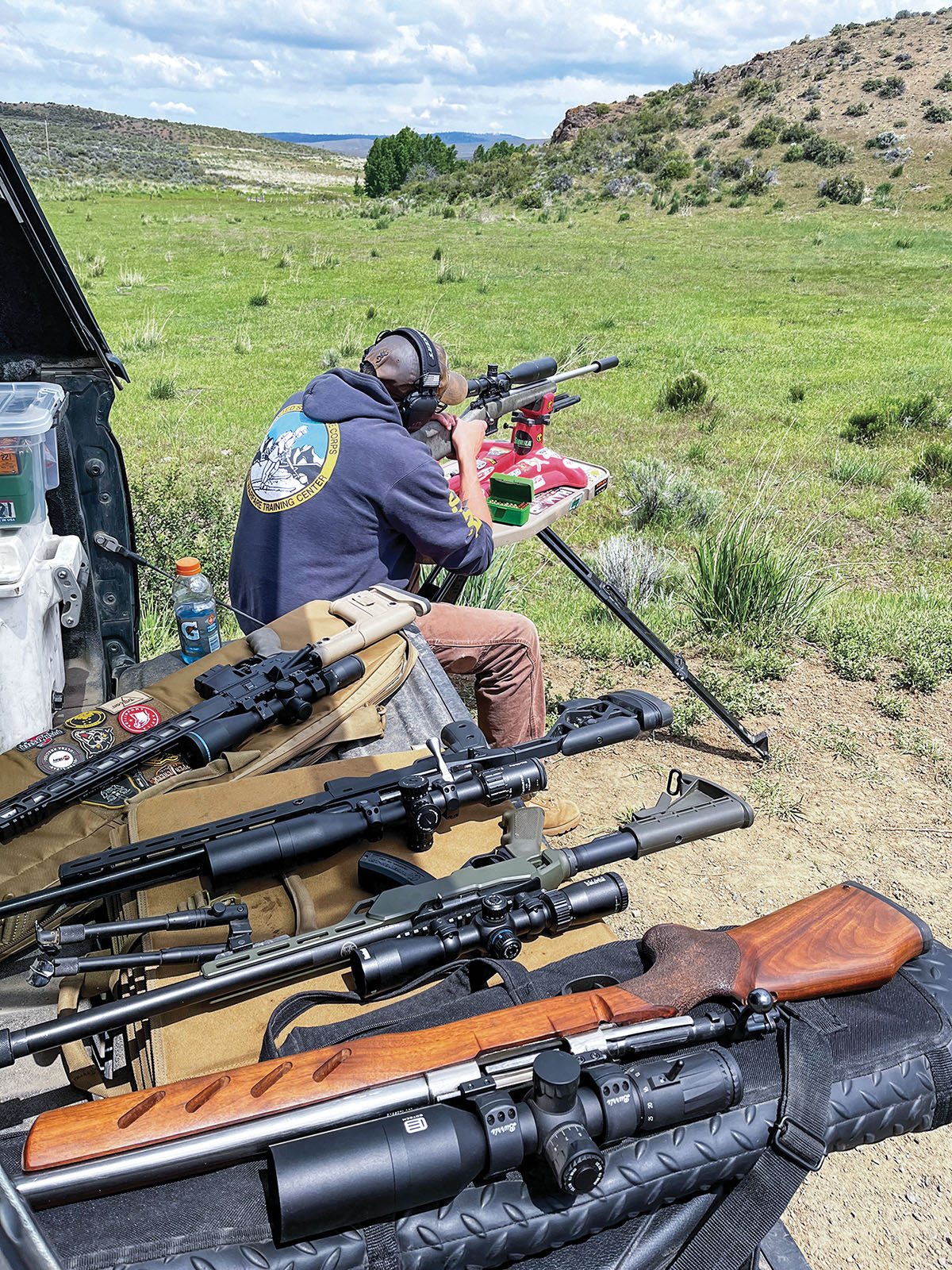
House in the Woods is a veteran retreat organization headquartered in Lee, Maine. The nonprofit organization provides outdoor opportunities for veterans and Gold Star families free of charge. It was founded by Paul and Dee House after they lost their son in Iraq in 2007. Timber Creek Outdoors is an Oregon-based firearms accessory company that manufactures all of its products in the USA.
For the past four years House in the Woods and Timber Creek Outdoors’ Tyler and Matthew Tiller (members of the Tiller family who own and operate Timber Creek Outdoors, Inc.) and Jason Goss (U.S. Marine Corp veteran, Timber Creek Production Manager and partner), have taken a group of veterans to central Oregon to shoot ground squirrels and for trout fishing, but more importantly to disconnect from the stress of day-to-day life, connect with like-minded individuals, heal and help to understand they are not alone.
Veterans arrive in late May at a vintage log cabin sitting on a central Oregon ranch owned by Chris and Kate Meier. The main event is the region’s unrivaled Belding’s ground squirrel shooting. The 2026 group included four veterans from Oregon: Dan Cushman, Marine Corps combat engineer and U.S. Army; Tony Barber, U.S. Navy Nuclear Specialist; Brian Admire, 30 years U.S. Army; and Joe Stutzman, U.S. Army Military Intelligence. Also on hand to represent House in the Woods was Retired Colonel Warren Perry, 28 years U.S. Army. Attendees enjoyed great company, rustic accommodations and hearty meals, all geared to foster healing and relaxation.
House in the Woods retreats are held in several locations aside from Oregon, including Oswego, New York (salmon fishing on Lake Ontario), Lake Winnebago, Wisconsin (sturgeon spearing), across Maine (black bear, moose, turkey and deer hunting), Texas (deer hunting) and Florida (alligator hunting). Attendance is open – without conditions – to any veteran or Gold Star family member. All getaways provide attendees with an opportunity to thoroughly disconnect, enjoy great camaraderie and reap the healing powers of the great outdoors.
Every veteran that deploys returns from combat a different person, and House in the Woods believes it is important that they have the opportunity to discover healthy coping mechanisms. Further, they believe there is no better place to aid in this process than in the great outdoors. To learn more and to support this worthy cause, visit HouseInTheWoods.org.