

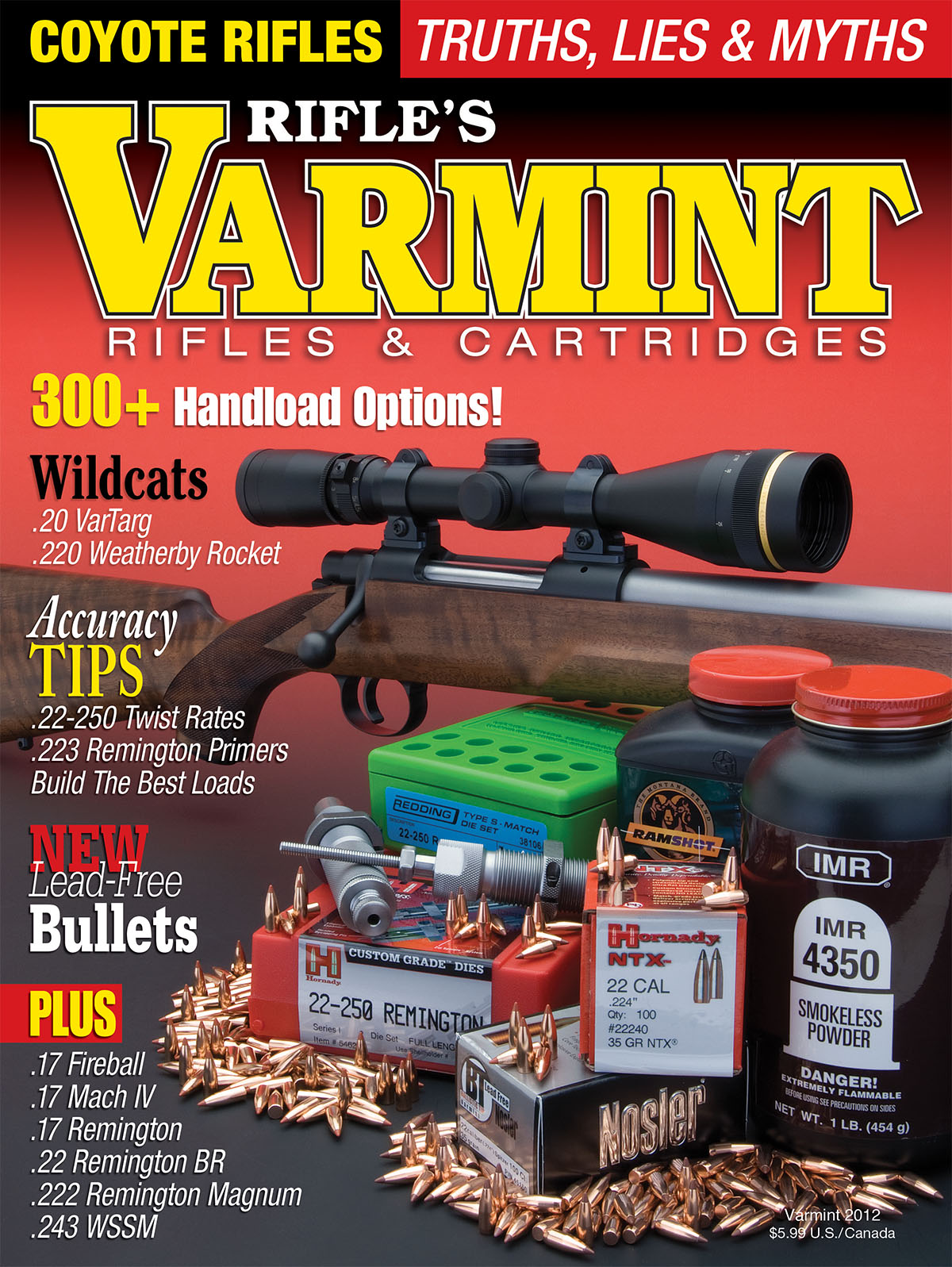
.222 Magnum Remembered
The Other .22!
feature By: Ken Waters | August, 12
.jpg)
Once again, if I seem to be plugging for the revival of a near-dormant cartridge, it’s only in the sense that one definition of revival is: “To bring back into use or attention,” while dormant refers to something that is “inactive; as if asleep.” The latter comes close to describing the Remington .222 Magnum and the former my attempt here to speak for a round too good to die.
Admittedly in decline ever since the military’s adoption of its sibling .223, the probability is that had the .222 Magnum been chosen instead, their respective popularity would be reversed.
Let’s face it, the deciding feature was the .223’s shorter length and thus suitability for automatic and semiautomatic rifles – not ballistic superiority! In plain fact, something of the reverse is true (though in minor degree) where use as a sporting round for bolt-action varmint rifles is contemplated.
Introduced in 1958 and first chambered in the Remington Model 722, my rifle was acquired in 1960, and I last wrote a “Pet Loads” report on it a decade later. In those days the .222 Magnum was usually compared with the standard .222 Remington where the difference in velocity is considerable.
As the .223 Remington gained ascendancy, however, discussions among varmint hunters more often turned upon a comparison with the .222 Magnum, they being more nearly alike.
In round numbers, a .223 is around 130 fps faster than a .222 Remington, and the .222 Magnum is capable of adding another 100 fps, all with the same bullet weight and barrel length. The cases being so similar (except for length), this is a straightforward function of case capacity, the .222 Magnum case holding some 22 percent more (water) than a .222 and 41⁄2 percent more than a .223. Accordingly, pressures run a bit lower in the magnum’s case than in a .223.
In actual practice, however, handloads in the 722 Remington .222 Magnum haven’t exceeded those found to be safe maximums despite this advantage. After all, the most important edge either of these longer cartridges has over a standard .222 Remington is longer range and a flatter trajectory. I’ve often taken shots with mine at distant ’chucks that would have been passed up if carrying a .222. Unlike a big game rifle, it isn’t a question of killing power, nor is it one of accuracy.
The other capability of a .222 Magnum (likewise a .223) I find important is its (their) faculty of driving 55-grain bullets at velocities equaling a .222 with 50-grain bullets. Here that other obstacle of long-range shooting – windage – comes into play with 55-grain spitzers possessing a decided advantage.
At this juncture someone’s sure to make the point that up to now I’ve been grouping the .223 and .222 Magnum as near equals ballistically; so what, if any, distinctions does the latter have warranting consideration here?
Fair enough. Let’s start with the fact that there are thousands of .222 Magnums still in use for which their owners might conceivably profit from additional loading data – especially with modern bullets – some of the popular reloading manuals having dropped this caliber. It’s not that old, really.
.jpg)
Maybe gun writers are expected to establish the veracity of such a statement. Anyway, taking the proper precautions for protection, I tried an experimental firing of a .223 Remington round in my .222 Magnum. Believe me, this is no false alarm! Case separation was more than three-quarters complete, and the powder gas that issued could well have damaged a shooter’s eyes.
Thanks to the strong Model 722 action with bolt face surrounding the case head, there was no damage to the rifle, but the potentially serious injury a shooter might have suffered was obvious. Keep all .223 cartridges far away from any .222 Magnum rifle, and this goes for .223 cases as well. Don’t even take them for free!
Most .222 Magnums (at least the Remingtons) have a one-in-14-inch twist, which isn’t steep enough to properly stabilize heavy (long) bullets. Some 60-grain bullets, if on the short side, such as Hornady’s Spire Point, may give acceptable accuracy but not its 60-grain V-MAX. On the whole, I think it best to be content with 50- and 55-grain bullets. Accuracy will be better and velocities higher.
Finally, there’s the matter of the magnum’s longer case neck that’s been derided by some writer friends. Maybe the extra .06 inch length of a .222 Magnum’s neck over that of a .223 doesn’t contribute anything in the way of accuracy or ballistics, but as a confirmed handloader, I’ve never liked working with short-necked cases. While shallow seating is practiced by bench-resters, bullets of hunting loads should be seated deeper for obvious reasons of strength and reliable functioning under field conditions.
It’s true, a .222 Magnum won’t kill anymore ’chucks than a .223 Remington, but I still maintain the former is the better case for handloaders with a bolt rifle. Simply put, it gives handloaders a choice of either a bit more velocity or lower chamber pressures due to its larger capacity. Thirty years ago I rated the .222 Magnum as No. 1 among small case rifle cartridges, and still do.
My lot of R-P .222 Magnum brass weighs an average of 96.5 grains and has a water capacity of 29.4 grains, which is some 0.6 grain more than our .223 Remington R-P cases. Thus, with bullets of same diameter and weight, .223 load data may be used in reloading .222 Magnum cases.
For some reason, Remington 61⁄2 Small Rifle primers have always given me better accuracy in the .222 Magnum. Hence, I continue to use them in preference to commonly listed R-P 71⁄2s. However, the latter can be substituted if desired with loads I’ve listed.
.jpg)
Reduce high-speed loads by about one grain of powder, accepting a muzzle velocity loss of around 100 to 125 fps. Seat bullets out to an overall cartridge length of .04 inch more than the often listed 2.28-inch standard (if allowed by your rifle’s throating). Be sure to try 52- and 53-grain Match bullets.
From its acquisition date in 1960, I used this Model 722 in varminting almost exclusively until 1970 when a .22-250 Remington took over for the longer ranges. Out to around 300 yards, the .222 Magnum did its work with accuracy and efficiency so long as there wasn’t too much wind. Holding off to allow for windage was the biggest obstacle. Had it not been for a desire to lessen this, and to reach out still farther, the .222 Magnum would still be ample for a majority of shots at ’chuck dens in my area.
In this test series report, modern bullets are listed, but powders used are a mix of the old and recent for the simple reason that the initial report on loads for the .222 Magnum from 1970 didn’t include a sufficiently broad range. Also, many of the older powders currently available have since proved fully equal, and in some loads superior, in providing the finest accuracy. They’re no slouch for high velocity either.
Let’s look at bullets first. The lightweight 40-grain Nosler Ballistic Tip is even better suited to the .222 Magnum than to a .223 because of the magnum’s slower-twist rifling, these light and short bullets not requiring a high rate of torque to stabilize. If maximum velocity is your thing, these bullets will give it but are not the best selection for long range, especially in windy country. Expansion on impact with varmints is dramatic.
Wanting a 45-grain bullet that could be driven at velocities well above those conventionally made for Hornet and Bee rifles, I turned to Speer’s spitzer softpoint. It is a good choice for riflemen wishing a bullet lighter than 50 grains suitable for high-speed loads combined with accuracy.
Among those of the popular 50-grain weight, both Nosler’s Ballistic Tip and Hornady’s V-MAX have been outstanding, as they have been in our .223 Remington and .220 Swift. They may well prove the all-around most useful bullets in the .222 Magnum for varminting, blending accuracy with high velocity, their sharp spitzer points flattening trajectory over longer ranges. They’re so good at both, in fact, I can’t help wish--ing I’d had them years ago. Groups around .75 inch from the old Model 722 are still possible with these superb bullets.
.jpg)
If you are a “bug” on accuracy and want to find out what your .222 Magnum is really capable of, try loading Sierra’s 53-grain MatchKing (or the older 52-grain Sierra Bench Rest hollowpoints). They were responsible for first, second and third best accuracy in my rifle and have been so noted in the accompanying table opposite the loads proven best.
While not every .222 Magnum will do its best with these exact loads, I’d expect them to be among the top performers. Be sure to keep cases trimmed to 1.85 inches or less.
Powders
Reloder 7 is the fastest-burning powder used in this series, explaining why it was paired only with XMR-2015 and H-322 have dem-on-strated excellence in benchrest accuracy in these .22-caliber cartridges. They also develop high velocity with the lighter bullets. Although I didn’t use them with heavier bullets in the .222 Magnum, they proved very accurate in our .223 Remington, so there’s no reason they shouldn’t do likewise here. Just remember they’re relatively fast burning so don’t be heavy-handed on the powder measure.
Next up in the burning rate scale of powders in these trials is IMR-3031. Nothing spectacular occurred with this old and reliable powder, but 25.0 grains with 55-grain bullets did produce exceptional accuracy along with adequate velocity.
Hodgdon’s H-4895 and BL-C(2) can be considered together, though Ball-C(2) is slower burning, because they registered similar velocities with equal powder charges and bullet weights. Most noticeable, however, was their extraordinary propensity to make very small groups with bullets of 50 grains and heavier. When combined with 53-grain Sierra MatchKing bullets (see loads listed in the table), they made all three
H-335, W-748, IMR-4064 and IMR-4320 ran the entire gamut of bullet weights. That is to say, they were useful in each category. H-335 was the velocity producer, ranking very accurate in several loads as well. IMR-4320 came closest to matching it with the heavier bullets, while W-748 did much the same with the lighter slugs.
Although accurate loads could be worked up with any of the listed powders, were I to settle on one or two, it would unquestionably be H-4895 and BL-C(2). I’ve had so much experience with them in this rifle that there’s simply no question as to results expected.
For all that, I’ll say most emphatically that the .222 Magnum, for all its prowess on varmints, most definitely should not be used on deer! With poorly placed shots it is a terrible wounder. They deserve better treatment.
I’m not under any illusions about the .222 Magnum making a comeback. I find only four new rifles listed as still available in this chambering: the Cooper Arms Model 21 Varmint rifle, the Krico Model 700 and Wich-ita’s Varmint and Classic models. I hope they’ll generate some acclaim for this great little cartridge.
The irony, of course, is that Remington, its originator, appears to have abandoned the .222 Magnum despite the real (if small) advantage it holds over a .223 Remington for bolt-action sporting rifle shooters.
.jpg)